
Share this @internewscast.com
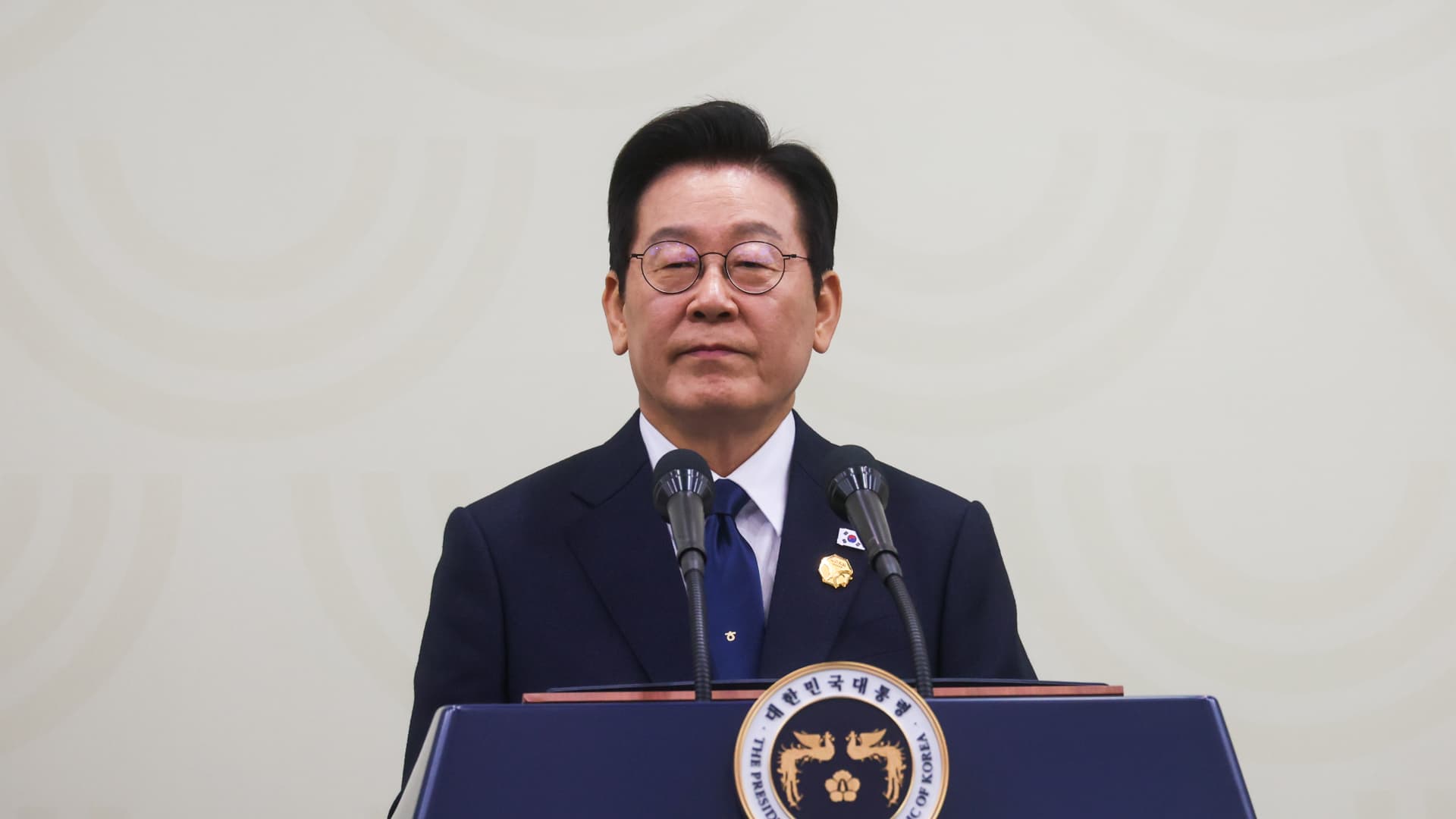
In Gyeongju, South Korea, on November 1, 2025, South Korean President Lee Jae-myung addressed an international press conference following the conclusion of the Asia Pacific Economic Cooperation (APEC) summit.
Amid growing concerns regarding regional security, President Lee expressed South Korea’s opposition to the United States’ potential relocation of air defense systems from the Korean Peninsula. Despite this stance, Lee acknowledged that South Korea is not in a position to enforce its preferences unilaterally.
During a cabinet meeting, Lee stated, “The USFK may dispatch some air defense systems abroad in accordance with its own military needs. While we have expressed opposition, the reality is that we cannot fully push through our position.” The USFK, or U.S. Forces Korea, represents the command structure for approximately 28,500 American military personnel stationed in South Korea.
Adding to the unfolding situation, South Korean Foreign Minister Cho Hyun mentioned on Friday that discussions were underway with Washington concerning the possibility of redeploying the Patriot missile defense systems currently in South Korea to support military efforts in the Middle East.
As the dialogue between the U.S. and South Korea continues, the strategic decisions surrounding these defense assets remain a critical focus for both nations amidst shifting global tensions.
South Korean Foreign Minister Cho Hyun reportedly said on Friday that Washington was in talks with Seoul over redeploying Patriot air defense batteries in South Korea for use in the conflict in the Middle East.
Quelling concerns over South Korea’s defense preparedness against North Korea, Lee maintained that even if the assets were moved out of the country, it would not cause a “serious setback” to its deterrence capability against North Korea, according to a CNBC translation of his comments in Korean.
A South Korean Air Force Patriot launch pad displayed at the Seoul International Aerospace & Defense Exhibition (ADEX) at Seoul Airport in Seongnam, South Korea, on Monday, Oct. 18, 2021.
Bloomberg | Bloomberg | Getty Images
Seoul’s relations with Pyongyang remain strained, with the latter’s leader Kim Jong Un calling the South the “most hostile entity.” Analysts have consistently assessed that the combined South Korean-U.S. forces on the peninsula are superior to North Korean forces.
“The temporary redeployment of Patriot missile defense systems and even limited quantities of offensive munitions would not rattle U.S. allies in Asia because North Korea is well deterred by South Korean conventional forces and American nuclear weapons,” said Leif-Eric Easley, professor of international studies at Seoul’s Ewha Womans University.
However, the Patriot is still a crucial element in Seoul’s defense against North Korea.
“Although South Korea has developed and deployed its own sophisticated missile defense systems, such as Cheongung, the Patriot system remains a major component of its air defense architecture,” said Lami Kim, Korea Chair in Advanced Technologies, National Security and Defence at the International Institute for Strategic Studies.
South Korea’s Cheongung surface-to-air missile system, developed by LIG Nex1 and Hanwha Aerospace, reportedly saw its first combat operations as the United Arab Emirates deployed it against Iranian projectiles.
Smoke from a reported rocket interception is seen in the sky over in Dubai on February 28, 2026. AFP correspondents heard a loud explosion in Dubai on February 28 and one of them saw a plume of smoke rising from the city. The explosions came in the wake of wide-ranging Iranian attacks on the Gulf, in retaliation for US and Israel strikes on Iran. (Photo by AFP via Getty Images)
– | Afp | Getty Images
South Korean media has reported several flights of U.S. military transport aircraft at Osan Air Base since the Iran conflict started, noting that the C-5 Galaxy and C-17 Globemaster planes that were seen are used to typically carry Patriot systems and THAAD anti-ballistic missile systems.
The U.S. move to deploy Patriot defense systems in South Korea to the Middle East comes against the backdrop of reports that air defense systems used by Gulf nations were running “dangerously low” on interceptors to defend against Iranian drone and missile strikes.
IISS’ Kim said that U.S. missile supplies are already under significant strain, given that Iran continues to retaliate and the conflict is likely to be a prolonged one.
If the redeployment happens, it will feed the perception that U.S. is prioritizing its Middle East interests ahead of an Asian ally, according to Philip Shetler‑Jones, senior research fellow for Indo‑Pacific Security at the Royal United Services Institute, a UK-based think tank.
Another reasonable perception would be that if it is happening at this stage, the U.S. had not planned well for Iran’s response.
Philip Shetler‑Jones
Senior Research Fellow, Indo‑Pacific Security, Royal United Services Institute
“Another reasonable perception would be that if it is happening at this stage, the U.S. had not planned well for Iran’s response,” he said, adding that if Seoul earns the status of a “model ally” by spending more on defense and becoming self-reliant, “the consequence may be that you are left more on your own.”
— CNBC’s Blair Baek contributed to this story.