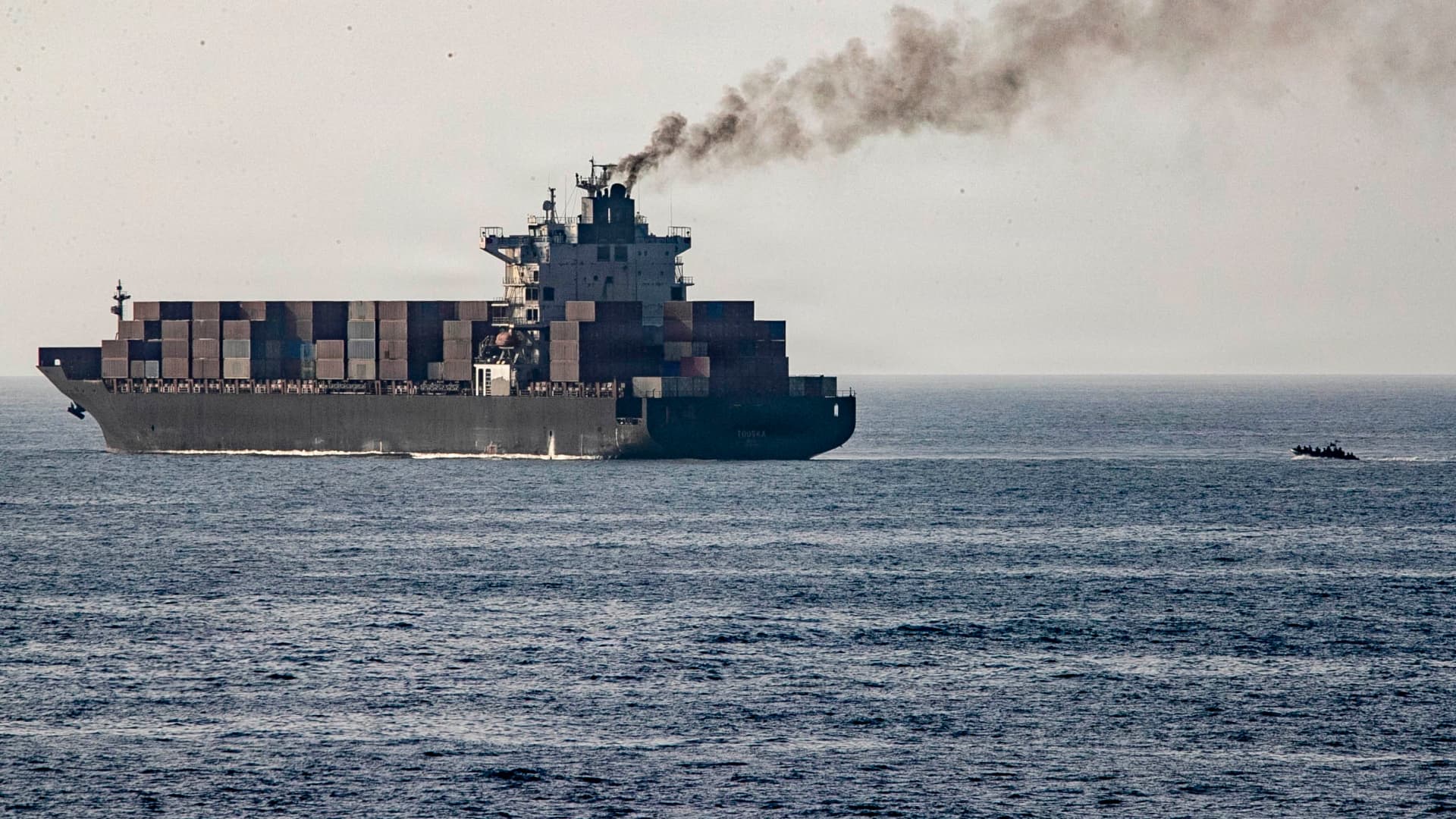

In a striking turn of events, U.S. forces were seen patrolling the Arabian Sea on April 20, 2026, near the Iranian-flagged vessel M/V Touska. The patrol followed an incident where U.S. forces fired upon the vessel, accusing it of attempting to breach the U.S. naval blockade of Iranian ports in the vicinity of the Strait of Hormuz. This image, provided by U.S. Central Command and distributed by Getty Images, captures the tense maritime situation.
Adding to the escalating tensions, Iran’s navy announced on Wednesday that it had seized two container ships in the crucial Strait of Hormuz. This development comes hot on the heels of the U.S. extending a ceasefire and amid ongoing diplomatic efforts to bring both nations to the negotiation table for peace talks.
According to a statement from Iran’s Revolutionary Guard Navy, the two ships were detained for alleged maritime violations and subsequently transported to Iranian territory. However, these claims remain unverified by independent sources, including CNBC.
The situation intensified as U.K. maritime authorities reported attacks on two vessels in the Strait of Hormuz. Iranian media further suggested that a third ship had also been targeted by Iran’s military forces.
In response to these geopolitical tensions, international oil markets reacted with Brent crude futures for June delivery inching up by 0.5%, reaching $99.03 per barrel after briefly crossing the $100 mark. Simultaneously, U.S. West Texas Intermediate futures for the same delivery period rose by 0.5%, trading at $90.13 per barrel.
International benchmark Brent crude futures with June delivery traded 0.5% higher at $99.03 per barrel, paring gains after briefly surpassing $100. U.S. West Texas Intermediate futures with June delivery, meanwhile, traded up 0.5% at $90.13.
The United Kingdom Maritime Trade Operations, or UKMTO, center said a vessel reported being fired upon about 8 nautical miles off the coast of Iran at 8:38 a.m. London time (3:38 a.m. ET).
The crew were reported to be safe and accounted for and the vessel did not sustain any damage, the UKMTO said, which also warned of “high levels of activity” in the Strait of Hormuz area.
The incident followed an earlier report of an attack that took place roughly 15 miles northeast of Oman at 5:47 a.m. London time.
The UKMTO said a container ship was approached by a Revolutionary Guard gunboat. The Guard’s vessel was said to have fired upon the ship, causing “heavy damage” to the bridge. All crew were reported safe.
The attacks come shortly after President Donald Trump said the U.S. would extend the ceasefire with Iran to allow for the Islamic Republic’s leaders to submit a “unified proposal” to end the war.
This came after reports that Vice President JD Vance’s trip to Pakistan for a second round of peace talks with Iranian officials had been put on hold, and after the Iranian state news outlet Tasnim reported that negotiators from Tehran would not attend further talks.
The Strait of Hormuz is a key maritime corridor that connects the Persian Gulf and the Gulf of Oman. Roughly 20% of global oil and liquefied natural gas typically passes through it. Attacks on commercial ships in the Gulf in recent weeks have ratcheted up fears of a prolonged economic shock.
— CNBC’s Dan Mangan and Kevin Breuninger contributed to this report.


