
Share this @internewscast.com

The Trump administration appears to be gearing up for a potentially extensive military operation in Iran, raising the specter of a conflict that could significantly alter the geopolitical landscape of the Middle East. Sources close to the matter suggest that the scale of this operation would far surpass recent military interventions, possibly resembling a “full-fledged war” rather than a limited strike. This campaign, expected to unfold over several weeks, is described as having the potential to pose an existential threat to Tehran’s regime, with implications that could redefine power dynamics across the region.
A defining crisis

Insiders warn that the repercussions of such a military endeavor could have a dramatic impact on the region and might even shape the legacy of Donald Trump’s presidency. Despite the stakes involved, there has been surprisingly little public discourse in Washington, as both Congress and the general public seem preoccupied with other matters. Tensions have been simmering for weeks, particularly after Trump considered military action in response to the Iranian regime’s violent crackdown on protesters earlier in the year. When the immediate opportunity for action passed, the administration shifted tactics, blending renewed diplomatic negotiations with a strategic military buildup in the region.
JD Vance warns of vanishing window for peace

Recent talks in Geneva between key Trump advisors, including Jared Kushner and Steve Witkoff, and Iran’s Foreign Minister Abbas Araghchi, lasted three hours. While both parties reported some progress, US officials acknowledge significant differences remain. In an interview with Fox News, US Vice President JD Vance conveyed mixed results from the discussions, noting that although some aspects went well, Iran has yet to address certain “red lines” set by President Trump. Vance hinted that Trump remains hopeful for a diplomatic resolution but acknowledged the possibility that talks could soon reach an impasse.
Saturday standby

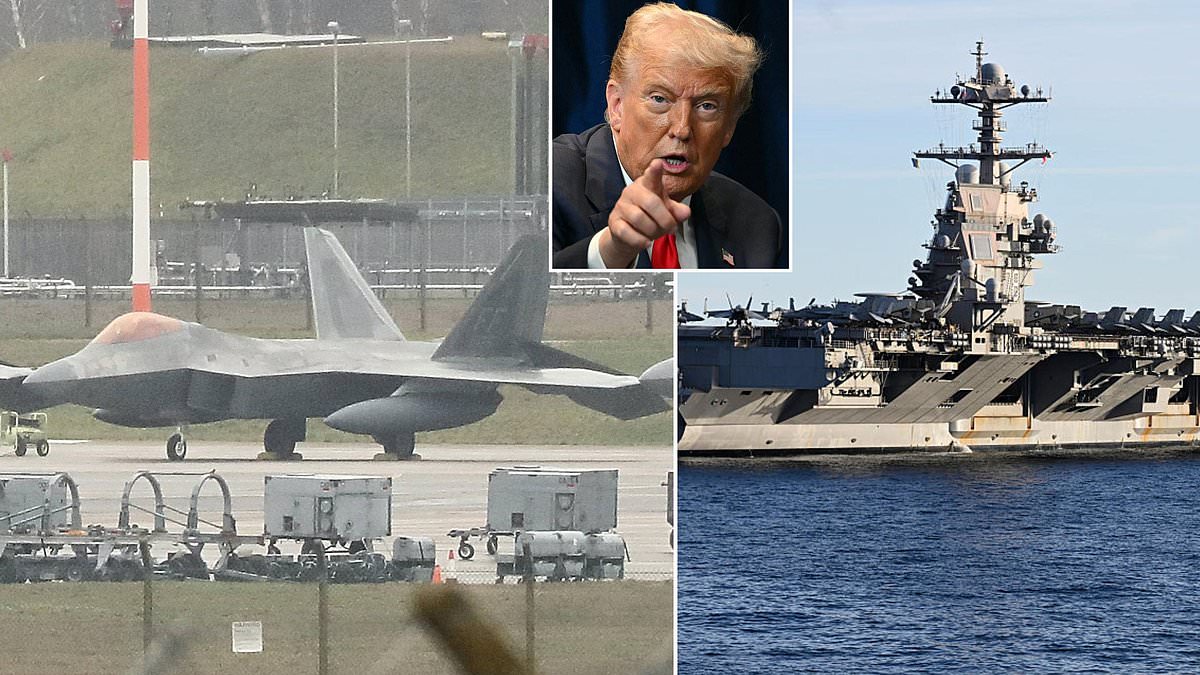
The disagreement over the use of the British military sites is behind Trump’s withdrawal of his support for Sir Keir Starmer ’s deal to hand over the Chagos Islands to Mauritius, a report has claimed. The White House is drawing up a detailed military plan for an attack on Iran involving the use of both Diego Garcia and RAF Fairford in Gloucestershire, the site of America’s fleet of heavy bombers in Europe. Now with the build-up of American aircraft and ships, defence officials reportedly briefed Trump that the US will be ready to begin a war by Saturday. As per international law, there is no formal distinction between a nation carrying out a strike and those in support, if the latter have ‘knowledge of the circumstances of the internationally wrongful act’. The UK has not yet granted permission to the US to use the military sites in the event that Trump orders an attack on Tehran, because of concerns that the strike would be a breach of international law, according to a report in the Times.

Trump’s military deployments and increasingly forceful rhetoric have also made backing down without significant concessions from Iran politically difficult. Israel, which has pushed for a more aggressive approach targeting not only Iran’s nuclear and missile programmes but also regime change, is already preparing for the possibility of war within days, according to Israeli officials. The Israeli military has over 200 combat aircraft at its disposal, including F-35s, F-16s and F-15s. A second aircraft carrier strike group, the USS Gerald R. Ford, is expected to reach the eastern Mediterranean within the next few days. From there, the world’s largest warship and its escort could protect Israel from an Iranian counter-attack, utilising fast jets from the carrier to take out drones, and its destroyers to assist the Jewish state’s powerful but not comprehensive missile defence umbrella. Alternatively, the F-35s and other combat aircraft from the carrier could also be deployed to attack Iran from the eastern Mediterranean , however if the carrier moved to the Arabian Sea, where USS Abraham Lincoln is currently located, that could improve the American sortie rate in the scenario of a sustained campaign.

With the combined power of combat jets, support aircraft and warships, the US has the capacity to pummel Iran non-stop for weeks, if Trump issues the order. However, timelines remain uncertain, with some US sources like Senator Lindsey Graham telling Axios strikes could still be weeks away. Others believe the window could be much shorter. One Trump adviser said: ‘The boss is getting fed up. Some people around him warn him against going to war with Iran, but I think there is a 90% chance we see kinetic action in the next few weeks.’ The US has given Iran a two-week deadline following the latest round of talks to present a detailed proposal. Last June, Trump also set a two-week window to decide between continued diplomacy or military action, before launching Operation Midnight Hammer just three days later. On Tuesday night, Trump spoke to Starmer about his ultimatum to Iran over its nuclear programme. The following day, he published a post on his social media platform Truth Social attacking the UK over its plans to settle the future of the Chagos Islands with Mauritius. ‘I have been telling Prime Minister Keir Starmer, of the United Kingdom, that Leases are no good when it comes to Countries, and that he is making a big mistake by entering a 100 Year Lease with whoever it is that is “claiming” Right, Title, and Interest to Diego Garcia, strategically located in the Indian Ocean,’ Trump wrote. ‘Should Iran decide not to make a Deal, it may be necessary for the United States to use Diego Garcia, and the Airfield located in Fairford, in order to eradicate a potential attack by a highly unstable and dangerous Regime,’ he added.

Trump suggested the government’s support for a strike would be legal under international law, as Tehran could potentially attack the UK as well as ‘other friendly Countries’. ‘We will always be ready, willing, and able to fight for the U.K., but they have to remain strong in the face of Wokeism, and other problems put before them. DO NOT GIVE AWAY DIEGO GARCIA!’ Trump concluded. The UK government has repeatedly emphasised that an agreement with Mauritius – forecasted to cost the taxpayer £35 billion – is necessary for security reasons and would avoid an expensive legal battle over the territory. Diego Garcia is the largest island in the Chagos archipelago and has been used as a joint UK–US military base since the 1970s. Under the deal, announced last May, the UK will lease back Diego Garcia for 99 years at an average cost of £101 million annually. According to the Wall Street Journal, Trump has been briefed on his military options, amid the assemblage of the most air power in the region since the 2003 Iraq invasion.
![As well as attacking Iran's nuclear facilities - which Trump previously claimed had been 'obliterated' during Operation Midnight Hammer in June - the US could also try to trigger regime change from the air. Such a campaign would involve attempts to assassinate Iran's supreme leader, 86-year-old Ali Khamenei, and several of his senior officers, as well as the chiefs of the fanatically loyal Islamic Revolutionary Guard Corps. Combined with the potential return of nationwide popular demonstrations against the regime, analysts have calculated that this might spell the end of the Islamic Republic. Sascha Bruchmann, a research fellow at the International Institute for Strategic Studies, told The Telegraph : 'The aim would be that the mainstream Iranian army, the Artesh, might side with the people. I want to be clear that we didn’t see that in January, but that would be the design. Air strikes would likely aim to hit the regime in its communications, so it was unable to communicate and organise itself – levelling the playing field [for anti-regime forces],' she added.](https://i.dailymail.co.uk/1s/2026/02/20/14/106515777-0-image-a-483_1771597145830.jpg)
As well as attacking Iran’s nuclear facilities – which Trump previously claimed had been ‘obliterated’ during Operation Midnight Hammer in June – the US could also try to trigger regime change from the air. Such a campaign would involve attempts to assassinate Iran’s supreme leader, 86-year-old Ali Khamenei, and several of his senior officers, as well as the chiefs of the fanatically loyal Islamic Revolutionary Guard Corps. Combined with the potential return of nationwide popular demonstrations against the regime, analysts have calculated that this might spell the end of the Islamic Republic. Sascha Bruchmann, a research fellow at the International Institute for Strategic Studies, told The Telegraph : ‘The aim would be that the mainstream Iranian army, the Artesh, might side with the people. I want to be clear that we didn’t see that in January, but that would be the design. Air strikes would likely aim to hit the regime in its communications, so it was unable to communicate and organise itself – levelling the playing field [for anti-regime forces],’ she added.