Share this @internewscast.com
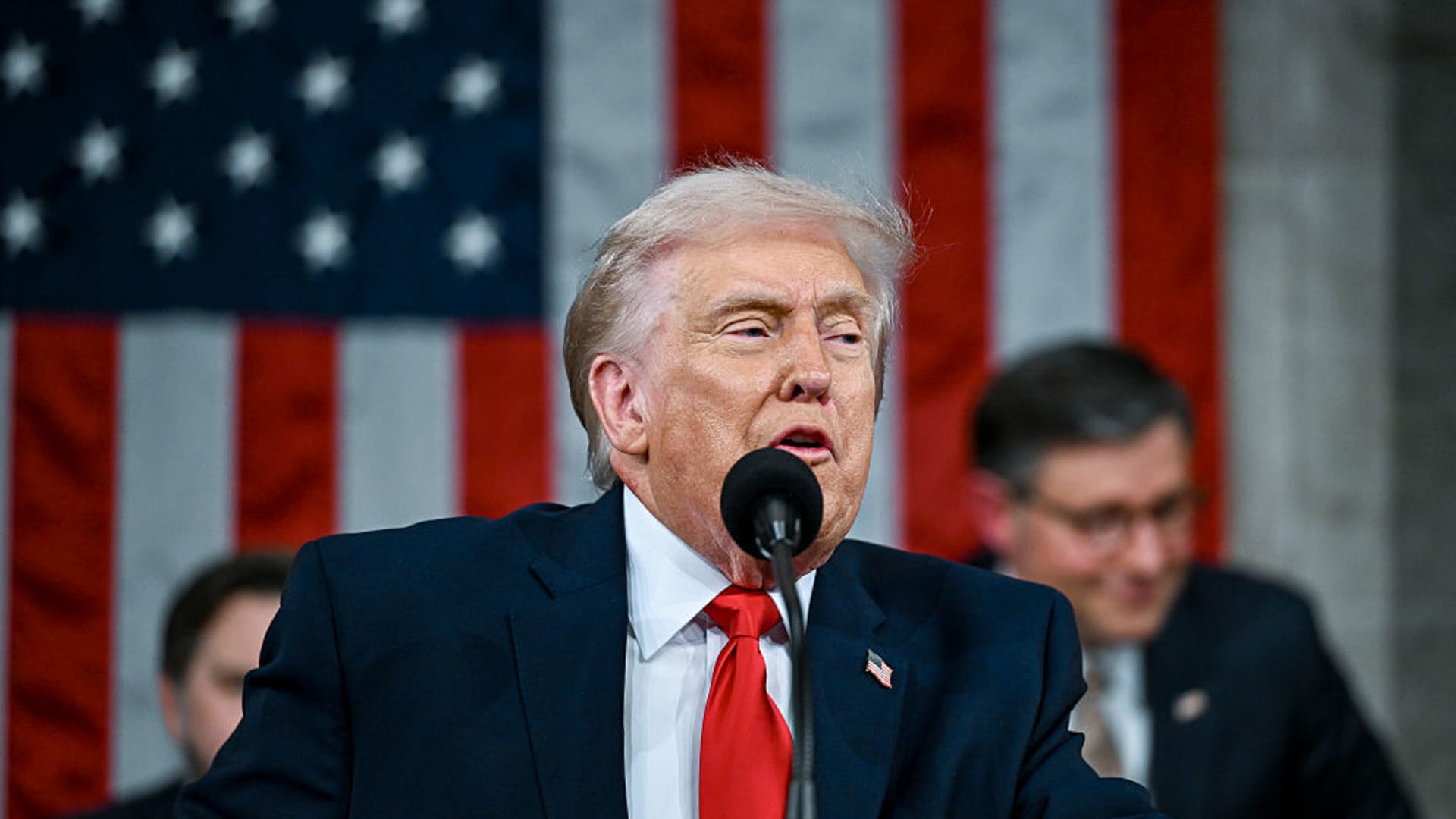
On February 24, 2026, President Donald Trump addressed the nation in his State of the Union speech, delivered before a joint session of Congress in the House Chamber at the Capitol in Washington, DC. This address followed closely on the heels of the Supreme Court’s decision to overturn the administration’s tariff policy, and occurred against a backdrop of escalating U.S. military presence in the Persian Gulf, heightening tensions with Iran.
Photo: Pool via Getty Images News
As the world watches closely, the United States and Iran are scheduled to engage in another round of nuclear discussions in Geneva, Switzerland, this Thursday. The talks are set against a backdrop of ongoing concerns over potential military conflict in the resource-rich Middle East.
This latest series of negotiations aims to chart the course for Tehran’s nuclear ambitions, even as the United States continues to bolster its military forces in the area. President Trump has issued stern warnings, suggesting dire consequences should Iran fail to agree to a nuclear accord.
In his State of the Union address, which lasted nearly two hours, President Trump touched briefly on the situation with Iran, choosing instead to concentrate on a range of domestic policies and political issues.
“We are negotiating with them. They’re interested in making a deal, but we have yet to hear those crucial words: ‘We will never have a nuclear weapon,’” Trump remarked.
“My preference is to solve this problem through diplomacy. But one thing is certain, I will never allow the world’s number one sponsor of terror, which they are by far, to have a nuclear weapon.”

For some, the comments boosted expectations of an imminent diplomatic breakthrough.
Trump “basically wants the optics of a win, which is why he talks about why he’s ended eight wars. I think it’s pretty clear he hasn’t. He has helped navigate, you know, skirmishes … but he hasn’t ended these conflicts,” said George Pollack, U.S. policy analyst at Signum Global Advisors.
“For him, I think it is more about how he’s exerting U.S. strength, U.S. force and trying to make the world more peaceful but that’s more optics than it is a substantive policy,” Pollack told CNBC’s “Europe Early Edition” on Wednesday.
“And that’s why, for us, we do think this Thursday meeting will likely be a success and bring about some more diplomatic opportunities,” he added.
The USS Gerald R. Ford aircraft carrier docks at Souda Bay on Crete Island, Greece on February 24, 2026.
Anadolu | Anadolu | Getty Images
For others, however, the absence of a deal means the likelihood of military action appears to be both high and growing.
“President Trump’s 10-to-15-day deadline for Iran works out to a date sometime in very early March,” strategists at Dutch bank ING said in a note published Wednesday.
“This uncertainty means the market will continue to price in a large risk premium and remain sensitive to any fresh developments,” they added.
Iran FM: An agreement is ‘within reach’
Iran, for its part, has talked up the prospect of a deal this week, saying an agreement is “within reach.”
Iranian Foreign Minister Abbas Araghchi said on social media Tuesday that the country would resume talks with the U.S. in Geneva this week “with a determination to achieve a fair and equitable deal — in the shortest possible time.”
Araghchi added: “Our fundamental convictions are crystal clear: Iran will under no circumstances ever develop a nuclear weapon; neither will we Iranians ever forgo our right to harness the dividends of peaceful nuclear technology for our people.”
Vehicles move along a highway near Tehran’s landmark Azadi (Freedom) Tower in Tehran on February 23, 2026. The 45-metre-tall marble-clad Azadi Tower, formerly known as Shahyad Tower (Shah’s Memorial Tower’), was commissioned by Mohammad Reza Pahlavi, the last Shah of Iran, to mark the 2,500-year celebration of the Persian Empire, and completed in 1971. It was erected at the westernmost entrance to the city of Tehran.
Atta Kenare | Afp | Getty Images
Oil prices traded near seven-month highs on Wednesday morning as energy market participants continued to closely monitor potential supply disruptions.
International benchmark Brent crude futures with April delivery rose 0.6% to $71.13 a barrel, while U.S. West Texas Intermediate futures with April delivery, traded 0.6% higher at $66.02.
Iran, a member of OPEC, is a major player in the global oil market, producing more than 3 million barrels of crude a day.
The Islamic Republic has recently conducted military drills in the strategically important Strait of Hormuz, as well as joint naval drills with Russia in the Gulf of Oman, also known as the Sea of Oman.