
Share this @internewscast.com
The International Energy Agency (IEA) is set to host its 2026 Ministerial Meeting alongside the Energy Innovation Forum at the OCDE in Paris, France, on February 18 and 19, 2026.
Image Source: Nurphoto via Getty Images
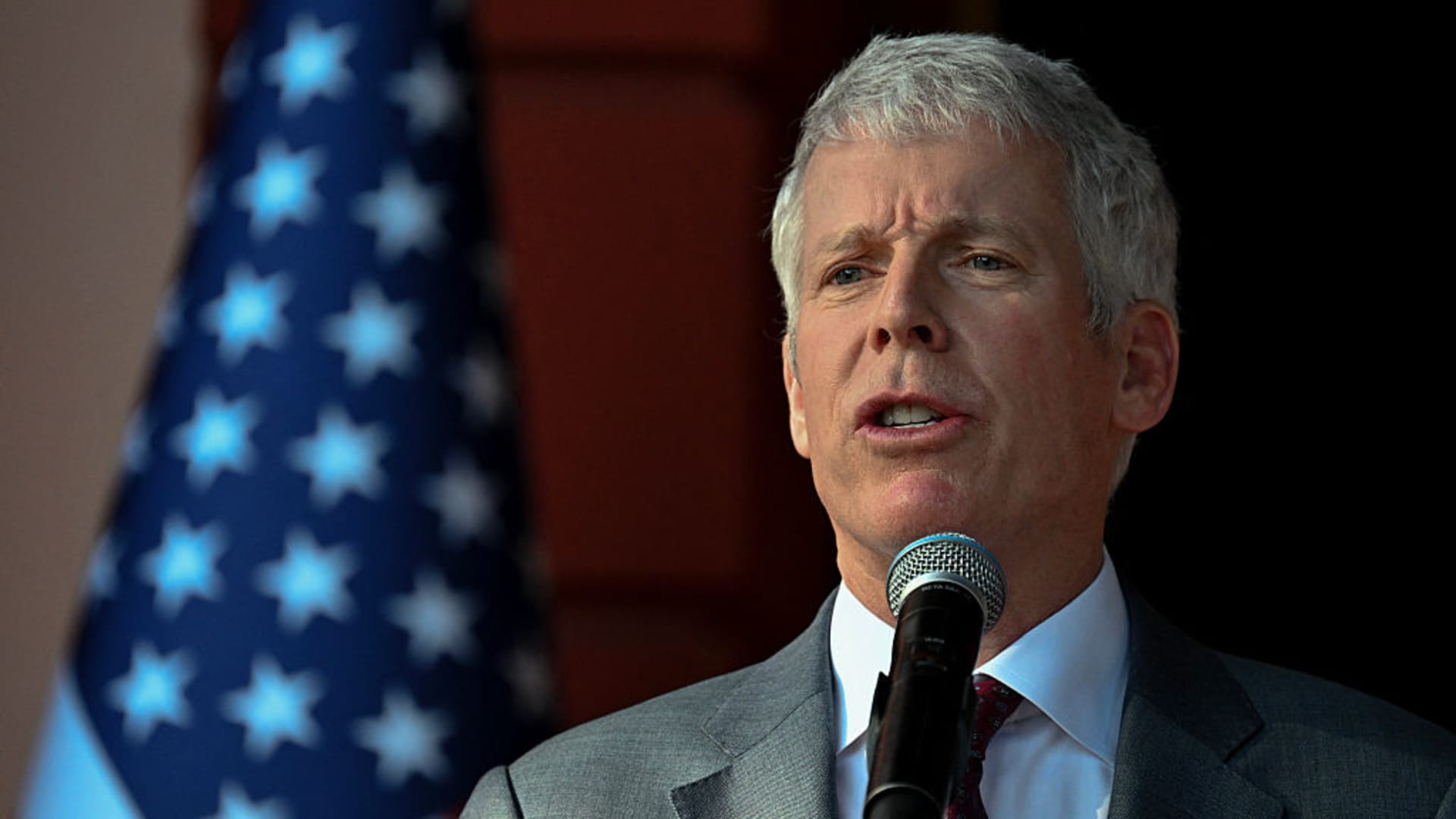
On Thursday, U.S. Energy Secretary Chris Wright announced that the United States intends to “exert pressure” on the IEA to abandon its net-zero goals, warning that the U.S. might withdraw from the organization if changes are not made.
Wright’s remarks came during the closing session of an IEA ministerial gathering in Paris, where he emphasized the need for agency reforms to ensure continued U.S. participation.
“The past decade has seen a collective fixation on the destructive fantasy of achieving net zero by 2050. The U.S. is determined to apply all the leverage at our disposal to persuade the IEA to shift away from this path within the next year,” Wright stated, as reported by Reuters.
The 2015 Paris Agreement saw nations commit to “net zero,” a goal of equalizing the carbon released into the atmosphere with the amount removed. Major polluters, including the U.S., India, and the European Union, were signatories to this accord.
Wright added that it was not Washington’s intention to leave the IEA, as there’s “always a risk” China could gain dominance in the agency if it did.
CNBC has reached out to the U.S. Department of Energy and the IEA for comment.
A long-running war of words
The IEA, which was established in 1974 to ensure the security of oil supplies, faced criticism from the Trump administration last year when it projected that “peak oil”, when global crude production will reach its highest point before entering an irreversible decline, will take place around 2030.
OPEC, the influential group of oil-exporting countries, accused the energy agency of fearmongering and risking the destabilization of the global economy. Wright called the IEA’s forecast “nonsensical.”
The energy watchdog later watered down its forecast, signaling in a major tonal shift that oil demand could keep growing through to the middle of the century.
An aerial view of construction of new ski trails and a ski lift on Feb. 8, 2026 in Park City, Utah. A snow drought and warmer weather across Utah and much of the Western United States has resulted in Utah receiving only around one-third of its normal early February snowpack.
Mario Tama | Getty Images
Scientists have warned that global average temperatures must not increase by more than 1.5 degrees Celsius, if the worst of the climate crisis is to be avoided.
This threshold is recognized as a crucial long-term target because tipping points become more likely beyond this level. Tipping points can lead to dramatic shifts or potentially irreversible changes to some of Earth’s largest systems.