
Share this @internewscast.com

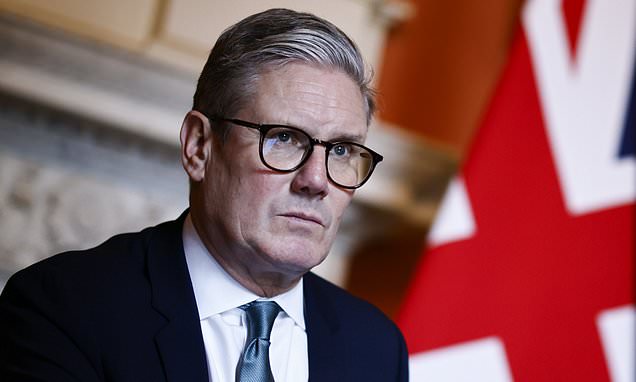
Just a few months into Sir Keir Starmer’s leadership, I posed a question to a Labour minister about the Prime Minister’s foreign policy priorities. “It’s not about specifics,” he remarked. “It’s more about a vision.” Inside No 10, they referred to it as ‘The Bridge’—a metaphorical connection between Europe and the United States, particularly crucial if Trump reclaims the White House. Fast forward to early 2026, and it seems this vision—and the bridge itself—are on the brink of collapse. Recently, we’ve all seen the striking images of Venezuelan President Nicolas Maduro being escorted onto the USS Iwo Jima, restrained and blindfolded. Simultaneously, it appears that Britain’s Prime Minister has found himself equally restrained in his response.
Starmer Dodges Questions on US Intervention

When questioned about his stance on the audacious, some say reckless and illegal, American operation, Starmer has been uncharacteristically silent. “The US will have to justify the action it has taken,” he stated today, a statement lacking the usual clarity and conviction that have defined his leadership. Pressed further on whether the US acted within the boundaries of international law, the self-proclaimed advocate of the rules-based international order could only offer an evasive response: “There was an illegitimate president who has now been removed, and I don’t think anybody is really shedding any tears about that,” he mumbled, before meekly urging for “a peaceful transition to democracy as soon as possible.”

Until recently, foreign affairs seemed to be one of the few areas where Starmer displayed a semblance of competence. Amid the chaos characterizing other aspects of his governance, this was a low bar indeed. Yet, there was a fleeting moment when it appeared the new Prime Minister might successfully navigate the global stage without faltering. Unfortunately, like many positive assumptions about Starmer, this too has crumbled. Along with what once passed for British foreign policy. Survey the global landscape—Ukraine, Gaza, Israel and Iran, the Venezuela invasion—and you will search in vain for the stabilizing influence of the United Kingdom.
Ukraine Promises Fade as Missiles Keep Falling

We are now approaching a year from the date when Starmer first announced ‘boots on the ground’ as a part of a ‘coalition of the willing’ to protect the Ukranians. Twelve months on, the only thing to have landed on Ukranian soil are Putin’s missiles. On Gaza, Starmer’s ministers stepped in and hijacked the Government’s stance, bouncing him towards a premature recognition of a Palestinian state because they could no longer stomach his vacillation. When Israel and the US – supposedly two of our closest allies – opted to strike Iran’s nuclear programme, Starmer was as blindsided as the mullahs in Tehran.

For a while, the Prime Minister was able to trade off successfully managing the optics of his relationship with Trump. The fact that his first visit to the White House passed without the humiliating brow-beating delivered to other visitors was hailed a diplomatic triumph. But it’s now clear that, on the Prime Minister’s watch, the special relationship has been reduced to nothing more than a glorified photocall. As new tariffs were slapped onto the UK, Starmer’s only response was platitudes. ‘We are taking a calm, pragmatic approach and keeping our feet on the ground. Constructive talks are ongoing on a wider economic prosperity deal with the US,’ he announced.

Meanwhile, Trump’s feet were clad in steel-capped boots, which kept getting rammed into the nether regions of British exporters. Yes, Starmer and the President continue to maintain a solid – if uneasy – personal relationship. But the Prime Minister is increasingly unable to leverage that into any meaningful influence over US policy making. The conflagration many anticipated between the liberal north London lawyer and the Godfather of the MAGA movement has not materialised. And the reason for that is Trump clearly regards Starmer as a benign irrelevance. To him, under Starmer, the British Government is nothing more than a glorified international valet service. When he feels the whim, he will pick up the phone and Downing Street will happily arrange a tour of Windsor Castle or a round of golf at St Andrews.
China Trip Seen as Diplomatic Begging Mission

As the year progresses, this disconnect between the early hopes and promise of Starmer’s foreign policy strategy and the hard geopolitical reality will become increasingly apparent. First, there will be the trip to China, one in which the Prime Minister will not so much be waving the flag as carrying round the begging bowl. As one minister told me, people are saying: ‘Will this be the moment Keir signs off on the new Super Embassy?’ Well, we’re so desperate for Chinese money, if they asked to build it in Buckingham Palace we’d say yes.’ Then there will be increasing spectacle of Government infighting over Brexit, and Britain’s relationship with Europe. Starmer has decided the Brexit project has failed and has determined to become increasingly voluble in saying so.

But, as ever, he is unclear about what he thinks should replace it. We will hear much over the next few months about ‘closer alignment with the single market’. Yet precious little detail about what that alignment should actually look like. Most damaging of all, the recognition that there is a gaping hole where No 10’s international strategy should be will embolden those preparing to mount an overt challenge to Starmer’s leadership. His proximity to Trump. His equivocation over Gaza. His inability to paint his own compelling picture of Britain’s relationship with Europe. All will be highlighted – to varying degrees – by Wes Streeting, Angela Rayner, Andy Burnham and the other pretenders as they manoeuvre into position to strike after May’s local elections. People have been shocked and awed by Trump’s Venezuela adventurism. But no one is now in any doubt – if they ever were – about the lengths he will go to protect what he sees as his nation’s vital interests. How far would Starmer go to protect Britain’s interests? No one has a clue. Including, it would seem, our Prime Minister himself.