
Share this @internewscast.com
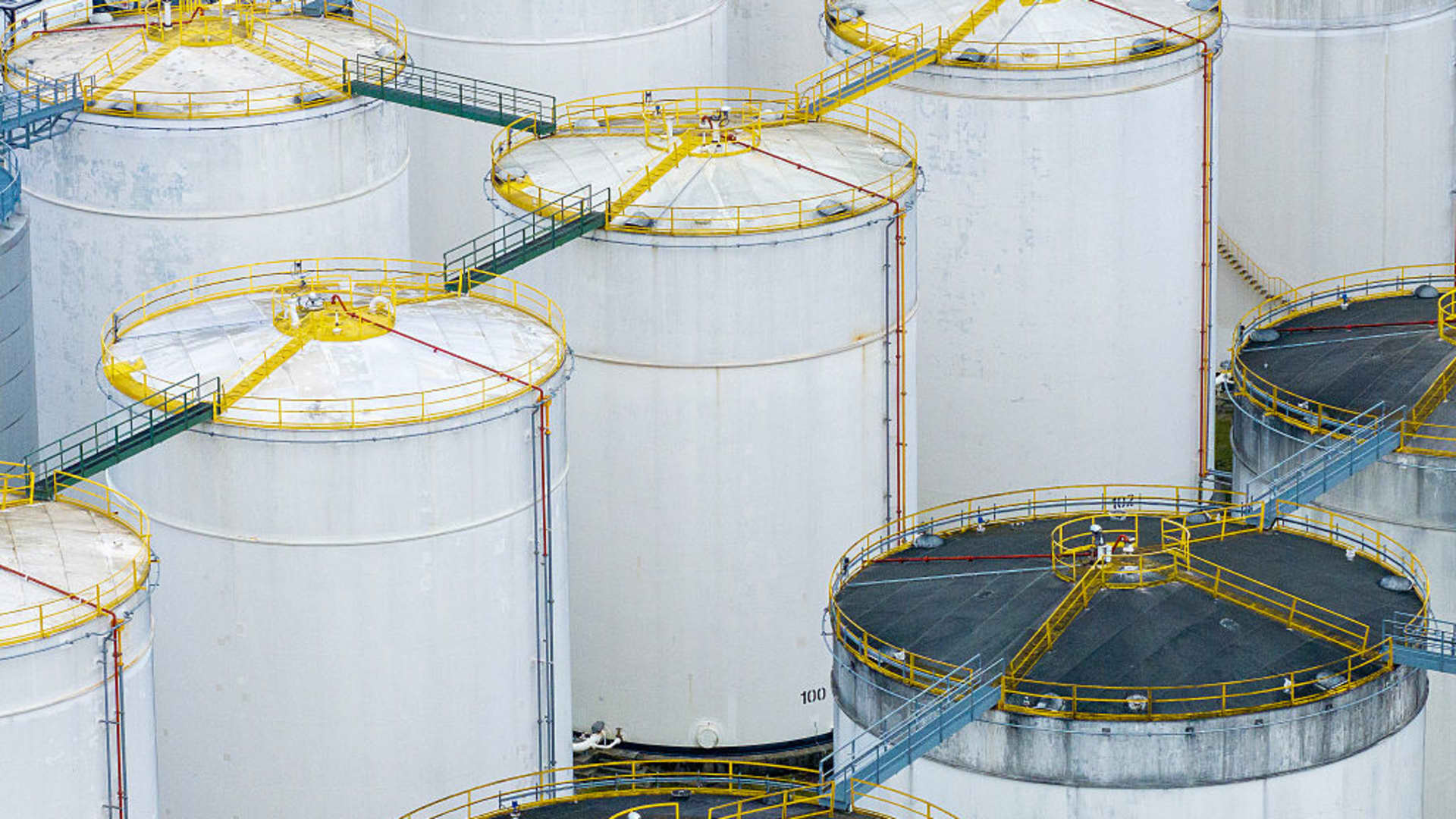
On March 10, 2026, a panoramic view captures Navigator Terminals, an oil storage facility nestled along the River Thames in London, England.
Photo by Dan Kitwood | Getty Images News | Getty Images
The ever-changing cost of dated Brent, a key indicator for actual crude oil transactions globally, has led energy experts to caution that the intense pressure in the physical oil market remains persistent. This is largely due to concerns surrounding a tentative ceasefire in the Middle East.
As the energy sector closely observes shipping disruptions through the crucial Strait of Hormuz, an unusual disparity has developed between dated Brent and front-month Brent futures. This suggests that oil supplies are likely to remain under strain in the near future.
The current spot price for dated Brent, which pertains to physical oil cargoes scheduled for delivery between 10 days and one month in advance, reached $131.97 per barrel on Thursday afternoon, as reported by Platts.
This figure marks an increase of over 7% from the previous session, though it has dipped from a peak of $144.42 on Tuesday, right before the U.S. and Iran declared a two-week ceasefire.
Dated Brent is assessed based on bids, offers and trades in the open physical spot market, which means it reflects the real-world price tag of crude oil.
Brent crude futures for June delivery, meanwhile, were last seen trading 0.6% higher at $96.51 per barrel on Friday morning.
“Dated Brent at $144 is not just a price record. It’s the physical market telling you that real barrels are becoming scarce. The market is pricing in scarcity, not just risk,” Andrejka Bernatova, founder and CEO of Dynamix Corporation III, told CNBC by email.

“Even with the ceasefire bringing the number down, the underlying stress hasn’t gone away, and frankly, I think the market is getting ahead of itself,” Bernatova said.
“The Strait of Hormuz remains almost entirely blocked, and this ceasefire is fragile at best. Until those flows are actually moving again, the $144 print is less of a historical anomaly and more of a preview.”
Roughly 20% of global oil and gas typically passes through the Strait of Hormuz, a narrow maritime corridor that connects the Persian Gulf and the Gulf of Oman. Shipping and maritime experts have told CNBC that traffic through the critical energy artery will not normalize anytime soon.
“If refiners delay purchases in anticipation of further price declines while physical flows remain constrained, product tightness could worsen even amid de-escalation,” Janiv Shah, vice president of oil markets at Rystad Energy, said in a research note published Wednesday.
“The Brent flat price has fallen, but prompt physical differentials are likely to remain sticky, tanker rates stay elevated, and sour crude buyers continue to pay up for security of limited global supply away from the Gulf,” he continued.
“This goes to show that the perceived geopolitical risk can ease faster than operational risk,” Shah said.
Market dislocation
Strategists at Morgan Stanley said the Strait of Hormuz disruption has prompted a much more violent shock in physical Brent-linked barrels compared to the main financial contract of Brent futures.
“Dated Brent is the market’s assessment of what a prompt physical seaborne barrel is worth in Northwest Europe. ICE Brent, on the other hand, is a standardized, centrally cleared futures contract whose final cash settlement is linked to the forward Brent cargo market through a defined expiry process,” Martijn Rats, commodities strategist at Morgan Stanley, said in a research note published Tuesday.
“Those two prices are connected, but they do not measure the same exposure in time or at the same point in the chain.”
The market dislocation shows the Brent system identifying where the shock is most acute and immediate, Rats said.

Pavel Molchanov, senior analyst at Raymond James Investment, said this latest episode of supply disruption had caused traditional trading patterns between various grades of crude to break down.
“This speaks to unprecedented stress and uncertainty in the oil market,” Molchanov told CNBC by email.
Among some examples of this, Molchanov said Brent crude futures typically traded $3 to $5 per barrel higher than U.S. West Texas Intermediate futures over the past decade, although WTI briefly surpassed a premium of more than $10 during the Middle East crisis.
Russian Urals crude oil prices, meanwhile, reached levels as much as $30 above Brent in recent weeks, Molchanov said, noting that Urals have traded at steep discounts to Brent since Russia’s full-scale invasion of Ukraine in early 2022.
Molchanov also pointed out that Saudi Arabia raised the premium for Arab Light crude over Oman/Dubai benchmark to $19.50, adding that this premium had “never before” exceeded the $10 level.