Share this @internewscast.com
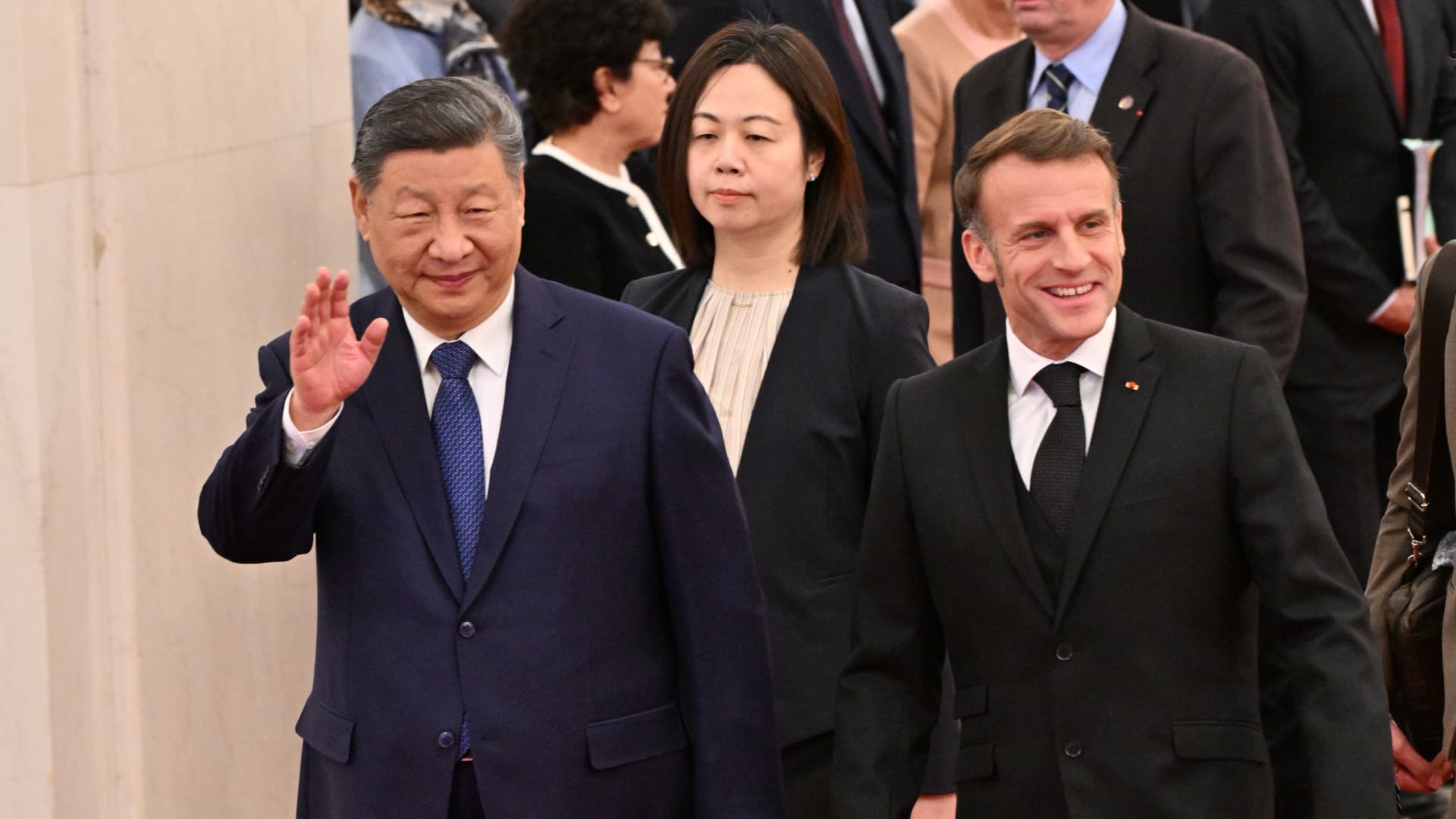
On December 3, 2025, in the heart of Beijing, two of the world’s leading powers sought to bridge their differences during a high-profile state visit. French President Emmanuel Macron and Chinese President Xi Jinping met at the Great Hall of the People, where they discussed trade and international relations. The meeting underscored the delicate balance both nations are attempting to maintain amid global tensions and economic challenges.
President Xi Jinping expressed China’s willingness to import more goods from France. This move, he suggested, would be contingent upon France providing a “fair, conducive environment” for Chinese enterprises operating within its borders. This proposal was positioned as a potential win-win, aiming to ease the trade imbalance that has been a point of contention between the two countries.
Macron’s visit, which began on Wednesday, marked his first return to Beijing in over two years. The timing of this trip is crucial, given the increasing frictions over trade and the ongoing conflict in Ukraine. The French president’s agenda was clear: to recalibrate the economic partnership with China while urging Beijing to play a more active role in resolving the Russia-Ukraine war.
In a statement released by the French government, Macron emphasized the need for a “balanced relationship” between the two countries. He welcomed China’s renewed openness to French exports, particularly in the agricultural sector. Macron’s focus on boosting the market for French products like wine, pork, poultry, and beef reflects an effort to tap into the vast Chinese market and invigorate France’s agricultural exports.
As the leaders walked through Beijing’s Great Hall of the People, their discussions signaled a cautious optimism for future cooperation. Both nations stand at a crossroads, with opportunities to strengthen economic ties while navigating the complexities of global politics. The outcomes of this visit may well define the trajectory of Franco-Chinese relations in the coming years.
Macron said he welcomed Beijing’s “renewed willingness to facilitate access to the Chinese market for French products, particularly agricultural goods,” including wine, pork, poultry and beef, according to a Google translation of the statement in French.
The countries will work toward establishing a framework that allows for increased Chinese direct investment in Europe, particularly in France, where it will create more jobs, Macron said.
The two leaders also signed several deals covering energy, agriculture, education and environment, according to the official readout from Chinese state media, which did not elaborate on the agreed terms.
Xi also called for deepening bilateral collaboration in aerospace, nuclear energy, digital economy, biopharmaceutical and artificial intelligence sectors.
The readout reflects Paris’ “ambition to be a stabilizing force in EU-China relations,” said Daniel Balazs, a research fellow at S. Rajaratnam School of International Studies in Singapore, noting that the EU’s broader aim would be to preserve constructive ties with China despite recurring frictions.
“Good ties with France also ensure that China has friends within the EU when Brussels makes economic and political decisions that impact Chinese interests,” said Balazs.
Tensions between Beijing and Paris escalated last year when Macron backed the European Union’s decision to impose tariffs on Chinese-made electric vehicles, prompting Beijing to retaliate with minimum price requirements on French cognac makers.
Macron is expected to lobby the Chinese leader to not impose similar measures on French pork and dairy products, Bloomberg reported Wednesday, as Beijing has weighed those duties in response to the levies on EVs.
Macron had also pushed Brussels to respond with its toughest trade measures on China after Beijing restricted its rare earth exports that had triggered worries of supply shortages at European carmakers.
The bilateral meeting comes at a time when Beijing is locked in a diplomatic spat with Japan over Prime Minister Sanae Takaichi’s statement that signaled a Chinese invasion of Taiwan could draw a military response from Japan.
Without naming the democratically ruled island, China said Macron agreed to the “one China policy” — a diplomatic term commonly used to indicate Taiwan as part of China. The statement from French government did not mention Taiwan as part of the discussion.
On Wednesday, Chinese Foreign Minister Wang Yi told his French counterpart Jean-Noël Barrot that he hoped Paris to continue “showing understanding for and supporting China’s legitimate stance” and prevent Japan from “stirring up troubles” over Taiwan.
The Xi-Macron meeting “provides a platform for top-level engagement [but] whether the problems can be solved is another question,” said Tianchen Xu, senior economist at Economist Intelligence Unit.
Trade, Ukraine, panda
A key goal of Macron’s visit was expected to be on addressing what he’s called “global imbalances” including over-production in China and Beijing’s dependence on exports which he says leads to global trade imbalance. France’s trade balance with China stood at nearly 20 billion euros (about $23 billion) in 2024.
“Macron can make his case for a partnership among equals to Xi Jinping. This includes opening China’s wider market to European companies and possibly paving the way to some joint-ventures in Europe in not-so-sensitive domains,” said Philippe Le Corre, senior fellow on foreign policy at New York-based Center for China Analysis.
The two presidents exchanged views on the Ukraine war, with Xi saying that China will “continue to play a constructive role in resolving the conflict and support European nations in pushing for a balanced, effective, and sustainable security framework.”
Macron has long been urging Xi to use his influence on Russian President Vladimir Putin to end the war in Ukraine.
“I hope China will join our call and our efforts to achieve, as soon as possible, at the very least a cease-fire in the form of a moratorium on strikes targeting critical infrastructure,” Macron said in a statement.
This trip offers a rare chance to get Paris’ views on Ukraine to a Chinese leadership which has been Russia’s “all-weather partner,” especially since the war started in 2022, said CCA’s Le Corre.
After formal meetings in Beijing the two leaders will head to the southwestern city of Chengdu — home of China’s giant panda breeding center. Last month, France returned a pair of loaned pandas to the Chinese city after 13 years, with their arrival being been hailed as a sign of warming diplomatic ties.
The Chinese embassy promised new pandas would soon be dispatched to France. Xi, who emphasized on expanding cultural exchange between the two countries, said that China and France had agreed to a new deal on panda protection.
— CNBC’s Charlotte Reed contributed to this story.