Share this @internewscast.com
The cost of living in Australia is on the rise, and recent figures confirm that households across the board are feeling the financial squeeze. According to the latest data from the Australian Bureau of Statistics (ABS), every type of household experienced an increase in living costs during the year leading up to the December 2025 quarter. The annual rise in expenses ranged from 2.3% to 4.2%, impacting families and individuals alike.
Significant contributors to these cost hikes include the essential areas of housing and food, two categories that form the backbone of household budgets and are notoriously difficult to cut back on. Additionally, expenses related to recreation and culture have also seen a notable increase, adding further financial pressure.
The ABS’s living cost indexes serve as a crucial tool, offering valuable insight into the out-of-pocket expenses households face. This data helps to paint a more vivid picture of how these rising costs affect daily life across the nation.
Compounding the issue, a leading food charity has raised concerns that the recent interest rate hike could exacerbate financial challenges for those already struggling to make ends meet. The increase in interest rates is expected to deepen the financial strain, particularly for vulnerable groups.
Among those hit hardest are households mainly dependent on government assistance, such as pensioners and beneficiaries, who saw their living costs surge by 4.1% to 4.2% over the past year. This trend underscores the growing economic pressures faced by some of Australia’s most at-risk communities.
Which households were hit hardest?
Those relying primarily on government payments — including pensioner and beneficiary households — recorded the largest rise in living costs over the year, with living costs rising by 4.1 to 4.2 per cent.
That was driven in part by higher electricity prices as state-based rebates in Queensland and Western Australia were used up.
Employee households — where wages and salaries are the main source of income — recorded the smallest annual rise in living costs, up 2.3 per cent.
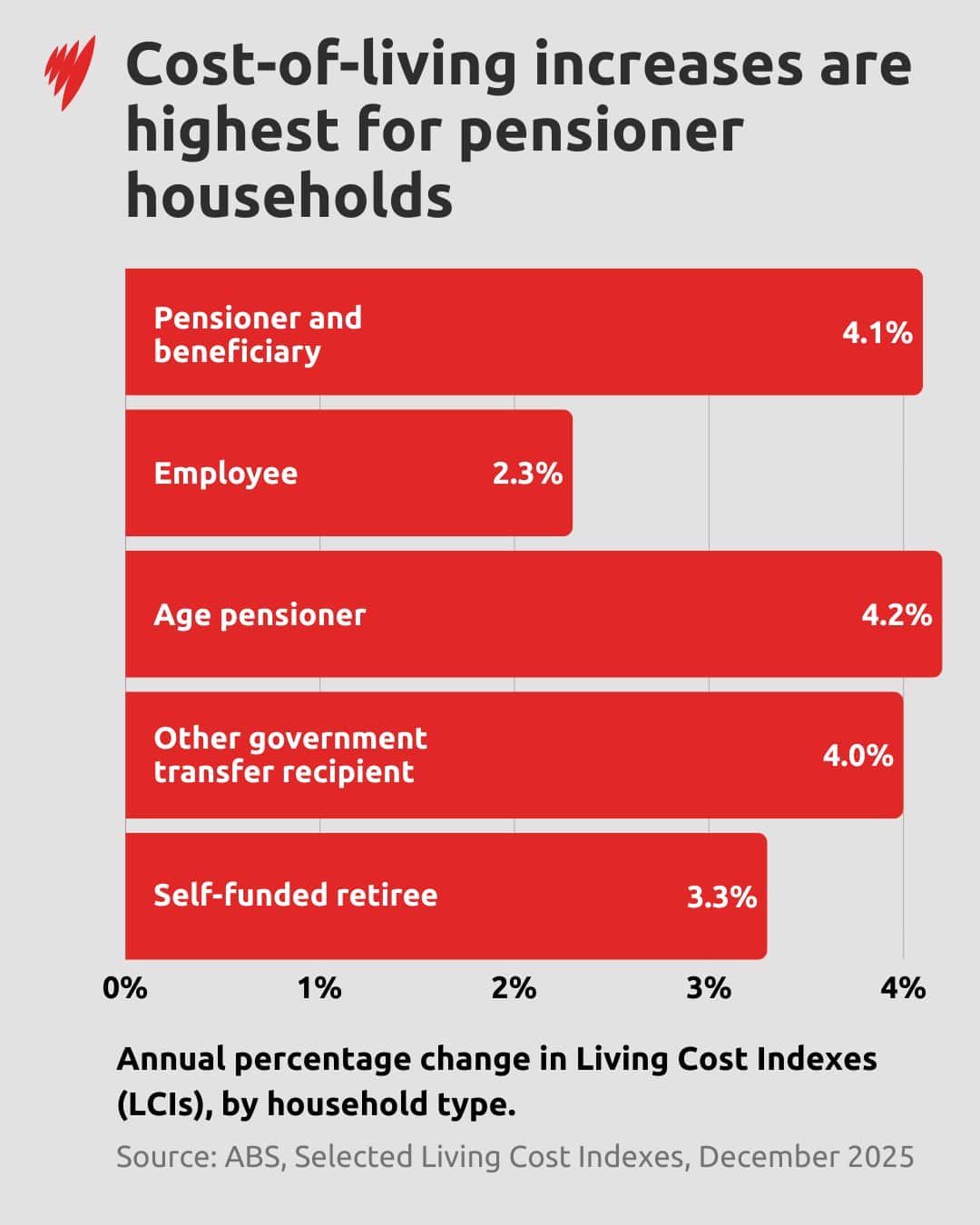
The ABS said this group benefited most from earlier falls in mortgage interest charges, which make up a larger share of their spending than for other household types.
Last year, the Reserve Bank of Australia cut rates in February, March and August.
This week, the RBA lifted the cash rate to 3.85 per cent — its first hike in more than two years — raising concerns that housing costs could once again climb, particularly for mortgage holders and renters.
What’s driving higher living costs?
Over the year, housing, food and non-alcoholic beverages, recreation and culture remained the biggest contributors to rising costs.
Housing costs rose sharply, led by a 21.5 per cent jump in electricity prices as state-based rebates were wound back. Rents rose 3.9 per cent, while new dwelling costs increased 3 per cent.
Food prices increased 3.5 per cent, reflecting higher grocery and eating-out costs.
Meat and seafood rose 4.4 per cent, with particularly steep increases for beef and veal (+10.8 per cent) and lamb and goat (+13.4 per cent). Fruit and vegetable prices were up 4 per cent, affected by extreme rainfall in Queensland.
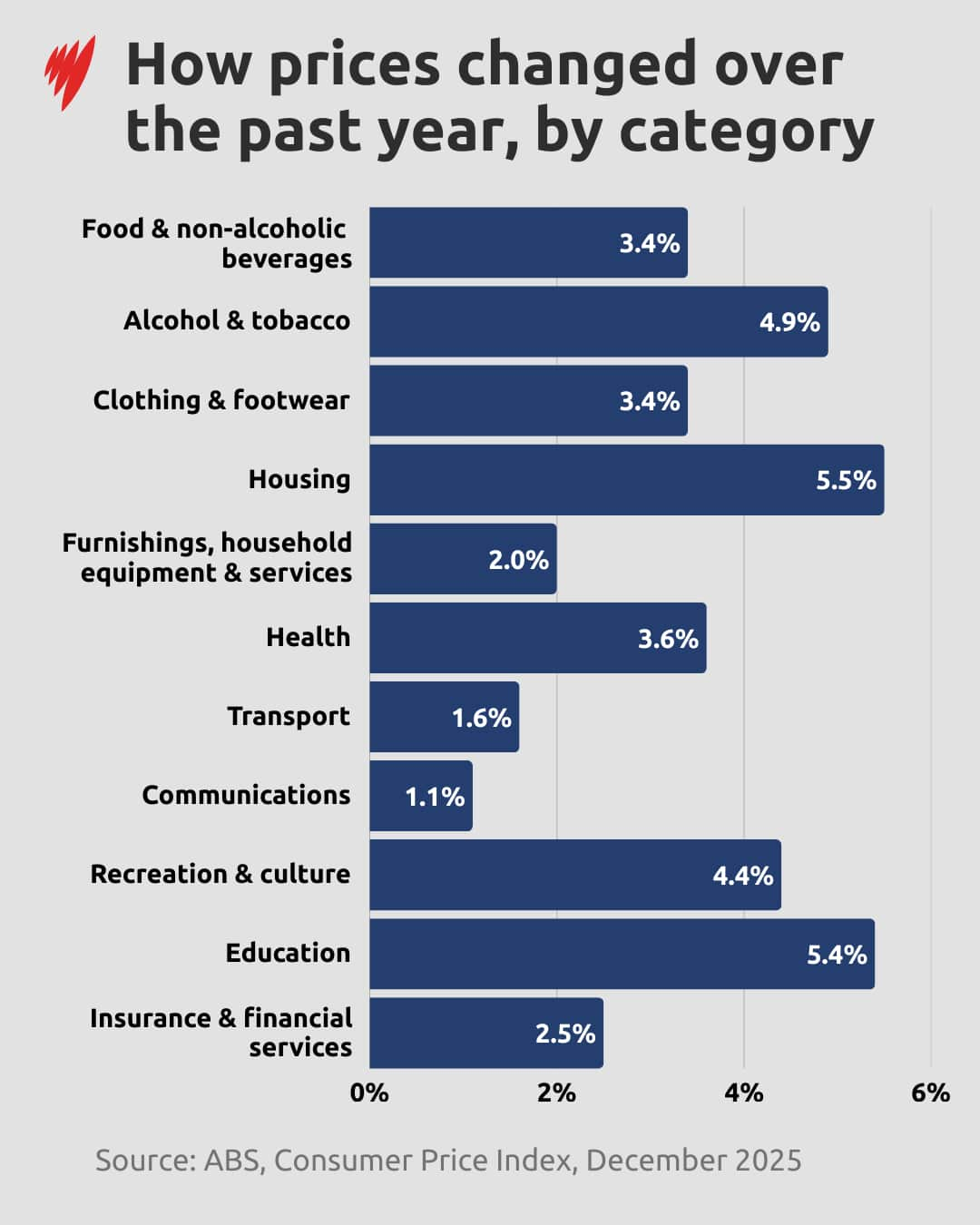
Recreation and culture costs also climbed, driven by higher travel prices. Holiday travel and accommodation rose 5.8 per cent, with domestic travel up 9.6 per cent and international travel and accommodation jumping 24.4 per cent.
But compared to the September 2025 quarter, the rise in living costs across all household types slowed.
“This quarter, lower electricity and health costs offset rises in other areas of living costs,” ABS head of prices statistics Michelle Marquardt said.
She noted Commonwealth Energy Bill Relief Fund payments and falling medical costs helped reduce out-of-pocket expenses for some households during the quarter.
Interest rate rises to ‘squeeze’ households further, warns charity
Still, some warn that cost of living pressures are already pushing households into crisis — and that this week’s interest rate rise could make things worse.
Food relief charity OzHarvest says it is struggling to keep up with demand amid growing food insecurity.
“This is a national emergency hiding in plain sight,” OzHarvest founder Ronni Kahn AO told SBS News.
“Charities are stretched beyond their limits, as the gap between demand and resources keeps widening.”
Kahn said it was the toughest conditions the organisation had seen and expected pressures to intensify following the Reserve Bank’s latest rate hike.
“Rising rents, repeated moves, and unstable living situations are already putting enormous pressure on families,” she said. “This week’s interest rate rise will only squeeze household budgets further.”
“Many are already facing impossible choices between paying rent and putting food on the table. With costs continuing to climb, even the basics — like a meal for your children — can become a daily struggle.”
The Australian Council of Social Service (ACOSS) said people on the lowest incomes were bearing the brunt of rising costs, with many forced to go without essentials.
“The cost of living crisis shows no sign of easing for people on the lowest incomes,” ACOSS CEO Cassandra Goldie told SBS News.
“Our surveys show that people receiving income support are being forced to skip meals, go without critical medication or sleep in their cars because payments are woefully inadequate.”
Goldie said the high cost of everyday items was driving widespread deprivation, particularly among single parents and First Nations people.
“People receiving JobSeeker are 14 times more likely to lack a substantial meal at least once a day,” she said, adding they were also significantly more likely to lack access to necessities such as a mobile phone, internet or a washing machine.
“JobSeeker is just 42 per cent of the minimum wage. We know minimum wage workers are doing it tough, but people who lose their job must try and survive on an income less than half of that.”
For the latest from SBS News, download our app and subscribe to our newsletter.