Share this @internewscast.com
Labor’s historic number of women candidates played a pivotal role in their decisive election victory, sparking discussions on how the Coalition might improve its gender diversity.
For the first time, female representatives in Labor will outnumber their male colleagues in the lower house, as over 15 new female MPs have contributed to securing 51 of the predicted 92 seats for the major party according to polling firm Redbridge.
There were unexpected victories, including those in Dickson.
New parliamentary members feature Jo Briskey, succeeding former NDIS minister Bill Shorten in Maribyrnong, and Ash Ambihaipahar, who will take over Barton from the retiring former Indigenous Australians minister Linda Burney.
Women’s Minister Katy Gallagher explained to ABC’s RN that this is a reflection of Labor’s persistent efforts towards gender equality over the last 30 years, beginning with their 1994 quota introduction.

“In the Labor Party, every caucus member supports gender equality. That discussion is settled,” Gallagher said on Wednesday.
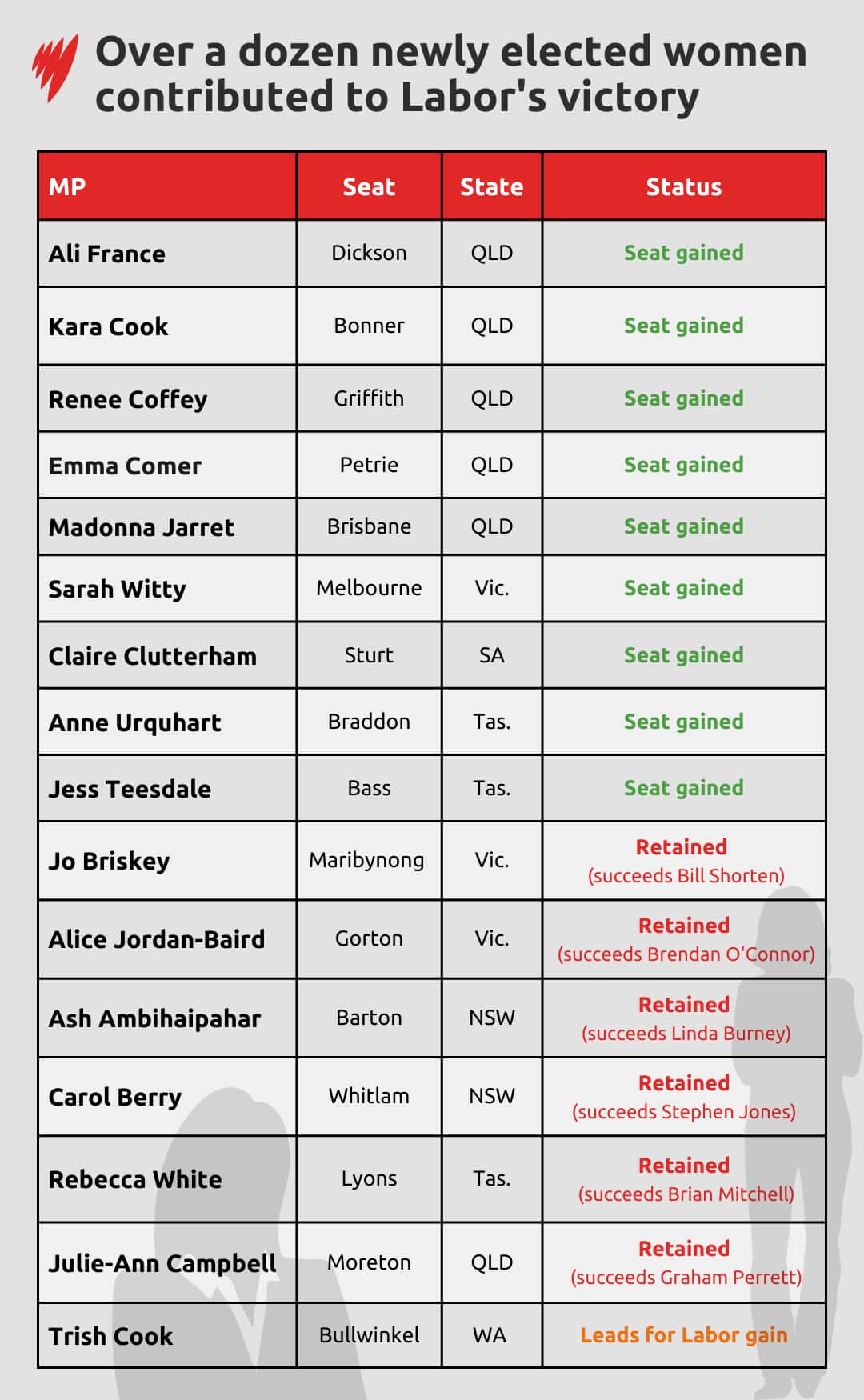
A list of all the women joining Labor in the 48th Parliament.

An unprecedented number of women will be part of Australia’s parliament, with Labor contributing a significant portion of female MPs to the House of Representatives. Source: SBS News

Labor MPs will join a historic 48th parliament with at least 68 women making up the lower house, an increase from 58 in 2022 and 40 under a Morrison-led government.

However, that number could rise as high as 72 depending on the final results in Bean, Longman, and Monash.
Catherine Hunter, CEO of the Diversity Council of Australia, told SBS News this election marked a major milestone for gender diversity in parliament, with diversity more broadly “essential for a healthy democracy”.
“When people making decisions reflect the diversity of the Australian community, the policies they create are more likely to be more inclusive, more effective, and ultimately, fairer,” she said.
She said lived experience is critical to making decisions, otherwise leaders risk “overlooking or misunderstanding the realities facing huge sections of the population”.

So, how does Australia compare to the rest of the world?

Coalition faces quota pressures as women representation drops

While Labor’s gender diversity continues to grow, the Coalition went backwards at this election.
It elected seven women MPs out of 40, a decrease from nine in 2022. It may be boosted slightly by Gisele Kapterian, if she retains the tightly contested seat of Bradfield in NSW.
This is due to Bridget Archer losing Bass and Jenny Ware losing Hughes, as well as men replacing retiring MPs Karen Andrews in McPherson and Nola Marino in Forrest.
Of the 10 independents currently projected to enter parliament, seven are women.
Former Liberal frontbencher Simon Birmingham argues the Coalition should consider “hard, fast and ambitious” quotas for women in parliament, with representation so low.
“I struggle to think of any alternatives if there’s to be a new direction that truly demonstrates change and truly guarantees that the party will better reflect the composition of modern society,” he said in a post on LinkedIn.
Former Liberal NSW premier Barry O’Farrell said it is important that political parties reflect the community they represent, with more diversity both culturally and in terms of gender.

Pressed on women quotas specifically, he told SBS News the Liberals “need to increase its diversity in all areas”.

A line graph showing how the percentage of women has grown across the major parties over the last five decades.

An unparalleled number of female representatives are about to serve in the federal parliament, marking a significant increase from the 58 women elected to the 47th parliament. Source: SBS News

Michelle Ryan is the director of the Global Institute for Women’s Leadership at The Australian National University.

She told SBS News that alongside quotas, the Coalition needs to consider where it’s placing its women candidates, avoiding the glass cliff.
The glass cliff refers to women being given leadership opportunities during difficult times or times of crises, but in a political context, can refer to being placed in more difficult contests.
“We did an analysis last election and what we saw is that women are more likely than men to be placed in risky and precarious seats, so ones that are basically either unwinnable or difficult to win or hold,” she said.

“They do differ by party as well. For the Coalition, women were much more likely to be in those unwinnable seats.”

A graph showing how the percentage of women in parliament has grown.

Source: SBS News

How does Australia compare to the rest of the world?

Australia does “pretty well relative to its comparators”, according to Ryan.
She said Scandinavian countries such as Finland, which has had three women prime ministers, and Switzerland, which has had five women presidents, often lead perceptions around gender diversity.
However, parliaments like Rwanda, which in 2024 had 50 per cent representation, often surprise the public.
“So that’s partly due to quotas. It’s partly to do with genocide, where many men were killed. So the reasons for representation are often different,” she said.
She said this includes the rise of women to head of state due to marriage or being the daughter of a previous prime minister.
Other countries with at least half of their parliament or lower house made up of women include Cuba, Nicaragua, Andorra, Mexico and the United Arab Emirates, according to UN Women.
UN Women calculates that globally, only 27.2 per cent of parliamentarians in single or lower houses are women, with monarchy-based systems excluded from the count.
Despite a mammoth election year globally in 2024, 107 countries have yet to have a woman as the head of state.

For the latest from SBS News, and .
Share this @internewscast.com
You May Also Like

From Backpacker to Restaurateur: Sammy Jeon’s Journey of Perseverance and Success

“In Korea, there’s a saying that if you can craft a beautifully…
Ocean swimmers head into the water at Coogee in Sydney as the sun shines on the water.

Australia Braces for Scorching Autumn: Anticipating Intense Heat and Drought Conditions

Australia will sweat through a dry, hot autumn as long-range forecasts show…
Angus Taylor

New Coalition Strategy to Criminalize Support for Individuals with Islamic State Ties

The Coalition is pushing a new criminal offence to punish those who…
Major US closure could cause chaos for Aussie travellers

US Shutdown May Disrupt Travel Plans for Australians

Global Entry is a US customs program that which offers some Australians…

Australians Brace for Impact: Rising Debt Amid Imminent Rate Hikes

In Brief New data shows mortgage and credit card applications are surging,…

Australia’s Skyline Revolution: Trump Tower Set to Soar as the Nation’s Tallest Landmark on Gold Coast

In brief A property developer says he has signed a deal with…

Premier League Players Face Disturbing Racist Abuse Post-Match

In Brief Some Premier League players copped racist abuse online following weekend…
A major superannuation shake-up is set to impact more than 14 million workers but many employers are still in the dark ahead of the July 1 deadline.

New Policy Shift Poised to Affect Over 14 Million Workers

A major superannuation shake-up is set to impact more than 14 million…

Anti-Racism Commissioner Criticizes Hanson’s Comments as ‘Endorsing Violence

In brief One Nation leader Pauline Hanson said there were “no good…
Victorian doctors warn strike action looms if pay and conditions not improved

Victorian Doctors Consider Strikes Over Pay and Working Conditions Concerns

Victorian doctors in the public sector have warned they may be forced…
One award after another for Oscar front-runner at BAFTAs

BAFTA Triumphs Propel Oscar Front-Runner to Awards Glory

The politically charged thriller, One Battle After Another, has made a notable…

Heartache in Afghanistan: Communities Grieve After Pakistan’s Nighttime Air Strikes

In Brief Afghans have gathered around a mass grave to bury villagers…