
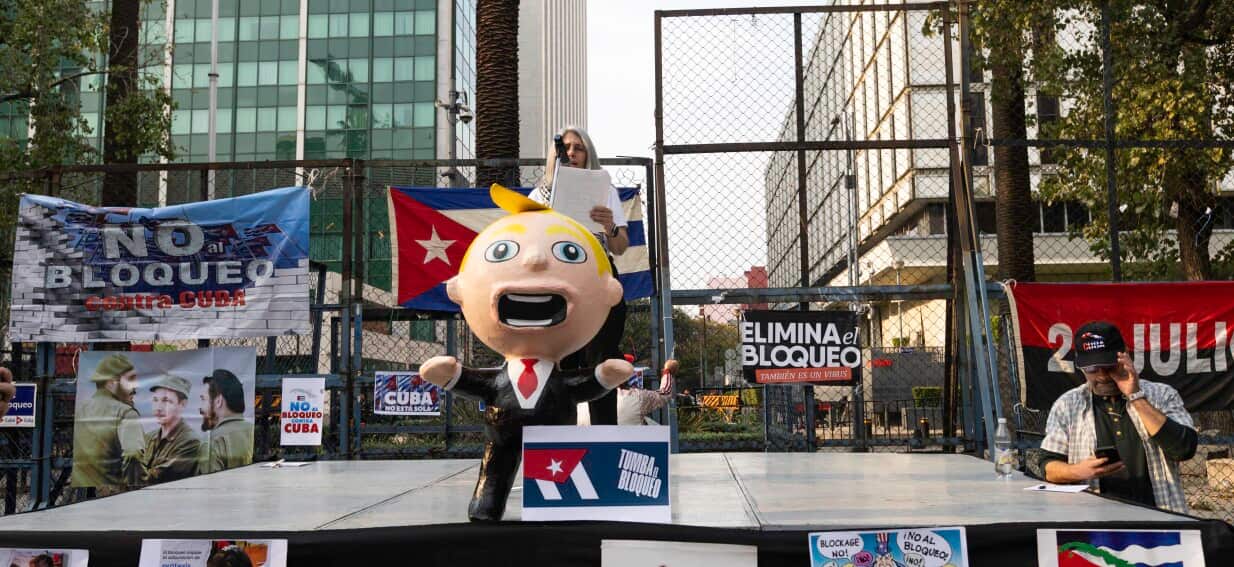
United States President Donald Trump has said no more Venezuelan oil or money will go to Cuba and suggested the island should strike a deal with the US, ramping up pressure on its long-time nemesis and provoking defiant words from the island’s leadership.
Venezuela is Cuba’s biggest oil supplier, but no cargoes have departed from Venezuelan ports to the Caribbean country since the capture of Venezuelan President Nicolás Maduro by US forces — widely seen as illegal by international law experts — in early January amid a strict US oil blockade on the OPEC country, shipping data shows.
Meanwhile, Venezuela and the US are progressing on a US$2 billion ($3 billion) deal to supply up to 50 million barrels of Venezuelan oil to the US, with proceeds to be deposited in US treasury-supervised accounts, a major test of the emerging relationship between Trump and interim President Delcy Rodriguez.
“THERE WILL BE NO MORE OIL OR MONEY GOING TO CUBA — ZERO! I strongly suggest they make a deal, BEFORE IT IS TOO LATE,” Trump wrote on his Truth Social platform on Sunday.

Cuba has long depended on substantial supplies of oil and financial resources provided by Venezuela to sustain its economy.

Cuban President Miguel Díaz-Canel rejected Trump’s threat on social media, suggesting the US had no moral authority to force a deal on Cuba.
“Cuba is a free, independent, and sovereign nation. Nobody dictates what we do,” he said on X.
“Cuba does not attack; it has been attacked by the US for 66 years, and it does not threaten; it prepares, ready to defend the homeland to the last drop of blood.”

Former President Trump hinted at a potential deal involving Cuba but refrained from providing further details.

But Trump’s push on Cuba represents the latest escalation in his move to bring regional powers in line with the US and underscores the seriousness of the administration’s ambition to dominate the Western Hemisphere.
Trump’s top officials, including secretary of state Marco Rubio, have made no secret of their expectation that the recent US intervention in Venezuela could push Cuba over the edge.

Recently, U.S. officials have intensified their critical stance towards Cuba, a country with which they have had strained relations since the 1959 revolution led by Fidel Castro.

Cuba’s energy needs are heavily reliant on imported crude oil and fuel, chiefly supplied by Venezuela, with lesser amounts coming from Mexico through market purchases, to power its electrical grid and vehicles.

Cuban foreign minister Bruno Rodriguez said in another post on X on that Cuba had the right to import fuel from any suppliers willing to export it. He also denied Cuba had received financial or other “material” compensation in return for security services provided to any country.
Thirty-two members of Cuba’s armed forces and intelligence services were killed during the US raid on Venezuela. Cuba said those killed were responsible for “security and defence” but did not provide details on the arrangement between the two long-time allies.

The island nation is currently facing severe shortages of essentials such as food, fuel, and medicine, leading to widespread discontent and triggering an unprecedented wave of migration to the United States over the last five years.

As Venezuela’s refining capacity has dwindled in recent years, its supply of crude and fuel to Cuba has fallen. But the South American country is still the largest provider, with some 26,500 barrels per day exported last year, according to ship-tracking data and internal documents of state-run PDVSA, which covered roughly 50 per cent of Cuba’s oil deficit.
It’s hard for many Cubans to imagine a situation much worse. The island’s government has been struggling to keep the lights on. A majority live without electricity for much of the day, and even the capital Havana has seen its economy crippled by hours-long rolling blackouts.

Shortages of food, fuel and medicine have put Cubans on edge and have prompted a record-breaking exodus, primarily to the US, in the past five years.

Mexico becomes key supplier

Mexico has emerged in recent weeks as a critical alternative oil supplier to the island, but the supply remains small, according to the shipping data.
Mexican President Claudia Sheinbaum said last week her country had not increased supply volumes, but given recent political events in Venezuela, Mexico had become an “important supplier” of crude to Cuba.
US intelligence has painted a grim picture of Cuba’s economic and political situation, but its assessments offer no clear support for Trump’s prediction that the island is “ready to fall”, Reuters news agency reported on Saturday, citing three people familiar with the confidential assessments.

You May Also Like

Australian Fans Splurge Up to $25,000 for Ultimate FIFA World Cup 2026 Experience

Key Points Australians heading to this year’s World Cup have told SBS…

Israeli Troops Advance Into Lebanon, Seize Key Mountain Fortress

IN BRIEF Israeli forces have made their deepest incursion into Lebanon in…

Poll Shift: Why One Nation is Gaining Momentum as Labor Faces Challenges

in brief A recent RedBridge/Accent survey saw One Nation surge to 31…

Minimum Wage Increase Sparks Controversy: Wage Umpire Expresses Regret Amid Union Cheers and Employer Concerns

In Brief The Fair Work Commission has delivered an increase to minimum…

Australia Imposes Sanctions on Israeli Extremists Amid Palestinian Conflict Tensions

In brief Australia has sanctioned Israeli settler farms in the West Bank…

Government Lifts Gag Orders, Empowering Defense Sexual Violence Survivors to Speak Out Ahead of Inquiry

In brief Military sexual assault survivors will be free to discuss their…