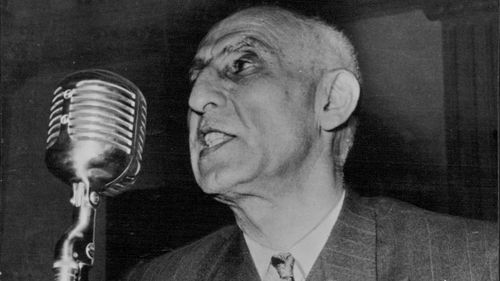

Persian Politicians; Dr. Muhammad Mossadeq -- Persia's Prime Minister and Minister of National Defence, photographed whilst delivering an impassioned radio address. June 10, 1953.
But the events leading up to the dramatic military action date back far further, US President Donald Trump ordering a increased armed presence in the region, instead reaching back almost three-quarters of a century ago.

In a pivotal moment of 20th-century geopolitics, Prime Minister Mohammed Mossadegh of Iran was ousted in a coup orchestrated by the UK and backed by the US. The primary aim was to safeguard British oil interests in the region.

This event significantly bolstered the authority of Shah Mohammad Reza Pahlavi, while simultaneously fueling anti-Western sentiment, particularly against the US and the UK, within Iran.
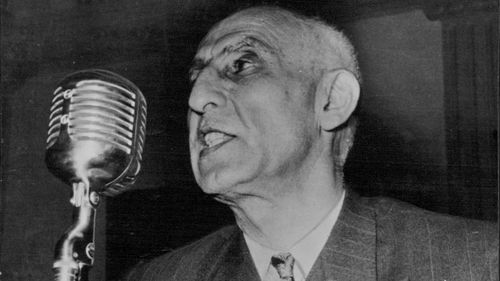
Persian Politicians; Dr. Muhammad Mossadeq -- Persia's Prime Minister and Minister of National Defence, photographed whilst delivering an impassioned radio address. June 10, 1953.
Mohammed Mossadegh was confined to house arrest after the 1953 coup. (Camera Press)

Eventually, the shah’s diminishing popularity culminated in his overthrow during the transformative 1979 Iranian Revolution. This led to the official establishment of the Islamic Republic of Iran, with Ayatollah Ruhollah Khomeini assuming the role of its inaugural supreme leader.

Following the revolution, the new regime imposed stringent restrictions on women’s rights, marking a stark shift in societal norms.
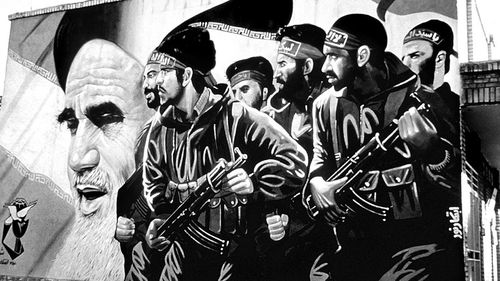
Billboard of the Ayatollah Khomeini in Tehran, Iran.
Ruhollah Khomeini led the 1979 revolution. (Sydney Morning Herald)

Amidst these changes, Ali Khamenei was inaugurated as Iran’s president, notable for taking his oath of office with his right arm in a sling due to an unsuccessful assassination attempt in 1981.

Upon Khomeini’s death, Khamenei ascended to become Iran’s second supreme leader, continuing to shape the country’s political landscape.

Around this time, it establishes a plan to develop nuclear weapons, known as Project AMAD.
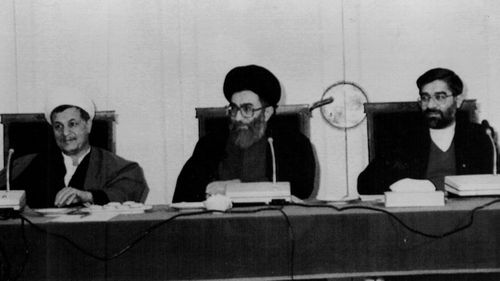
Iran's Majli's speaker and Imam's representative in supreme defence council Hashemi Rafsanjani (L) and Iranian Prime Minister, Hussein Musavi (R) during the session. War-Meeting.  Iranian President Ali Khamenei (M) Chairs a joint session of the cabinet minister. The supreme defence council and the supreme war support council Sunday to draw up the Islamic republic's strategy in relation to the Iraqi imposed war. November 15, 1987.
Ali Khamenei (centre) in 1987. Two years later, he was named the new supreme leader. (Fairfax Media)

Iran is subjected to oil and trade sanctions by the US over state terrorism sponsorship and the desire for a nuclear weapon. Further sanctions are applied in the coming decades.

Student protests break out in response to the closure of reformist newspaper Salam.

In the largest demonstrations since the days of the revolution, at least four students are killed, hundreds are wounded and more than 1000 are arrested in the crackdown by authorities.

Project AMAD is shelved, although Iran’s nuclear program, including civilian uses, continues.

Iran signs the Tehran Agreement, which included pledges to temporarily suspend uranium enrichment and reprocessing, and more intrusive inspections by international authorities, although its cooperation with those commitments is frequently questioned.

Protests in major cities break out in response to the 2009 presidential elections, after incumbent Mahmoud Ahmadinejad is declared the winner over two reformist opposition candidates, who claim the result is fraudulent.

Dozens are killed and thousands arrested in the ensuing crackdown.
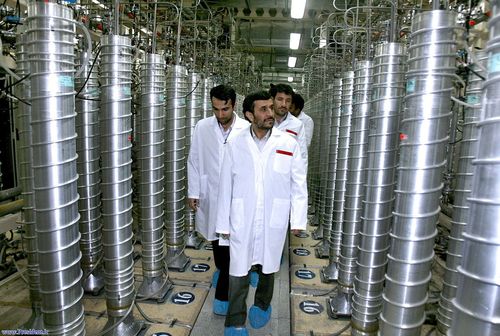
In this photo released by the Iranian President's Office, then-Iranian President Mahmoud Ahmadinejad, center, visits the Natanz Uranium Enrichment Facility near Natanz, Iran, April 8, 2008.
Then-Iranian president Mahmoud Ahmadinejad, center, visits the Natanz Uranium Enrichment Facility. His controversial re-election in 2009 led to major protests. (Iranian President’s Office via AP)

Iran admits it is building a uranium enrichment plant, but insists it is for civilian purposes.

Separately, it test-fires a range of medium- and long-range missiles that could reach Israel and US military bases in the region.

Iran signs the Joint Comprehensive Plan of Action with the United States under President Barack Obama, as well as China, France, Russia, United Kingdom and Germany.

The agreement limits Iran’s nuclear program in exchange for the lifting of sanctions.
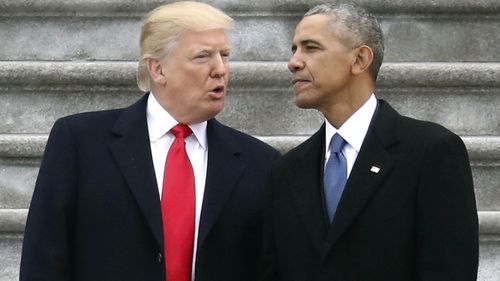
President Donald Trump talks with former President Barack Obama on Capitol Hill in Washington in January 2017.
Under Barack Obama, the United States signed a deal to limit Iran’s nuclear program, before Donald Trump withdrew from the agreement shortly after. (Rob Carr/Pool Photo)

US President Donald Trump withdraws from the nuclear deal.

More than 550 people are killed in the crackdown, and almost 20,000 arrested.
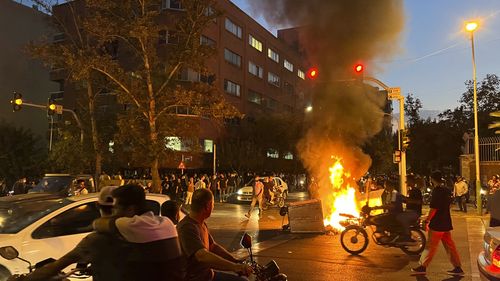
In this Monday, Sept. 19, 2022, photo taken by an individual not employed by the Associated Press and obtained by the AP outside Iran, a police motorcycle and a trash bin are burning during a protest over the death of Mahsa Amini, a 22-year-old woman who had been detained by the nation's morality police, in downtown Tehran, Iran.
Huge protests broke out in the wake of Mahsa Amini’s death. (AP)
Iranian proxy Hamas carries out the deadly October 7 attacks on Israel from Gaza. Nearly 1200 are killed and more than 200 hostages taken, and the Israeli retaliation leaves Hamas and fellow Iranian-backed group Hezbollah massively weakened.
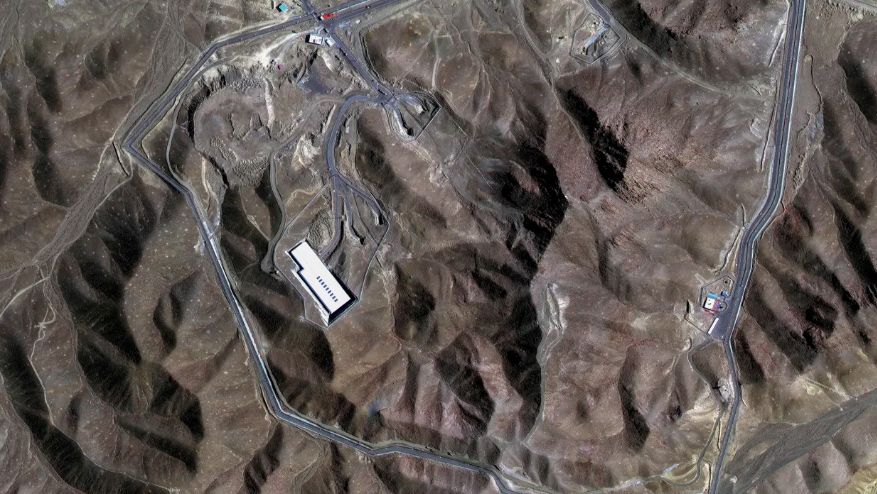
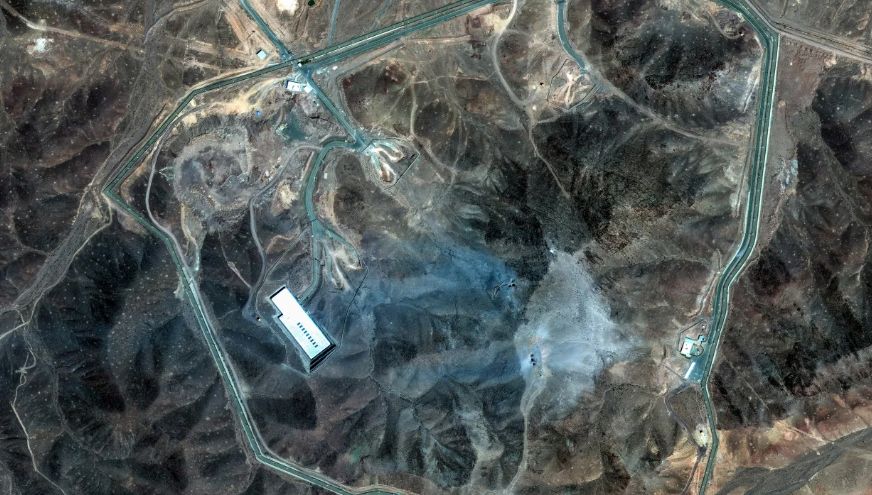
Israel carries out surprise strikes against Iranian nuclear facilities, starting what becomes known as the 12-Day War. Iran responds with missile strikes against Israel, most of which are intercepted. The US carries out bombing attacks on Iranian nuclear facilities, which Trump claims are “completely and totally obliterated”.
This satellite image provided by Maxar Technologies shows the Fordow enrichment facility in Iran before the US strikes.

This satellite image provided by Maxar Technologies shows the Fordow enrichment facility in Iran  after the US strikes.

This satellite image provided by Maxar Technologies shows the Fordow enrichment facility in Iran before the US strikes. / This satellite image provided by Maxar Technologies shows the Fordow enrichment facility in Iran after the US strikes. (Maxar Technologies)

However, the US does not take military action in Iran.
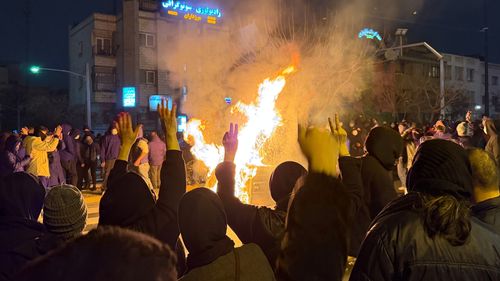
Thousands are killed by authorities. Exact casualty figures remain unknown, but one reputable human rights agency said about 7000 are dead, while others claim the death toll is higher than 30,000.
This year’s protests were the largest demonstrations in Iran since the 1979 revolution. (AP)
Israel and the US launch massive, widespread airstrikes on Iran. Iran responds with strikes on Israel and US bases in the Middle East. Supreme Leader Khamenei is killed in the strikes, along with the head of the Revolutionary Guard and other senior leaders.

NEVER MISS A STORY: Get your breaking news and exclusive stories first by following us across all platforms.
You May Also Like

Australia Imposes Sanctions on Israeli Extremists Amid Palestinian Conflict Tensions

In brief Australia has sanctioned Israeli settler farms in the West Bank…

Poll Shift: Why One Nation is Gaining Momentum as Labor Faces Challenges

in brief A recent RedBridge/Accent survey saw One Nation surge to 31…

Israeli Troops Advance Into Lebanon, Seize Key Mountain Fortress

IN BRIEF Israeli forces have made their deepest incursion into Lebanon in…

Government Lifts Gag Orders, Empowering Defense Sexual Violence Survivors to Speak Out Ahead of Inquiry

In brief Military sexual assault survivors will be free to discuss their…

Facing Early-Onset Dementia: Luke’s Struggle to Secure Support for Partner Lisa in Her 40s

Stay informed and connected with the latest happenings from around the globe.…

Australian Fans Splurge Up to $25,000 for Ultimate FIFA World Cup 2026 Experience

Key Points Australians heading to this year’s World Cup have told SBS…