
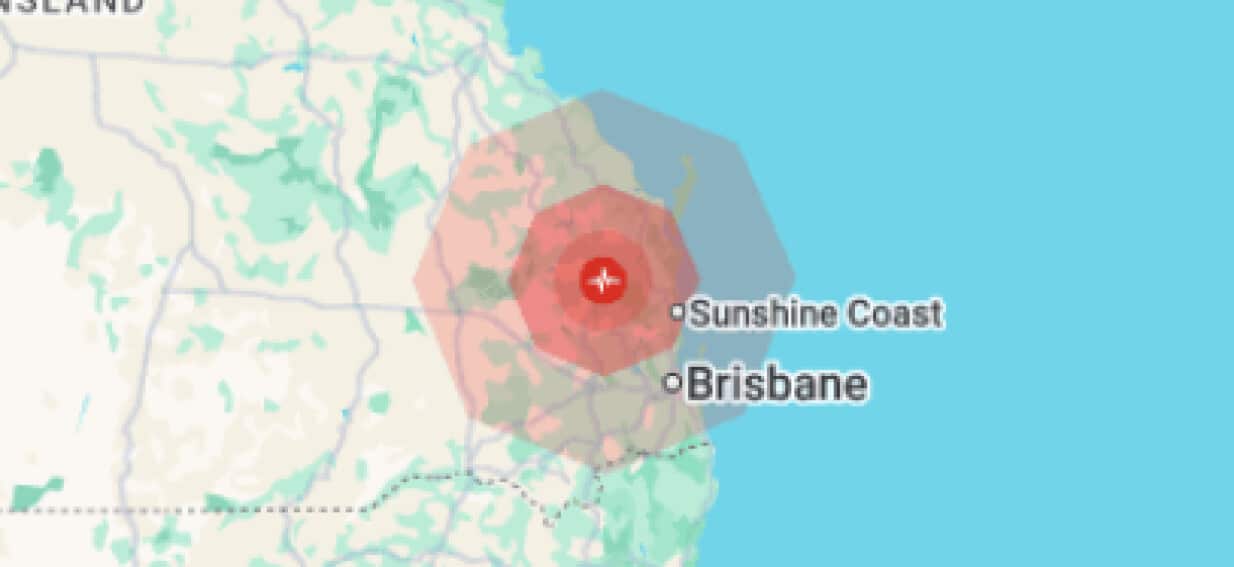
Residents in southern Queensland have been rocked by a magnitude-5.6 earthquake on Saturday morning, with tremors felt all the way down to Brisbane.
The Australian Government’s national geoscience organisation, Geosciences Australia, reported the earthquake striking at around 9:49am on Saturday morning.
The epicenter was identified as being near Kilkivan, approximately 220 kilometers northwest of Brisbane, with the earthquake’s depth reaching around 10 kilometers.
Residents as far south as the Gold Coast and as far north as Hervey Bay reported feeling the tremor.
Some homes in the region have been hit by power outages, according to Ergon Energy.
They reported 6 unplanned outages in regional Queensland, affecting over 8,000 homes.
Some were quick to joke on social media, while others reported feeling their houses shake.
“Woahhh earthquake on the Gold Coast… anyone else feel that? I assume that means median home price went through $2m?” one user wrote on X.
Another joked: “We will rebuild”.
Users on Reddit also shared their experiences. “40 mins north of the city, I thought it was just a very strong wind coming through until I realised the whole damn house was shaking,” one Reddit user wrote.
Another said residents were “very lucky” the epicentre was in a non-urbanised part of the state.
“As far as earthquakes in Australia goes, this is fairly significant,” they wrote. “This is the same magnitude as Newcastle’s 1989 quake.”
Geoscience Australia said there had been more than 10,000 “felt reports”.
There is no tsunami risk.
How big is a 5.6-magnitude earthquake?
An earthquake measuring 5.6 on the Richter scale is considered a moderate earthquake.
It can cause slight damage to buildings and other structures, with an estimated 350 of them occurring each year.
But the location of them can influence how damaging — or fatal — they might be.
In 1989, the New South Wales city of Newcastle was hit with an earthquake measuring 5.6 on the Richter scale. The epicentre was located about 15 kilometres from Newcastle’s CBD, injuring 160 people and killing 13.
The largest recorded earthquake in Australia occurred in 1988 in Tennant Creek in the Northern Territory, with three earthquakes ranging from 6.3 to 6.7 in magnitude shaking the regional area. It damaged a major natural gas pipeline.
It’s believed this tremor is the strongest in the Brisbane region in over a year, according to Earthquake Track.
Queensland Police said there have been no reports of major damage or injuries.
This is a developing story and this article will be updated.


