Share this @internewscast.com
Following the first human death from the H5N5 strain of bird flu, experts are warning the virus, of which a number of strains are circulating in parts of the world, could lead to the world’s next pandemic.
The death also comes as bird flu was detected in an Australian external territory for the first time.
European health authorities warned this month that governments should step up efforts to combat bird flu threats amid an “unprecedented” number of outbreaks in the northern hemisphere’s autumn.
Since September, more than 1,400 infections among wild birds and poultry have been detected in at least 26 European countries, four times higher than a year ago and the highest level since 2016, raising the risk that the virus could spill over into people, according to the European Centre for Disease Prevention and Control (ECDC).
Some forms of bird flu, like H5N1, have a higher mortality rate in humans than COVID-19, although infections are rare and typically occur in cases who have been in close contact with sick birds and livestock.

While some specialists suggest that the bird flu virus could potentially trigger the next pandemic, others maintain that although it’s possible, the likelihood remains “very low.”

According to a report from SBS News, the primary concern is the H5N1 strain, which is currently spreading across the globe. This strain is not only responsible for the deaths of millions of wild and domestic birds but is also impacting various mammals worldwide.

Professor Adrian Esterman, an epidemiologist and biostatistician from the University of South Australia, said H5N5, like the first strain detected in humans in Hong Kong in 1997, H5N1, was highly infectious.

Data from the United States Centers for Disease Control and Prevention (CDC) indicates that from January to August, there have been 11 fatalities linked to bird flu, reported in Cambodia, India, and Mexico.

“These are all what we call highly pathogenic avian flu, basically, there’s two types of bird flu, there’s bird flu, which is quite mild and basically doesn’t kill off the wild birds, which is called low pathogenic avian flu, then there’s highly pathogenic, and both H5N5 and H5N1 are highly pathogenic,” Esterman said.
Since the early Hong Kong human transmission cases, there have been more than a dozen strains, with cases flaring in different parts of the world at different times.
There are almost 1,000 recorded cases of the H5 strains being transmitted to humans, with at least 476 human deaths recorded since 2003.

Researchers first identified the H5N5 strain in animals back in 2008.

The H5 strains of the avian influenza virus are known for their high transmissibility and severity. Source: Getty / Digicomphoto/Science Photo Library

Esterman said like the coronavirus, the avian flu virus continued to morph.
“The H and the N stand for proteins that spike out from the flu,” he said.
“What happens is, every year they tend to change a little bit, and every few years they have a major change.”
Outbreaks of other strains, including H7 subtypes, have occurred on poultry farms in some eastern states in recent years and have been eradicated.

Scientists came across H5N5 in animals around 2008.
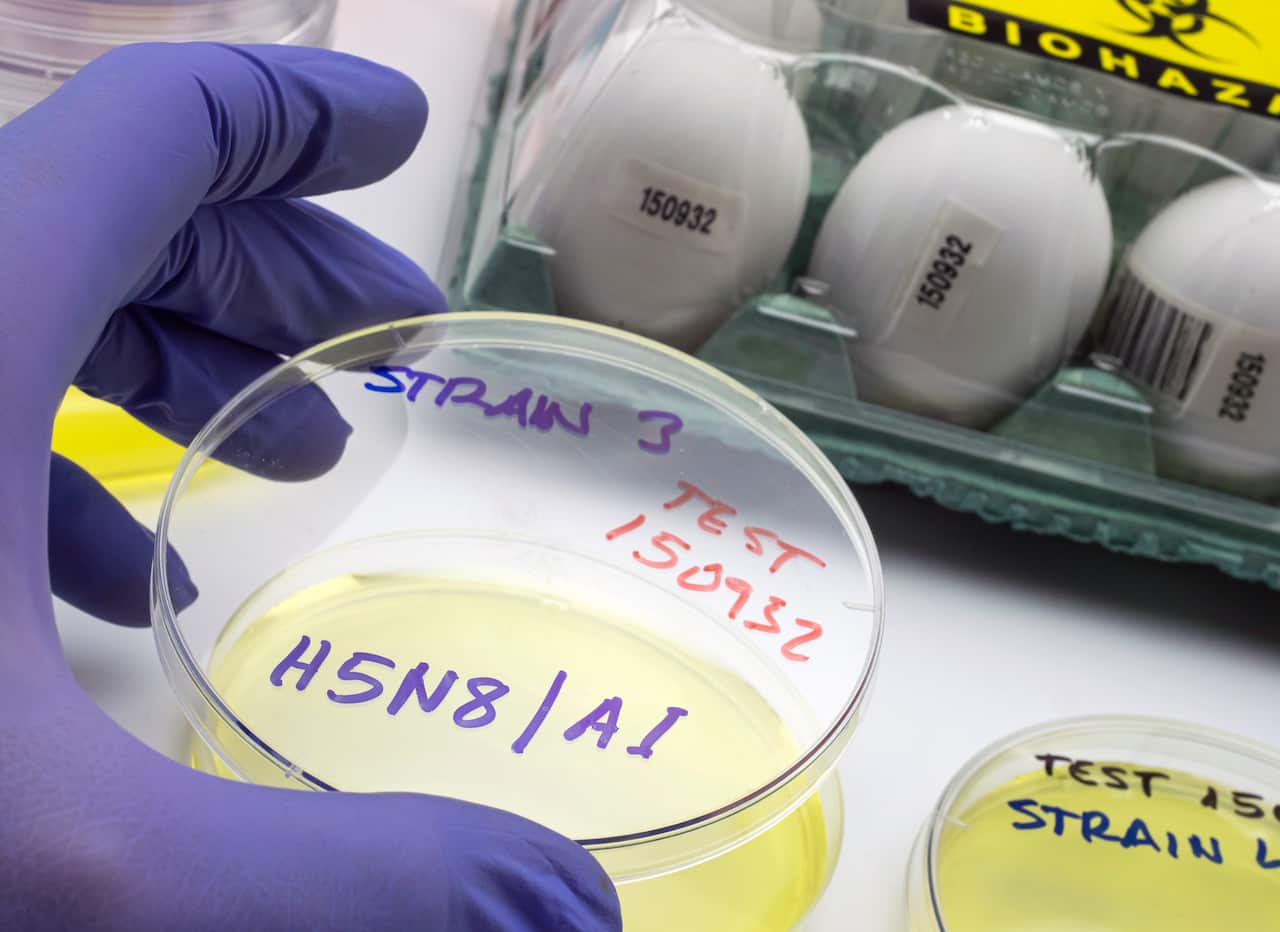
A hand wearing a blue clinical glove holds a petri dish containing bird flu samples.

The H5 strains of bird flu are contagious and severe. Source: Getty / Digicomphoto/Science Photo Libra

The first known human case of the variant was identified in the US this year and the man, who had underlying health conditions, died in November.

One case does not provide a full picture of the risk a variant poses, but Esterman said the fact that H5N1 had such a high mortality rate for humans, about 48 per cent, meant any spread of avian flu variants to humans was “a big worry”.

In November, the federal government confirmed the H5N1 strain had been detected for the first time on remote Heard Island, 4,000km south-west of Perth and 1,700km north of Antarctica.

How humans catch bird flu

Most of the recent cases of bird flu have been in the US.
Esterman said bird flu had been passed on from animals to humans through physical contact with the virus.
While the virus is also in wild birds, humans most often catch it from either domestic birds or from cattle and dairy cows.
“Usually it’s a dead animal, and you know, they’ll touch a dead animal, but I suppose they can pick it up from just droppings on the ground,” he said.
Esterman said most of the people who contracted the virus either worked in the dairy or poultry industries or were associated with them.

He said while it was possible for the virus to be passed from human to human, there was little to no evidence of its spread that way.

A smiling man in a blue suit.

Professor Paul Griffin from the University of Queensland is one of a number of experts who say bird flu has the potential to become a global pandemic for humans. Source: Supplied

Professor Paul Griffin, an infectious diseases physician from the University of Queensland’s medical school, said avian flu could result in chest infections, coughing, breathing difficulties and even respiratory failure.

Avian flu could arrive in Australia

Cassandra Berry, a professor of immunology at Murdoch University, said the eventual arrival of H5 variants of bird flu into Australia was inevitable.
“We are now surrounded by the virus,” she said.
“Australia and Antarctica were the only continents free of bird flu in the world, but that changed a few years ago, with virus outbreaks being observed in Antarctica and surrounding islands.

“Even the expedition leaders on my recent trip to the Antarctic peninsula earlier this year remarked on the low sightings of crab-eater seals and skuas, likely decimated by a highly pathogenic bird flu strain.”

Berry said if the virus jumped into animal species in Australia, culling and ring vaccination, in which populations of animals surrounding the confirmed cases were vaccinated, would be the preferred control measures.
“However, neighbouring countries have been mass vaccinating their poultry to protect flocks, industry and food supply,” she said.

“In the meantime, virus surveillance is the key biosecurity measure.”

The next potential pandemic

Berry, Griffin and Esterman all agreed there was potential for the bird flu to become a pandemic.
“A pandemic is always on the cards,” Berry said.
Esterman said one reason the H5 strains pose such a risk to humans is that “it’s got such a high mortality rate”.
“All the people who’ve been infected with the H5N1 strain over the last 20 years, half of them have died, so it’s nasty,” he said.
Griffin said while there were a lot of variables to consider, if bird flu started spreading between humans, he estimated it’d take just days to “really spread all around the world”.

He said the fact “we’re not seeing very many human cases, and seeing very rare, if any, human-to-human spread of these, so at the moment,” was reassuring.


However, he said a growing number of bird species and other animals were becoming affected and the virus was increasing its geographical spread.
“So it has the makings for a potentially significant situation, if that ability to be transmitted to and between humans increases,” Griffin said.
He said monitoring animal populations was vital.
“We need to be monitoring for the potential changes that might give these flus the ability to be more transmissible in humans, and we need to, you know, make sure that surveillance continues, but also that we’re preparing for if it does make its way into humans, for how we’d respond to that,” Griffin said.
He said while there was a vaccine for H5N1, there was not currently a vaccine for H5N5.
“With vaccine technology more broadly, we are in a fortunate position that we can adapt our vaccines potentially more quickly, but flu vaccines and the traditional platform do take quite a bit of time to manufacture,” he said.
Gregorio Torres, head of the Science Department at the World Organisation for Animal Health, told the Reuters news agency the risk of a human pandemic developing from the bird flu virus remains low,.
“We need to be prepared to respond early enough. But for the time being, you can happily walk in the forest, eat chicken and eggs and enjoy your life,” he said. “The pandemic risk is a possibility. But in terms of probability, it’s still very low.”
The government committed an additional $95 million to both protecting Australia from and preparing the country for the outbreak of bird flu in October 2024.
The funding has gone towards strengthening national biosecurity response capability, surveillance and public health preparedness.

Share this @internewscast.com
You May Also Like
Minister for Communications and Minister for Sport Anika Wells ahead of an address to the National Press Club of Australia in Canberra on Wednesday 3 December 2025. fedpol Photo: Alex Ellinghausen

Controversy Erupts: Anika Wells Under Fire for Husband’s $4000 Cricket Trip Expense

Federal Minister Anika Wells finds herself under a new wave of scrutiny…
Senator Linda Reynolds in the Senate at Parliament House

Further Delay in Linda Reynolds’ Legal Action Over Brittany Higgins’ Settlement

A former senator’s well-intentioned gesture toward Brittany Higgins may have inadvertently caused…
Treasurer Dr Jim Chalmers during a press conference at Parliament House in Canberra on Monday 8 December 2025. fedpol Photo: Alex Ellinghausen

Australian Households Face $300 Increase in Expenses

Treasurer Jim Chalmers has confirmed the federal government’s energy bill discount will…
Police are searching for a motorcyclist who fled the scene of a fiery explosion in Adelaide that was caught on CCTV.

Concerns Grow for Motorcyclist Who Escaped Fiery Crash Scene

Authorities are actively seeking a motorcyclist who vanished after a dramatic explosion…
Use a parcel locker to avoid packages going missing.

Australia Post Issues Alert on ‘Porch Pirates’ Targeting Holiday Deliveries

Australians are being advised to stay ahead of ‘porch pirates’ by using…

Concerns Mount for Afghan Community in Australia as Speculation Surrounds Potential Closure

Members of the Afghan Australian community are concerned about the future of…

Cleveland Dodd’s Death in Youth Detention Highlights Systemic Deficiencies in Justice System

Warning: This article contains the name and image of an Aboriginal person…
'Armageddon': Families return to devastation after Koolewong bushfire

Koolewong Inferno Aftermath: Families Confront Devastation and Despair

Inhabitants of the Central Coast in New South Wales have recounted the…
Car crashes into building in Niddrie

Tragic Accident: Car Crashes Into Medical Center, Leaving One Dead and Another Injured

A pedestrian has been killed and a woman injured after a car…
The Louvre hit by embarrassing new blunder

Latest Louvre Mishap: Unveiling the Museum’s Unfortunate Oversight

A water leak at the Louvre in Paris has damaged hundreds of…

Unlocking Future Fertility: How Accessing Superannuation Early Empowered My Egg Freezing Journey at 25

The business of making babies is worth more than $820 million in…
Private school boy allegedly lured, humiliated and assaulted in 'tradition'

Alleged Hazing Ritual Leaves Private School Student Humiliated and Assaulted

The mother of a 17-year-old student from Scots College has expressed her…