
Share this @internewscast.com
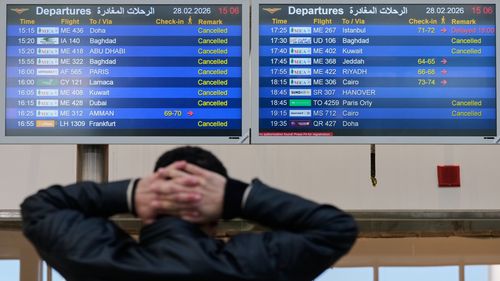
The sudden closure of airspace throughout the Middle East has thrown travel itineraries into disarray for passengers in Australia and worldwide.
Many Australian travelers, both domestically and overseas, find themselves unexpectedly stranded, including Penny Milton, who has been delayed in Qatar for several hours.
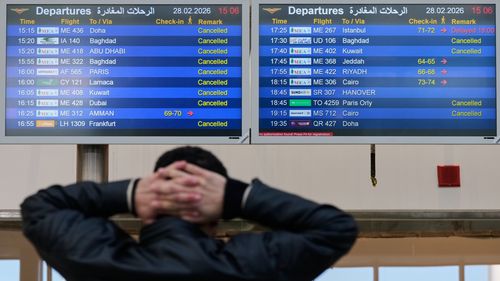
Milton recounted to Today how her flight was approaching Iraqi airspace when the pilot delivered a startling announcement to the passengers.
“He mentioned that the airspace was closed, and at that moment, I thought, ‘something significant has occurred,'” Milton explained.
“We haven’t been given any updates; we’re just waiting for the airspace to reopen.”
“So, here we are, waiting along with many others,” she added.
A traveller who was left stranded at Perth Airport after flights to Doha were cancelled said the change in plans had left her overstaying her visa.
“We’re all stuck here, but the big issue is myself and other passengers, our visas run out in Australia today and we’re all basically illegal immigrants,” she said.

Two flights from the Middle East arrived at Melbourne Airport about 6am today, including one flight from Doha and one flight from Dubai.
One traveller told 9News they felt “a little bit nervous” while the flight was en-route to the Victorian capital.
“When you don’t know what’s happening and how far away you are from it, if it’s in the air, you’re in the air too,” she said.
A fellow traveller on the flight to Melbourne described the situation as “a little bit scary”.
“I was just glad that we were on the plane,” he said.
Nine.com.au understands four Virgin Australia flights operated by Qatar Airways returned to Australia last night due to the closure of Qatari airspace.
This includes flight VA1 from Sydney to Doha, which was diverted to Melbourne due to Sydney curfew.
Flights VA15, VA7 and VA21 were also turned around.

A Virgin Australia spokesperson said the safety of its guests and crew remained its top priority.
“Due to the evolving situation in the Middle East, a number of Virgin Australia services operated by Qatar Airways have been cancelled,” the spokesperson said.
“Guests scheduled to travel on Virgin Australia services between Australia and Doha in the coming days are advised to closely monitor their flight information and visit the Smartraveller website for the latest travel advice.
“We thank everyone for their understanding, and we will continue to provide updates as the situation evolves.”
Travellers at Sydney Airport camped out this morning due to the flight cancellations and a lack of accommodation due to last night’s popular Mardi Gras celebration.
Yesterday flight maps showed the airspace over Iran, Iraq, Kuwait, Israel and Bahrain virtually empty as Israel said it struck Iran and the US military initiated a series of strikes against targets in the country.
Iran retaliated with a salvo of missiles.
Airlines cancelled almost 40 per cent of flights to Israel and 6.7 per cent of flights to the broader region yesterday, according to preliminary Cirium data.
The United Arab Emirates (UAE), home to both the long-haul carriers Emirates and Etihad, closed their airspace on Saturday.
The flow on effects were already being felt at Australian airports with the 6am and 6.15am Emirates flights out of Sydney and Melbourne both cancelled.
“We apologise to customers affected by disruptions for any inconvenience caused, and we are assisting them with rebooking, refunds, or alternative travel arrangements,” Emirates said in a statement to passengers.
“The safety and security of our passengers and crew remain our highest priority.”
Flow on effects all over the globe
Dutch airline KLM already announced earlier in the week that it was suspending flights to and from Tel Aviv starting today.
Airlines including Lufthansa, Air France, Transavia, Qatar Airways, and Pegasus have cancelled all flights to Lebanon.
Virgin Atlantic cancelled its flight from Heathrow Airport in London to Dubai and said it would avoid flying over Iraq, meaning flights to and from India, the Maldives and Riyadh could take slightly longer.
The airline already was not flying over Iran. Virgin Atlantic said all flights would carry appropriate fuel in case they need to reroute on short notice.
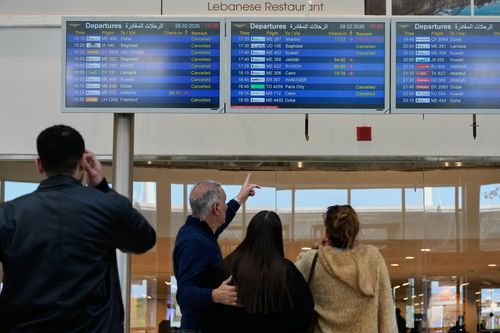
British Airways said flights to Tel Aviv and Bahrain will be suspended until next week, and flights to Amman, Jordan, will be cancelled yesterday.
United Airlines said flights en-route to Tel Aviv and Dubai yesterday morning were either diverted or returned to the US.
The airline cancelled flights between the US and Tel Aviv through Monday and flights between the US and Dubai through Sunday. It issued a travel waiver so passengers can change their flights at no cost.
Turkish Airlines said on X that flights to Lebanon, Syria, Iraq, Iran and Jordan will be suspended until Monday and flights to Qatar, Kuwait, Bahrain, the United Arab Emirates and Oman would be suspended on Saturday.
The airline said additional cancellations may be announced and Kuwait Airways temporarily suspended flights.
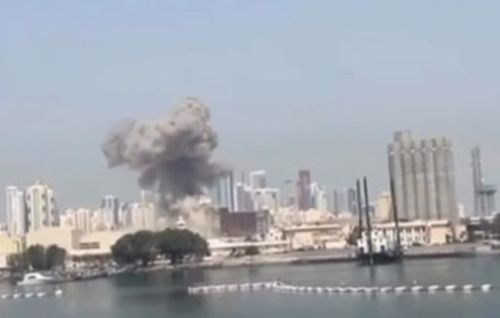
Kuwait’s aviation authority said it was halting all flights to Iran until further notice, according to the state news agency, while Oman Air said it had suspended all flights to Baghdad due to the regional developments.
The European Union’s aviation regulator EASA yesterday recommended its airlines stay out of the airspace affected by the on-going military intervention.
The Russian Ministry of Transport said yesterday that Russian air carriers had suspended flights to Iran and Israel.
Germany’s Lufthansa LHAG.DE said it was suspending flights to and from Dubai on Saturday and Sunday and halting temporarily the Tel Aviv, Beirut and Oman routes until March 7. Air France cancelled flights to and from Tel Aviv and Beirut.
Iberia also cancelled flights to Tel Aviv, while Wizz Air WIZZ.L suspended flights to and from Israel, Dubai, Abu Dhabi and Amman with immediate effect until the same date, it said.
Passengers and airlines can expect airspace to be shut for some time in the region. It’s also important to look at the tensions between Afghanistan and Pakistan as that will limit airspace even further, said Eric Schouten, head of aviation security advisory Dyami.
“With hostilities now underway, the impact on regional aviation is immediate and highly fluid,” he said.
“We also anticipate precautionary evacuations or temporary shutdowns at select Gulf airports if the threat envelope expands, which would immediately disrupt key transit hubs,” he noted.
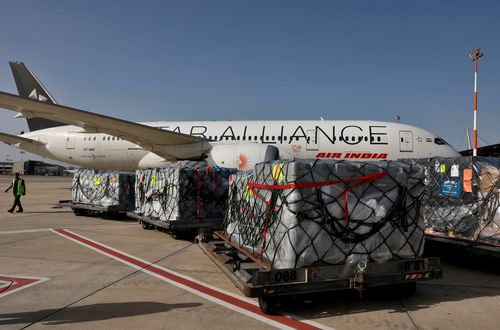
Various Indian airlines, including Air India, also suspended flights to the Middle East.
– Reported with Reuters, Associated Press and CNN.
NEVER MISS A STORY: Get your breaking news and exclusive stories first by following us across all platforms.