Share this @internewscast.com
Australians have been shocked by the news two police officers were killed in rural Victoria when a 56-year-old man allegedly shot them before fleeing into the bush.
Another police officer was injured during the incident, which sparked fresh debate about Australia’s gun laws and who owns firearms.
It may come as a shock to learn there are more guns in Australia now than there were before the Port Arthur massacre in 1996.
That event led to sweeping changes to gun laws and significant restrictions on gun ownership.

It seems counterintuitive that — against a background of measures that were meant to curb gun ownership and a landscape in which legislation has become consistently tighter — we now have more guns.

What do the stats say?

Although reliable pre-1996 statistics are not available, piecemeal data from that time suggest there were roughly three million firearms owned before the Port Arthur massacre.
That number now exceeds four million, according to estimates based on state and territory information.
And it is not just gun numbers on the rise, but the number of people who are licensed to own them.

Again, pre-1996 figures are not available, and not all states release historic or current information.

However, in New South Wales, for instance, there were 180,663 licences in 2001, rising to just fewer than 260,000 in 2025.
In Queensland, there were around 150,000 licences in 2010, rising to more than 200,000 today.
Although gun ownership is more common in rural parts of the country, available statistics (patchy though they are) show most gun owners live in urban areas.

This mirrors the distribution of the Australian population in general: in other words, where there are more people, there are more guns.
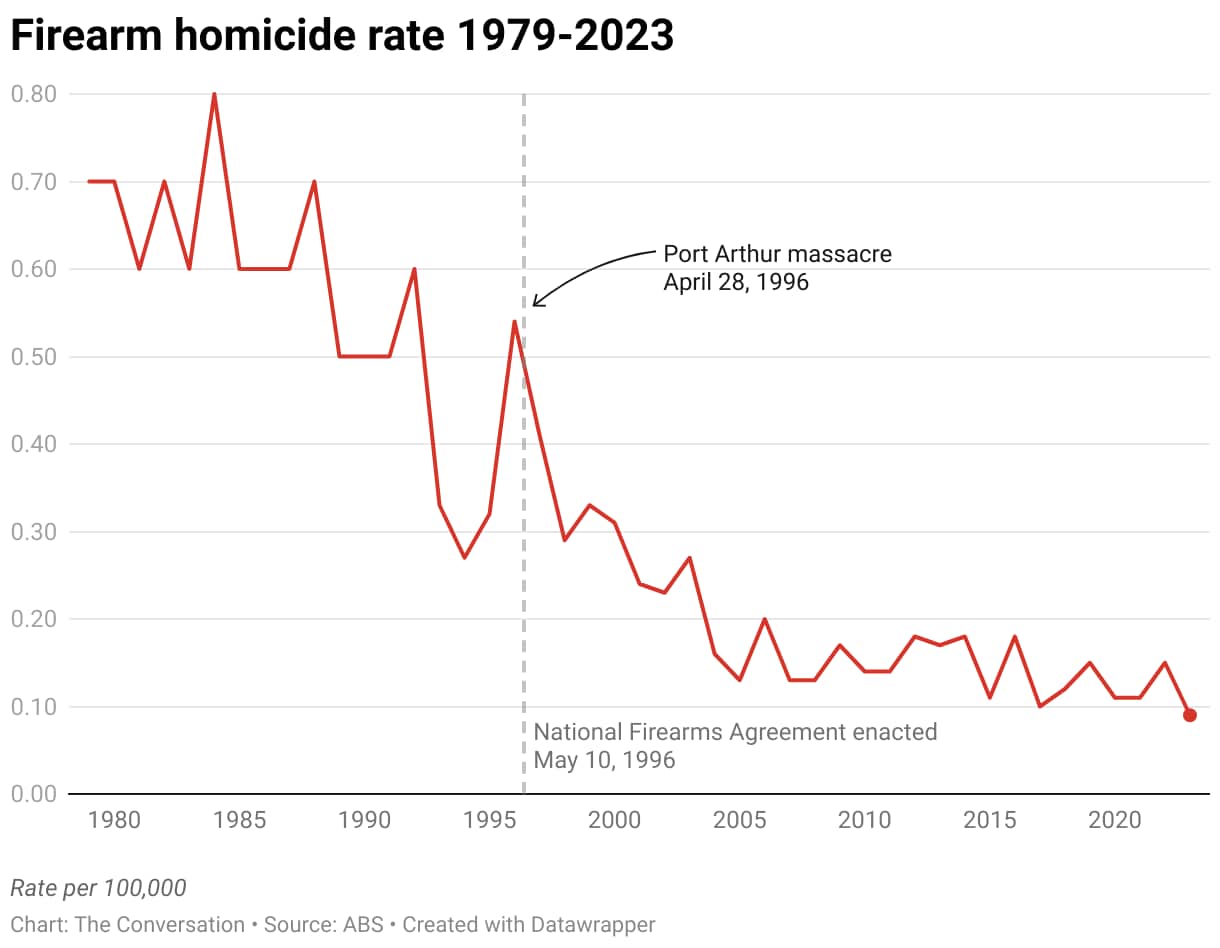
firearm-homicide-rate-1979-2023.png

Source: The Conversation / ABS

Does this mean we are awash with firearm crime?

No. Although the number of gun licences and legally owned guns have been going up for decades, firearm misuse has been declining for even longer.
Firearm homicides, for example, started falling in the early 1980s, continued falling at the same rate after 1996, and remain stable and low.
Firearm suicides have followed a similar general pattern. Armed robbery with a firearm started falling in the early 1990s.

This suggests there is little relationship between levels of legal gun ownership in Australia and levels of firearm violence and misuse.

Who owns guns and why?

Legally, people can own firearms in Australia for “genuine reasons” including primary production, target shooting, hunting and collecting.
Some gun clubs, and a small amount of research, suggests women and youth are growing demographics in what is traditionally a white, older, male-dominated activity.
However, this is another area where reliable information is scarce.
The increase in guns and gun licenses in Australia is, in part, an unsurprising outcome of our growing population. Our 1996 population was around 18 million. Today it exceeds 27 million (a growth that exceeds the increase in the number of guns owned).

Again, though, statistics tell only part of the story. There are many unexplored nuances. For instance, anecdotal evidence — which is sometimes all we have to work with — suggests multiculturalism has played a role.

Some gun owners report they own guns because they were not permitted to do so in the authoritarian regime they migrated from. Others, although Australian born, say they come from culturally diverse backgrounds where hunting is a tradition that they take up to keep the practice alive for their children.
These stories hint that Australian gun ownership is being driven by a wide range of different influences — many of which remain largely invisible.
There is little Australian research into what motivates gun ownership.

Research from the United States, with its very different approach to firearms, may not apply here (for example, owning guns for self protection is explicitly prohibited in Australia but common in the US).

However, work from New Zealand indicates there are many reasons why people own guns, including learning or mastering new skills, participating in conservation activities, making social connections, historical interest and enjoyment of competitive sport.
Social and economic circumstances are likely to influence gun ownership.
For example, the sight of empty supermarket shelves during COVID and the realisation we cannot always rely on supply chains for fresh meat seems to have prompted an increase in hunting.

In a disrupted and uncertain world, where cost of living is a concern for so many, it is unsurprising that various forms of self-sufficiency – whether that is bread making, growing vegetables, fishing or hunting – are attracting interest.


The law of unintended consequences?

Alongside all these plausible explanations for rising gun ownership, there remains one thing that is not said: the approach Australia has long taken to “de-normalising” firearm ownership, is itself likely to have fuelled the rise in guns.
As any parent will know, the more you tell someone that they should not do or have something, the more enticing that thing becomes and the more determined they are to do or have it.
After 1996, then-Prime Minister John Howard stated he hated guns and did not think people should have them.
Ironically, it may well be Howard’s hardline stance, and its continuing influence, that has sparked decades of growth in Australian gun ownership.
Samara McPhedran is principal research fellow at Griffith University. McPhedran’s research expertise includes gun violence and injury prevention, homicide, domestic and family violence, firearms legislation and policy, and social and health policy analysis.

Share this @internewscast.com
You May Also Like
Kate Gosselin had fans wondering if she secretly tied the knot with her former bodyguard and boyfriend Steve Neild when they saw the wedding band on her ring finger

Kate Gosselin Addresses Wedding Band Speculation: The Truth Behind Her Relationship with Former Bodyguard

Speculation is swirling around Kate Gosselin and her rumored romance with Steve…

Portland Shooting by Federal Agents Fuels National Tensions Amid Minneapolis Crisis

United States federal agents shot and wounded two people in Portland, Oregon,…

Inflation Eases but Interest Rate Hike Predictions Persist: What Investors Need to Know

A drop in Australia’s headline inflation has not eliminated the possibility of…

Venezuela Frees Numerous Prisoners in Major Peace Initiative: What It Means for the Nation

Venezuela is releasing a “significant number” of citizens and foreigners from its…
Heavily armed ICE agents face off with protesters in Minnesota.

FBI Declines Collaboration with State Investigators in Minneapolis ICE Shooting Investigation

WARNING: The video above contains disturbing content. In recent developments, the FBI…
Bondi hero Ahmed Al Ahmed has spoken to CNN in the US.

Bondi Hero Shares His Harrowing Tale of Courage with a Global Audience

Ahmed al Ahmed, celebrated for his bravery during the Bondi terror attack,…
Was an ICE officer allowed to open fire at a driver? The rules explained

Examining the Regulations: Was an ICE Officer Justified in Using Firearms on a Driver?

A mobile phone video has emerged showing a shooting incident that federal…
'Nobody shied away': Bystanders jumped in to help family trapped in major crash

Heroic Bystanders Spring into Action to Rescue Family in Devastating Crash

A police inspector recounted the harrowing scene where bystanders rushed to aid…
Man jailed over hoax bombing campaign threatening London hospitals

Man Sentenced for Orchestrating Hoax Bomb Threats Targeting London Hospitals

An American man has received a one-year prison sentence for orchestrating a…

Adelaide Festival Controversy: Authors Withdraw Amid Accusations of Racism in Palestinian Writer’s Ouster

The board of Adelaide Writers’ Week has made the decision to exclude…

Is it Time for Australia to Name Heatwaves?

Australia’s climate is changing rapidly due to rising global greenhouse gas emissions.…
Shops are closed during protests in Tehran's centuries-old main bazaar in Iran on January 6.

Iran in Turmoil: Nationwide Protests Ignite Against Government Policies

Anti-government protests erupted in Tehran, as Iranians angered by a flailing economy…