
Share this @internewscast.com
New data showing a continued decline in the number of physical banking services around Australia has raised concerns among advocates who say banking needs to be inclusive and accessible.
From June 2020 to June 2025, the number of bank branches across Australia fell by 33 per cent, with a 4.6 per cent drop in the last year alone, newly released data from Australia’s chief financial industry regulator shows.
Over the 2020-2025 timespan, the number of ATMs fell by 47 per cent, according to the Australian Prudential Regulation Authority’s (APRA) annual Points of Presence report.

The latest report sheds light on the array of banking services available to Australians, covering traditional in-branch services, alternative face-to-face interactions, banking through Australia Post’s Bank@Post, as well as ATMs and EFTPOS terminals.
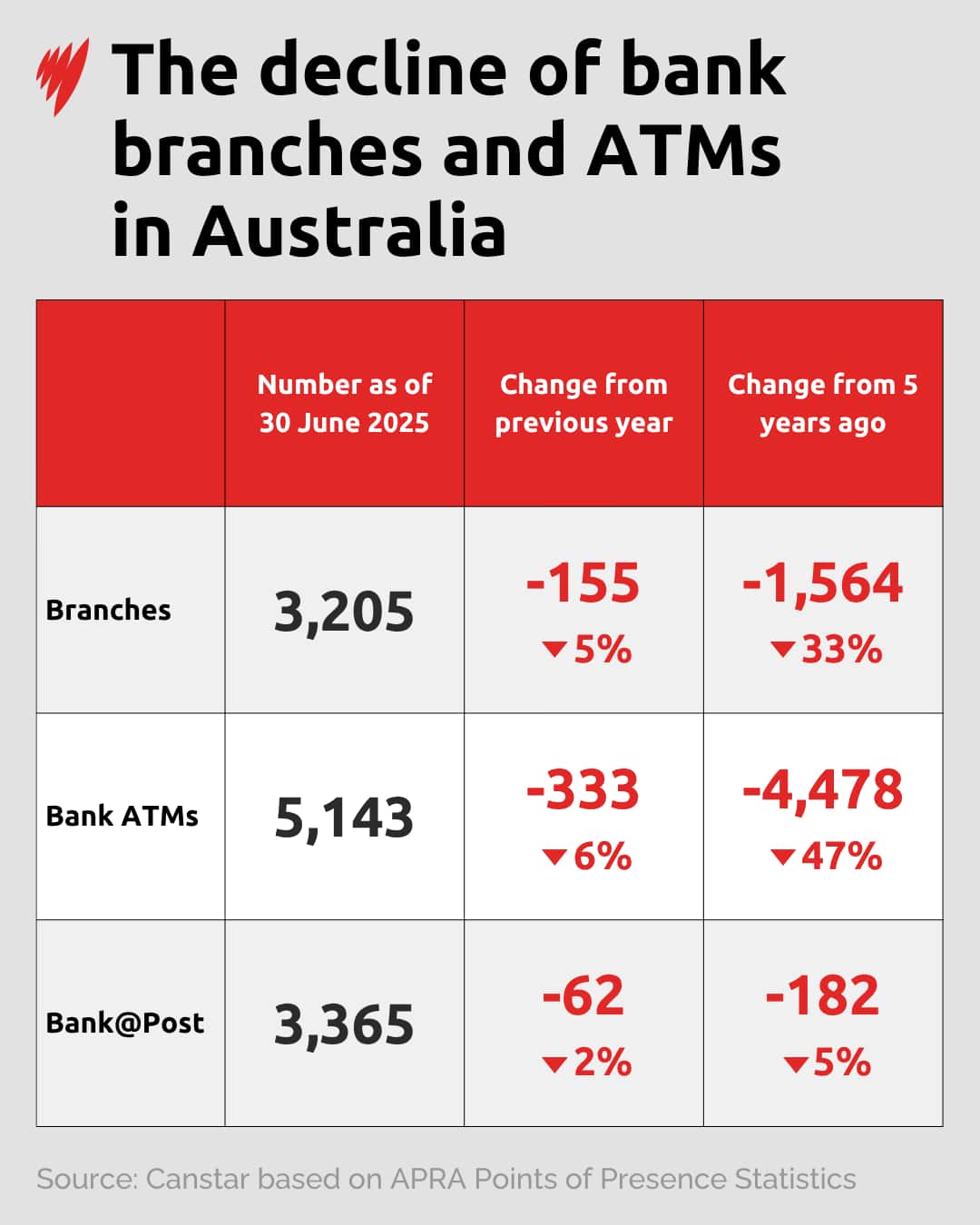
A table showing the decline in the number of bank branches, ATMs and banking services at Australia Post from 2020 to 2025

According to SBS News, this data illustrates the evolving landscape of banking accessibility across the nation.

Advocates emphasize the importance of maintaining face-to-face banking options and cash transactions, particularly for those who face barriers with technology or have concerns about online security. They argue that despite technological advancements, personal banking services are crucial.

“While it’s important to drive technological innovation, it’s equally vital to ensure that financial services remain inclusive and accessible to all,” remarked Zhou.

Chris Grice, CEO of National Seniors Australia, told SBS News that despite many older Australians transitioning to digital banking, many find digital systems challenging and some cannot afford or operate smart devices to use banking apps.
Face-to face interactions with bank tellers can also be important for identifying older Australians who may be experiencing financial elder abuse, Grice said.
In the government’s 2022 Survey of Older People snapshot, 2 per cent of people aged 65 and older living in the community reported experiencing financial abuse in the past year.

Grice also highlighted the critical role of bank tellers, noting, “Bank staff have been instrumental in identifying situations where a caregiver or family member might be exerting undue pressure on an elderly person’s financial decisions.”

Grice added that younger people must also rely on face-to-face banking in certain circumstances.
“If you’re trying to sort out deceased estates, you can’t do these things electronically. They need to see physical copies, they need to cite the copies, as in, original documents,” he said.
Shortfalls in tech and internet coverage also sometimes necessitate physical services.

Cash and in-person banking can become crucial to all Australians when banking apps fail, Grice noted.

Australia’s major banks — including CommBank, Bank Australia, Westpac and NAB — have all experienced online banking failures in the past two years.

Zhou said face-to-face banking can be essential for those living in regional and rural areas because digital banking relies on internet service, and internet infrastructure in such areas is “relatively weaker, compared to the metro areas”.

Security concerns and scams

Patricia Sparrow, CEO of the Council on the Ageing Australia (COTA), told SBS News that face-to-face banking also remains important for those with security concerns.
“Any large financial transaction that you do, it’s actually easier to go in and speak to a branch than having to do it all online,” she said.

“I’ve spoken to people who have done a big financial transaction — that might be whether they’ve moved house or whatever it is — and they’re very nervous about doing that online.”

Sparrow said in-person banking can also feel more reassuring to older Australians, who are the demographic most likely to be targeted by and fall victim to scammers.
“If you’ve been the victim of a scam, you’re going to be very uncertain and not confident to do something online. Going to somebody who can really help you is going to be important,” she said.
According to recent data from the Australian Competition and Consumer Commission, Australians are reporting fewer scams in 2025 compared to previous years, but reports of financial losses to the National anti-Scam Centre’s Scamwatch service have increased significantly.

Banks ‘pivotal’ to regional communities

Both Grice and Sparrow said there are flow-on effects for local communities when bank branches close.
Grice said banks and Australia Post are “pivotal and central to a community and maintaining the prosperity of those communities”.
“If Australia Post is shut down in a town or their bank is shut down in a town, that means people have to go to the next town to do that sort of stuff,” he said.

“What happens therefore is that normal trade, people who might have a coffee or lunch or whatever, they don’t buy it in their local town; they buy it when they have their trip 40 or 50 minutes down the road.”

Sparrow said bank branches closing can make it more difficult for small businesses in regional areas to operate, and there is a loss of connection for people who need face-to-face banking services.

“We don’t want to lose the human connection and what’s important in the community. I know there’s lots of jokes about bankers but it is an essential service and people actually do like going in and talking to a real person and not everything being automated,” she said.

Government mandate for accepting cash

A list of recommendations published following a 2023 Senate inquiry into bank closures in regional Australia included the government adopting a policy to recognise access to financial services as essential, including a commitment to guaranteeing reasonable access to cash and financial services for all Australians.
The Senate committee also recommended a banking code of conduct or customer service code that included a “robust branch closure process” that would include meaningful consultation with communities before a branch is closed and ongoing support for access to cash and essential banking services.
This year, regional and remote areas experienced the smallest fall recorded since the APRA data series began, due to a moratorium on regional branch closures agreed between the federal government and major banks in February this year and running through to mid-2027.

Last year, the Albanese government also pledged to mandate businesses to accept cash when selling essential items such as groceries and fuel, with a proposed start date of January 2026.

On Friday, Assistant Treasurer Daniel Mulino announced the government was releasing a draft of those regulations.
“We recognise that Australians are increasingly using digital payment methods, but there will be an ongoing place for cash in our society under the Albanese Government,” Mulino said.
Grice said a mandate is necessary to keep banks from closing branches.
“We need to make sure that there’s a follow-through on this particular process; it’s important. To have physical cash as a backup is important,” he said.

Share this @internewscast.com
You May Also Like
The government's plan to underwrite fuel costs is aimed to shore up supply and bring down costs.

Government Allocates Taxpayer Money to Offset Rising Petrol Prices

The Albanese government will use public funds to bring down the cost…
Donald Trump speaking about his favourite pen at a cabinet meeting today.

Survey Identifies Key Figures Australians Hold Responsible for Fuel Crisis

According to the latest poll conducted by The Australian Financial Review in…

Man in Critical Condition Following Suspected Hit-and-Run Incident

Authorities continue their search for a vehicle and its driver following a…
Trump slammed over 'huge miscalculation'

Trump Faces Backlash Over Alleged Strategic Misstep: Experts Weigh In

A prominent member of the Coalition has openly criticized Donald Trump’s recent…

Unveiling Iran’s Power Shift: Meet the New Leaders Steering the Nation

The recent US-Israeli strikes have significantly impacted Iran, claiming the lives of…

Albanese Unveils Strategic Fuel Powers: Key Changes and Their Impact on Australia’s Energy Future

IN BRIEF The Australian government will underwrite private fuel cargo purchases. This…

Lebanon Decries ‘Brazen Crime’ as Israeli Airstrikes Claim Lives of Three Journalists

In Brief The Israeli military admitted to killing Al Manar correspondent Ali…
Helen Lister and Angie List travelled to Paris, France together in 2010.

In Helen’s Last Days, Swallowing Became Impossible: A Family’s Heartfelt Struggle

Helen Lister was a beacon of positivity for her family, bringing light…
FILE - A KitKat chocolate bar in Rugby, England, on July 25, 2018. (AP Photo/Martin Cleaver, File)

Twelve Tonnes of KitKat Bars Stolen in Major Chocolate Heist

Swiss food giant Nestlé says about 12 tonnes, or 413,793 candy bars,…
Truck driver Robert Cook warning over diesel shortage

Pressure Mounts to Slash $3 Billion Tax Amid Escalating Fuel Crisis Concerns

Australia’s business chambers want the federal government to reduce the heavy vehicle…
An accused gunman on the run after two police officers were fatally shot and another was wounded as been identified as Dezi Freeman.

Breaking News: Dezi Freeman, Alleged Cop Killer, Fatally Shot by Law Enforcement

Accused cop killer and fugitive Dezi Freeman has been shot dead by…

Global Shipping Reroutes: What Australia’s Future Looks Like Amid Hormuz Disruption

In Brief Gulf countries have invested in alternatives long before the Hormuz…