Share this @internewscast.com
Israel’s deputy foreign minister, Sharren Haskel, has called for protesters to consider the needs of a “completely broken and shattered” Jewish community, urging them to remember the intent behind the Israeli president’s visit.
Israeli President Isaac Herzog landed in Canberra on Wednesday morning, having spent two days in Sydney. His visit comes at the invitation of the Albanese government, following the tragic events of the Bondi terror attack, which disrupted a Jewish Hanukkah celebration on December 14.
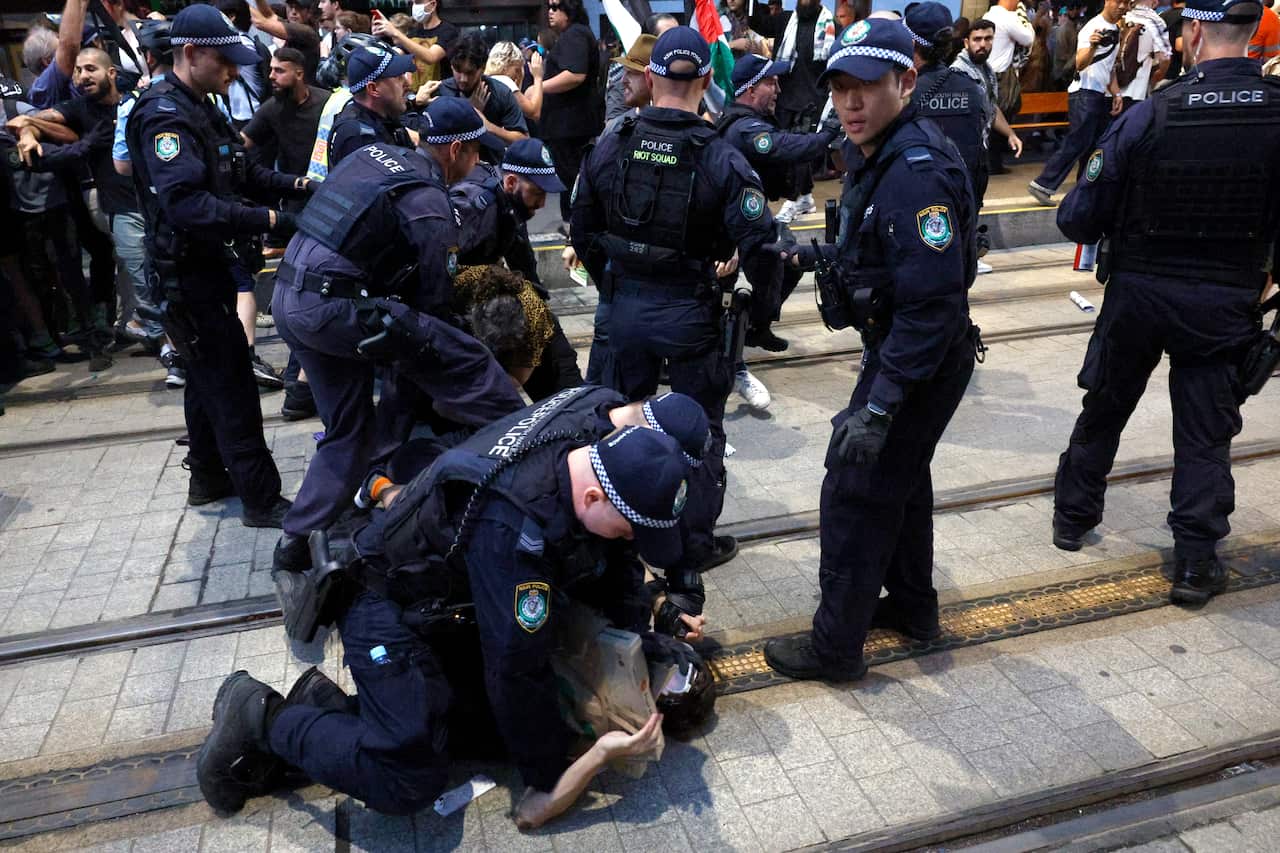
While Herzog’s official visit was welcomed by segments of the Jewish community, it was also met with widespread protests across the nation. Disturbing footage has emerged showing violent confrontations between police and demonstrators.
Haskel, who has a personal connection to Australia after living there for nearly seven years, expressed her distress over witnessing such division during a visit meant to provide solace to a grieving community.
“It’s absolutely heartbreaking to witness these events and hear the chants in Sydney during these difficult times,” Haskel shared on ABC Radio National Breakfast on Wednesday morning.
In response to questions about the impact of Herzog’s visit on the Palestinian community in Australia, Haskel acknowledged their mourning. This comes in the wake of Israel’s actions in Gaza, which, according to Gaza health authorities, have resulted in the deaths of over 70,000 Palestinians since October 2023.
“Look, a war is a war. It’s a terrible thing. There’s casualties and there’s death and destruction. We know that,” she said.
When pressed further about their distress, she acknowledged a right to protest but urged protesters not to “import the conflict in the Middle East to Australia”.
“There’s a red line that needs to be drawn with calls for violence, with calls for murder, you can go and protest in many ways, in many peaceful ways, in ways that respect other communities in Australia,” she said.
Haskel repeatedly took issue with the claims protesters chanted to “globalise the intifada”, which Jewish groups say incites violence and antisemitism towards Jewish people.
“These are no peaceful protesters. This is not about coexistence,” she said.
“It’s about celebrating death and destruction, about people trying to import the terrible conflict between radical Islamists and Western civilisation into Australia, and that’s what created and paved the way towards the Bondi massacre.”
The word “intifada” translates to “shaking off” in Arabic, and activists say the words are calls for Palestinian freedom and human rights, rather than violence or the destruction of Israel.
Haskel has previously spoken of her time serving in the Israel Defense Forces, during the Second Intifada, which was a period of uprising of Palestinians between 2000 and 2005 in the West Bank and Gaza aimed at ending Israeli occupation.
The NSW government is looking at banning the phrase, after a report in the wake of Bondi recommended it prohibit slogans that incite hatred.
While the committee acknowledged the term “intifada” was not exclusively used to incite violence, they argued that the context had changed during a broader rise in antisemitism.
For the latest from SBS News, download our app and subscribe to our newsletter.