Share this @internewscast.com


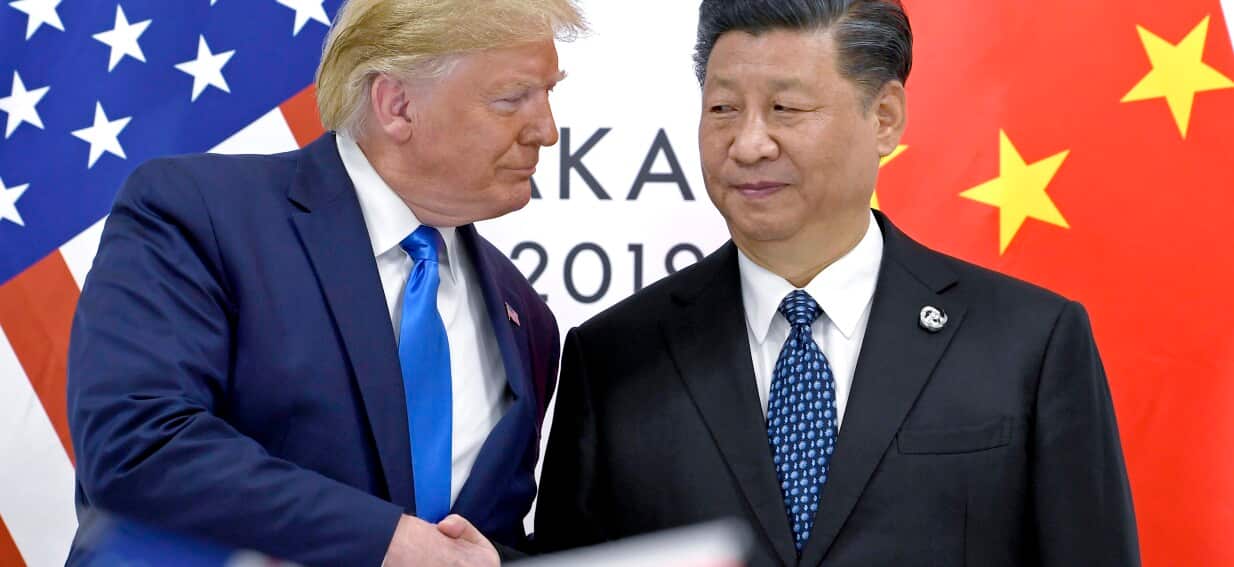
White House press secretary Karoline Leavitt told reporters Trump will depart for Malaysia late on Friday night and will also visit Japan and South Korea, where he will meet Xi next Thursday after addressing the Asia-Pacific Economic Cooperation (APEC) CEO Summit.
“On Thursday morning local time, President Trump will participate in a bilateral meeting with President Xi of the People’s Republic of China, before departing to return home,” Leavitt said.
He will also meet Malaysia’s Prime Minister Anwar Ibrahim on Sunday, Japan’s new Prime Minister Sanae Takaichi in Tokyo on Tuesday and South Korean President Lee Jae Myung in Busan on Wednesday.

The ongoing trade tension between the United States and China escalated significantly in early October when China decided to broaden its restrictions on the export of rare earth minerals.

Trump had quickly threatened to retaliate with tariffs and other measures, but has in recent days expressed optimism about reaching a trade deal with China.
“I think we’re going to come out very well, and everyone’s going to be very happy,” Trump said of the meeting.
Those comments have been in contrast to more strident remarks from his top trade negotiator and finance chief, who were headed to Asia on Wednesday to keep Trump’s meeting with Xi, the first of his second term, on track.

President Trump indicated that his primary concern in discussions with the Chinese leader would be the issue of fentanyl.

“I’m putting it right at the front of the list,” Trump said.
The US accuses China of failing to curb the flow of precursor chemicals for fentanyl, a leading cause of overdose deaths in the US. China has defended its drug control record and accused the US of using fentanyl to “blackmail” China.

The administration highlighted the influx of fentanyl-related chemicals from China as a key reason for imposing higher tariffs on Chinese imports.

Despite President Trump’s efforts to explore alternative sources for these crucial minerals, including a recent agreement with Australia, China continues to wield considerable influence in this sector, according to Gray.

The meeting could be an opportunity for Trump to discuss China’s ongoing restrictions on rare earth minerals, which are key ingredients in military technology.
Nathan Gray, a senior research fellow at the Institute for International Trade at the University of Adelaide, said Trump is looking to address shortages of these minerals.
China has been gradually ramping up its export controls on rare earth minerals since 2023, according to Gray, not only restricting the minerals themselves but also the methods used to process them.
“Trump and the US thought they had absolute dominance in terms of trade and placing tariffs on China,” he told SBS News.
“But China has been able to escalate on this one issue and cause a headache for the US.”

While Trump has been looking to diversify how the US accesses these minerals, most recently through a deal with Australia, China still holds significant power, Gray said.

China has a monopoly on key minerals like gallium and antimony, and even though roughly 50 per cent of lithium comes from Australia, it is still processed in China.
“This is preventing the US military from accessing these minerals, which are components of touch screens, missiles and radar systems,” Gray said.
“Trump will be looking to do what he can to negotiate access to these minerals.”
But he said China is unlikely to reduce export controls, as they are an effective “bargaining chip” in the ongoing tit for tat tariff war with the US.
With additional reporting by Reuters.

Share this @internewscast.com
You May Also Like
Kid Rock in the Oval Office with Donald Trump.

US Army Grounds Crew Following Kid Rock Helicopter Stunt Incident

The US Army has suspended the helicopter crews involved in a recent…

Australia’s Firm Reply to Donald Trump’s Oil Comments: A Diplomatic Exchange Unfolds

In Brief US President Donald Trump has lashed out at allies, including…
A strong police presence remains outside the Arana Hills home.

Police-Involved Shooting: Teen Allegedly Brandishes Knife During Welfare Visit

A teenager is undergoing emergency surgery after he was shot twice by…
Man pleads guilty to teacher's murder after remains found in buried freezer

Man Admits Guilt in Teacher’s Tragic Murder; Victim’s Remains Discovered in Hidden Freezer

A man has pleaded guilty to murder exactly seven years after body…
Prime Minister Anthony Albanese during a press conference at Parliament House in Canberra on Monday 30 March 2026. fedpol Photo: Alex Ellinghausen

Setback Emerges in PM’s National Gun Buyback Initiative

The initiative aimed to facilitate the confiscation and destruction of a significant…

Eurovision Expands Horizons with First-Ever Asia Edition, Celebrating a Region Rich in Culture

In Brief The music spectacle Eurovision will hold its first Asian edition…

Socceroos’ World Cup Opponents Finalized as FIFA Confirms Complete Team Lineup

After an intense final round of qualification matches, the lineup for the…

Unlock $19 Savings at the Petrol Pump: Why Aussies May Face Weeks of Waiting

Australians could wait days or even weeks for much-needed relief at the…

Unanswered Questions Emerge in the Aftermath of Dezi Freeman’s Shooting

In brief Dezi Freeman was shot dead by police on Monday after…
Trump blasts allies for not helping his war effort

Trump Criticizes Allies Over Lack of Support for His Military Campaign

US President Donald Trump recently vented his frustrations toward allies who have…
Australians planning a holiday are facing a brutal blow with airfares set to surge and flights slashed as jet fuel supplies tighten and China curbs exports. From tomorrow, a return flight from Sydney to London with Cathay Pacific will be hit by an eye-watering $800 fuel surcharge on top of the usual ticket price. Qantas has already imposed a 5 per cent increase on international fares, while Virgin Australia has also begun raising its prices. Jetstar is quietly cancelling one in ten of its May flights in New Zealand, and Air New Zealand has already axed around 1,100 services. Experts warn prices are only going to get worse, with global jet fuel costs surging 11.2 per cent in a week to $175 a barrel - after jumping more than 80 per cent since late February, according to the International Air Transport Association.

Australian Travelers Face $800 Fuel Surcharge Hike: What You Need to Know

Australians considering upcoming travel plans are bracing for a significant financial impact…
Prime Minister Anthony Albanese during a press conference at Parliament House in Canberra on Monday 11 August 2025. fedpol Photo: Alex Ellinghausen

Anticipating Key Highlights from the Prime Minister’s Uncommon National Address

Prime Minister Anthony Albanese has told parliament that his national address tonight…