
Share this @internewscast.com

The World Health Organization has announced that the United Kingdom has lost its measles elimination status due to a significant increase in cases.
According to the WHO, measles transmission has resumed following a 2024 outbreak in the UK, which saw approximately 3,600 suspected cases.
Losing elimination status indicates that the disease is being transmitted continuously, and experts had anticipated this outcome.
Already in 2025, the UK has reported over 1,000 measles cases, while Europe is experiencing unprecedented infection rates.
The year 2024 marked the UK’s worst measles outbreak on record, with 3,681 confirmed cases.
Authorities attribute this situation to a concerning decline in herd immunity, as vaccination rates have dropped below the critical 95% threshold needed to curb persistent outbreaks.
The UK was first granted measles elimination status in 2017, but lost it two years later before regaining it in 2021 after Covid restrictions largely halted the spread of the virus.
However, measles began circulating again in late 2023, triggering the surge seen last year.
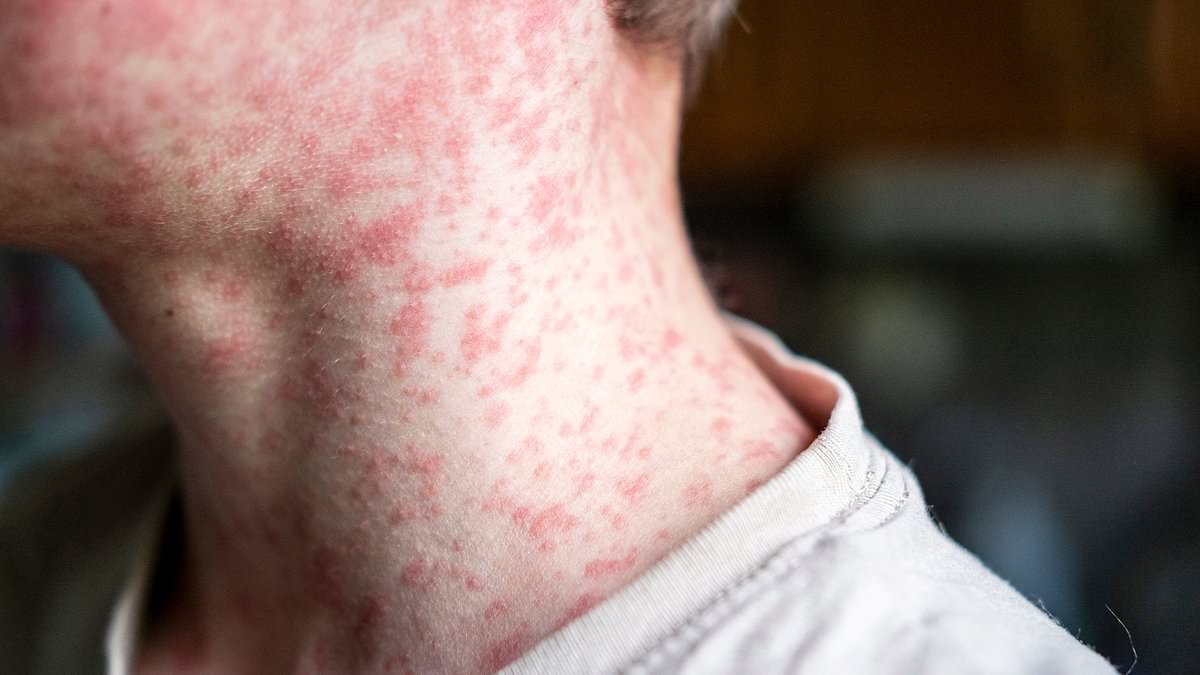
Cold-like symptoms, such as a fever, cough and a runny or blocked nose, are usually the first signal of measles. A few days later, some people develop small white spots on the inside of their cheeks and the back of their lips
Cold-like symptoms – including fever, cough, and a runny or blocked nose – are often the first signs. A few days later, some people develop small white spots inside the mouth, before the distinctive rash appears.
Vaccination uptake has been slipping for years, with coverage at around 92 per cent for the first dose and just under 85 per cent for the second.
Dr Vanessa Saliba, consultant epidemiologist at the UK Health Security Agency, warned: ‘Infections can return quickly when childhood vaccine uptake falls.
‘Measles elimination is only possible if all eligible children receive two MMRV doses before school and older children and adults who missed vaccination must be caught up.’
The NHS is now urging families to come forward and is offering the second dose earlier, bringing it forward to a new 18-month appointment.
A WHO spokesperson said the UK’s change in status reflects a wider problem unfolding across Europe.
It said: ‘Outbreaks of measles and other vaccine-preventable diseases are threats to health security in Europe, alongside antimicrobial resistance and other emerging threats.
‘Persistent immunity gaps led to a region-wide resurgence in measles and other vaccine-preventable diseases in 2024 and a decrease in the number of countries that have achieved or sustained measles elimination status.
‘Through strengthened surveillance, improved outbreak response, and focused efforts to reach under-vaccinated communities, all countries can achieve and sustain elimination.’
Experts warned the UK losing its measles elimination status was the inevitable consequence of a sustained drop in vaccination rates.
Prof Andrew Pollard, Director of the Oxford Vaccine Group, University of Oxford, said: ‘With thousands of cases of measles in the UK over the last few years, it was entirely expected that the UK would formally lose its measles elimination status before long.
‘To keep measles away we must sustain immunisation of over 95 per cent of children, but we haven’t done that.
‘This moment is a miserable reflection of the state of measles vaccination in the UK and a very alarming indication of the risk to our children from this potentially fatal disease.’
Others said the decision underlined both the deadly stakes of measles and the urgent need to boost uptake.
Dr David Elliman, Honorary Associate Professor in Child Health at UCL GOSH Institute of Child Health, said: ‘The loss of measles elimination status indicates that measles is circulating in the population… Any death is a tragedy, but more so when we have a very effective vaccine with a good safety profile.’
Measles typically starts as a flu-like illness followed by the tell-tale rash – but it can be deadly if it spreads to the lungs or brain.
One in five infected children will be hospitalised, with around one in 15 developing severe complications such as meningitis or sepsis.
The MMR vaccine has been offered to children in the UK since the late 1980s.
But uptake collapsed in the late 1990s and early 2000s after a now-discredited 1998 study by Andrew Wakefield falsely linked the jab to autism.
The claim triggered widespread fear, leading tens of thousands of parents to refuse the vaccine.
Earlier this year, Donald Trump’s Health Secretary Robert F Kennedy Jr vowed to ‘look at vaccines’ as he investigated rising autism diagnoses.
But in April, amid a measles surge in the US, RFK Jr performed a major about-face – saying the MMR jab is the ‘most effective way’ to prevent the potentially dangerous virus.