Share this @internewscast.com
Australia’s most prominent neo-Nazi group has been dealt a “significant” blow by proposed hate speech laws, experts say, while warning the movement is likely to adapt rather than vanish.
The proposed laws would allow the home affairs minister — with security and legal oversight — to ban groups found to be engaging in or advocating hate crimes based on race, nationality or ethnic origin, even if they fall short of the threshold for being designated a terrorist organisation.
Membership, recruitment and material support for such groups could then become criminal offences. Organisers would face up to 15 years in jail if found guilty of “intentionally” directing the activities of a listed hate group, while members could receive a seven-year prison sentence.
When flagging the reforms late last year, Home Affairs Minister Tony Burke said the consequences for such groups would “effectively be a very close to exact match” to those that currently apply to listed terror organisations.
After the proposed legislation was revealed on Tuesday, white supremacist group the National Socialist Network (NSN) said it would disband entirely by the end of the week, along with its “co-projects” White Australia, the White Australia Party and the European Australian Movement (EAM).
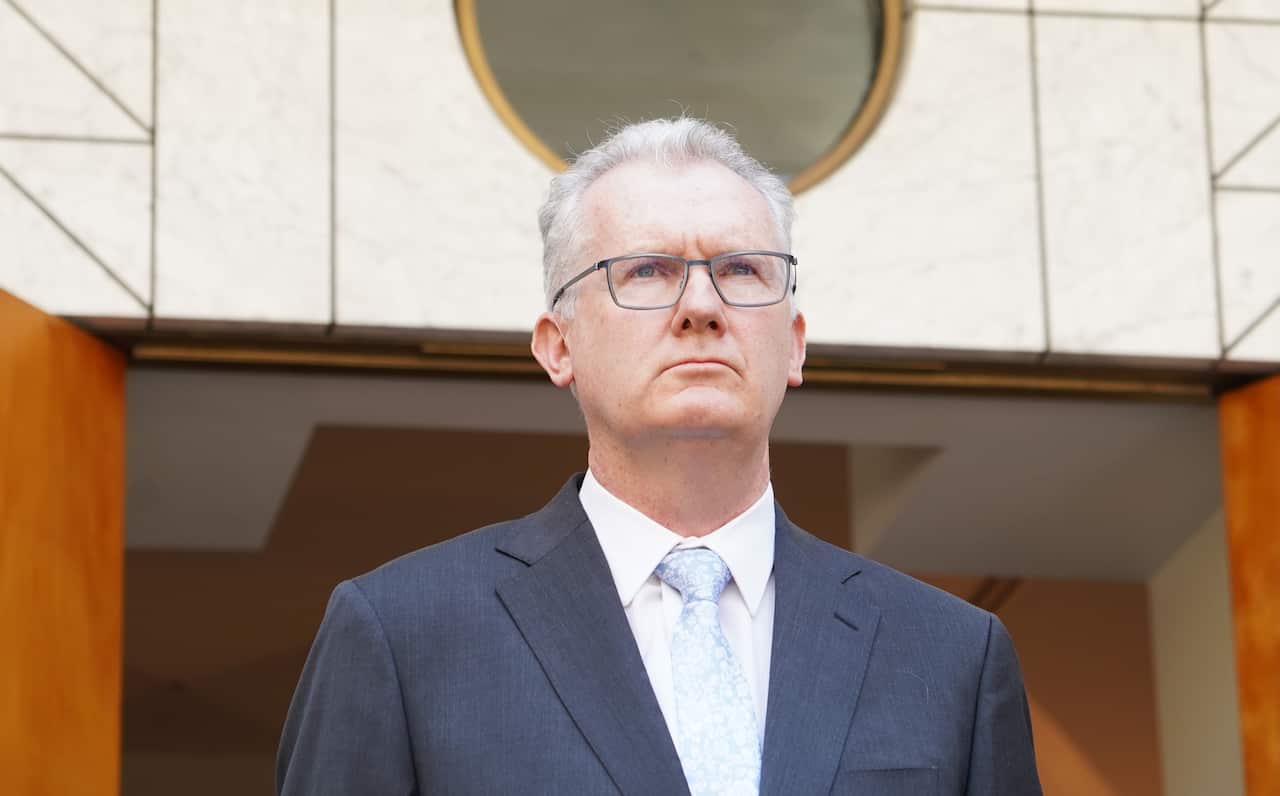
A man in a dark blue blazer, standing in front of a white building with brown doors.

Home Affairs Minister Tony Burke has reaffirmed his commitment to dismantling organizations that hold anti-Australian sentiments. This announcement comes amid developments surrounding the disbandment of the National Socialist Network (NSN), a group notorious for its advocacy of a white ethno-state rooted in Nazi ideology.

The NSN leadership has announced their decision to disband in anticipation of new laws that could lead to arrests and charges against its members. Although the group has never been officially designated as a terrorist organization, it has drawn scrutiny for its extremist views. The lack of evidence demonstrating active planning or advocacy for terrorist acts has previously kept the NSN off the proscription list.

In a recent statement on Telegram, Thomas Sewell, the leader of the NSN, alongside other senior figures, acknowledged that the proposed legislation would render them unable to avoid an official ban if it were passed by parliament. The group’s decision to dissolve is seen as a strategic move to evade the impending legal ramifications.

Minister Burke has previously suggested that the NSN, as well as the Islamist organization Hizb ut-Tahrir, could be targeted under the forthcoming reforms, which aim to curb extremist activities. Reflecting on these developments, Burke expressed optimism, stating, “That’s positive, that’s good news,” as he continues to push forward with his agenda to safeguard national security.

The legislation, assuming it passes, marks “the most significant bump in the road” the NSN had faced as an organisation, according to Jordan McSwiney, a senior research fellow at the University of Canberra’s Centre for Deliberative Democracy, who researches far-right politics.
“It seems that the game is up for a formal, openly neo-Nazi organisation in Australia for the time being,” McSwiney told SBS News.

“That’s positive, that’s good news.”

But McSwiney cautioned that the networks the NSN’s leadership have spent years building are unlikely to disappear, and could instead become “more diffuse and informal”.
This is something the federal government appears to be conscious of.
Burke said on Thursday, “Any day the Nazis take a step backwards is a good day”, arguing the group’s response showed the proposed legislation was both urgent and effective.

But he cautioned that while the laws would make it harder for them to organise, it did not mean “the hate in these individuals goes away”.

Efforts to build ‘community’

While it has primarily garnered attention for its public rallies, the NSN and its auxiliaries have also run activities such as martial arts-focused ‘active clubs’. There have also been concerns the group was organising ‘mothers’ groups’, which the Victorian government said in December it was investigating.
McSwiney said the NSN has been preparing for a moment like this for some time, and has made a concerted effort to build a “durable community of white supremacists” within. In announcing its plans to disband, the NSN made no mention of shuttering programs like its fitness groups.
Kaz Ross, an independent researcher on far-right extremism, agreed that the NSN had likely known for some time that such a move by the government was coming, having long specialised in walking up to the line of legality but not crossing it.
“They’ve taken a cold, hard look at what the legislation means for them, and noted that there’s no wriggle room at all for them,” she told SBS News. The decision to disband, she said, was presumably to preserve future opportunities to reform.

“I think they perhaps naively and wrongly believe that by not existing by Sunday night, they’ll escape being proscribed. I think Tony Burke’s going to proscribe them anyway, and that will stymie their efforts to form a new political structure.”

The NSN’s move follows a year in which it took strides to increase its public visibility.

“They were moving into a new stage of populism and building,” Ross said. “Hopefully this sets them back quite significantly, but I think they will re-emerge”.

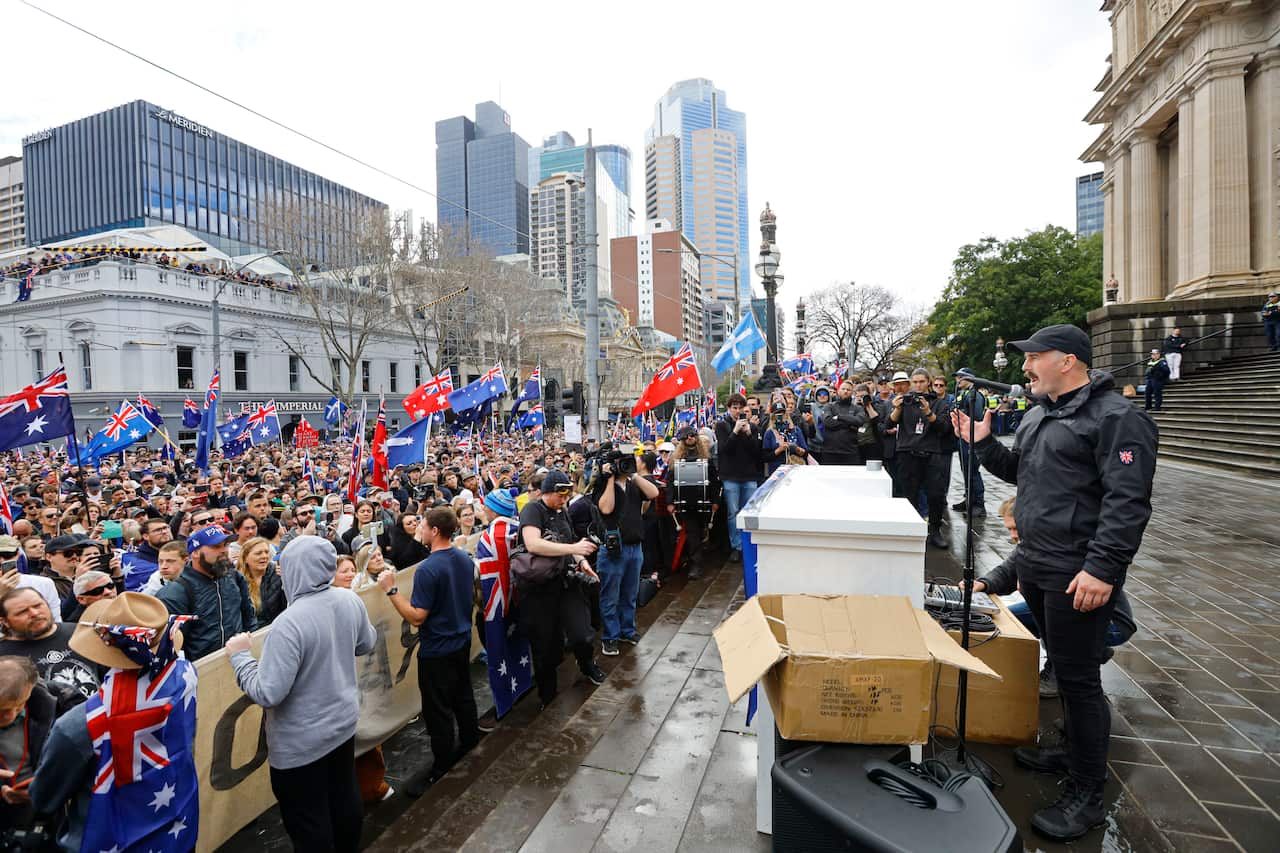
A man speaking on the steps of a building to a large crowd of people, many holding Australian flags.

National Socialist Network leader Thomas Sewell addressed thousands of people at the anti-immigration March for Australia rally in August last year. Source: Getty / SOPA Images / LightRocket / Ye Myo Khant

Labor MP Josh Burns said it was a “fundamentally good thing” the NSN had said it would disband in the wake of the draft legislation, but that the group and its members would continue to be monitored.

“I don’t trust their public statements for one second,” Burns told ABC radio on Wednesday. “So we’ll have to make sure that the organisation and the members aren’t continuing to promote or recruit.”

Opposition home affairs spokesperson Jonathon Duniam has also expressed concern the group could avoid accountability by “tearing down a banner and re-emerging under a different name”.

‘Definitely a headache for them’

It remains to be seen what scope the final legislation might have for banning new entities, but Ross said for its core members: “There’s nothing that you’re going to do to change their aim, which is to turn Australia into a whites-only, white supremacist country.”
“They will continue to try to find a way,” she said.
If the organisation re-emerged in some fashion, it wouldn’t be the first time. The NSN and EAM’s dissolution follows the collapse of earlier incarnations, such as the Lads Society, United Patriots Front, and Reclaim Australia.

Notably, one of the “co-projects” the organisation said would shut down in its announcement was the White Australia Party — the planned political party it spent much of last year seeking to bolster support for in its efforts towards legitimacy.

In November, senior NSN member Jack Eltis claimed the group had reached 1,500 enrolled members required by the Australian Electoral Commission (AEC) for a party to register. On Wednesday, Eltis said it had been planning to send out membership affirmations this weekend and submit documentation to the AEC later this month. Now, those aspirations appear to have met a dead end.
“They’ve put a lot of time and effort into building this infrastructure, this organisational infrastructure, particularly around building to try and get a party registered, and this seems to be putting at the very least a pin in that for now, and that I think is quite a positive development,” McSwiney said.
He, like Ross, believes key figures from the NSN will likely eventually try to launch another organisation to avoid falling foul of the proposed legislation.
“In the meantime, there’s still lots of other spaces for them to be involved in organised racist activism.
“It’s not clear the extent to which this will inhibit committed members of the group from continuing in their activity, just outside of the formal structures of the organisation. But I think it will make it more difficult to recruit new members, for example. It will definitely be a headache for them.”

Share this @internewscast.com
You May Also Like
Colin Gray, the father of Apalachee High School shooting suspect Colt Gray, reacts after a jury convicted him of second-degree murder and involuntary manslaughter at Barrow County Courthouse in Winder, Ga., Tuesday, March 3, 2026. (Abbey Cutrer/Atlanta Journal-Constitution via AP, Pool)

U.S. Father Found Guilty After Son Uses Gifted Gun in School Shooting Tragedy

A father in the United States has been convicted of murder and…

UN Demands Urgent Investigation into Heinous Attack on Iranian Girls’ School

In brief The school in southern Iran was hit on Saturday, the…
Arrest made in cold case disappearance of AFL great's brother

Breakthrough in Cold Case: Arrest Made in Disappearance of AFL Legend’s Brother After Decades

Police have arrested a man in relation to the 14-year-old cold case…

Queensland’s North Braces for Impact: Cyclone Warning Issued Amid Ongoing Rain Challenges

In brief A topical low pressure system northeast of Cooktown is making…

Australians Seek Unity Amid Deep National Divisions

Social cohesion in Australia is facing significant challenges, with recent surveys indicating…
An exterior shot of BrewDog DogTap in Murarrie, Brisbane is one of five BrewDog locations in Australia.

Australian Pubs and Employment Secure Amid UK Company’s Major Workforce Reduction

Despite recent closures and staff layoffs in the UK, Australian BrewDog pubs…

Australia Unveils Significant Visa Fee Hike to $2,300: Everything You Need to Know About the Latest Changes

The Australian government has announced a significant increase in application fees for…
Victorian work from home laws

Victoria’s New Work-From-Home Laws: What You Need to Know

The Victorian government is pushing ahead with its work-from-home laws, meaning millions…
Donald Trump is under increasing pressure over his war with Iran.

Is This the Biggest Challenge Trump Faces in the Iran Conflict?

The market downturn shows no signs of abating. Donald Trump is under…

Israeli President Isaac Herzog Tours ASIO Headquarters on Australia Trip

During his recent state visit, Israel’s President Isaac Herzog made a noteworthy…
A furious Thom Tillis demanded Kristi Noem's resignation.

Republican Senator’s Bold Stand: Potential Blockade on Trump Agenda Sparks Political Tension

Clearly frustrated, Tillis criticized Noem sharply for the wrongful detention of American…

Iran’s Alarming Nuclear Warning Sparks US Concerns: What You Need to Know

Israel has initiated a strategic deployment of troops into southern Lebanon, marking…