Share this @internewscast.com
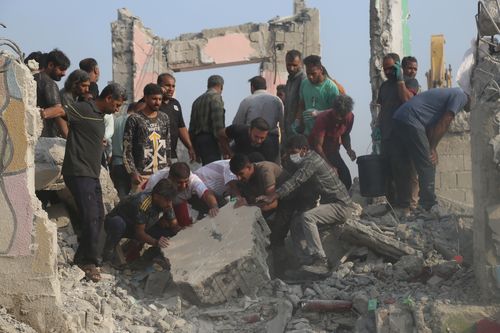
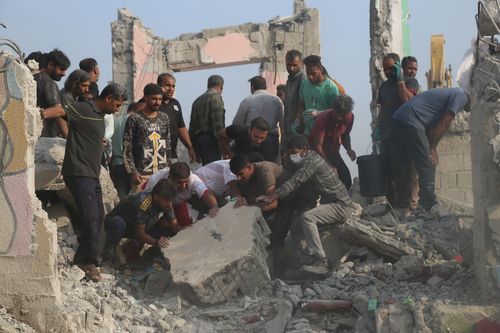
Recently surfaced footage reveals what a renowned investigative group suggests is likely a U.S. Tomahawk missile striking a site in southern Iran. The target lay mere meters from a school where a tragic, unclaimed explosion claimed over 165 lives at the onset of the ongoing Middle Eastern conflict.
This new evidence increasingly implicates the United States in the February 28 attack, which impacted a school located next to a Revolutionary Guard base in Minab, situated in Iran’s southern Hormozgan Province. Experts consulted by The Associated Press, leveraging satellite image analysis, indicate that the school was likely hit amidst a rapid series of bombardments on the compound.
An informed U.S. official, who opted to remain anonymous due to the sensitive nature of the topic, confirmed to the AP that the strike was probably American. This official was not authorized to publicly discuss these internal deliberations.

The footage, initially evaluated by the investigative team Bellingcat, was captured on the same day the school was attacked and later disseminated on Sunday by Iran’s semi-official Mehr news agency. The video captures a missile striking a structure, with a thick plume of smoke rising into the sky.
The Associated Press successfully geolocated the footage, confirming it was filmed from a location adjacent to the school, with smoke already billowing from the area. Satellite images of the compound align with features present in the footage, such as a flat-roofed building, power lines, and nearby vehicles.
Bellingcat researcher Trevor Ball identified the weapon as a Tomahawk cruise missile, a munition that only the U.S. is known to deploy in this conflict. This marks the first confirmation of the type of weapon used in the attack.
US Central Command has acknowledged using Tomahawk missiles in this war and even released a photo of the USS Spruance, part of the USS Abraham Lincoln aircraft carrier group located within range of the school, firing a Tomahawk missile on February 28.
Bellingcat said the footage “appears to contradict” US President Donald Trump’s claim that Iran was responsible for the deadly school blast. Neither the US military’s Central Command nor the Israeli military immediately replied to requests for comment from the AP.
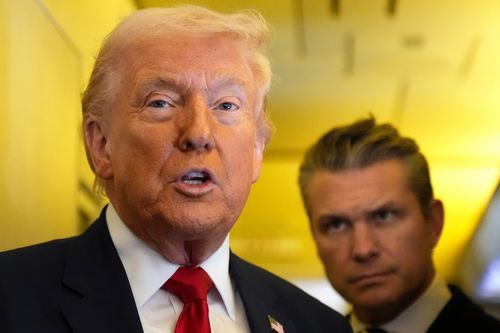
When asked by a reporter on Saturday whether the US was responsible for the blast, which killed mostly children, Trump responded, without providing evidence: “No, in my opinion, based on what I’ve seen, that was done by Iran.” Trump added that Iran is “very inaccurate” with its munitions. Defence Secretary Pete Hegseth quickly chimed in to say the US was investigating.
Several other factors point to a US strike.
One is the launching of an assessment of the incident by the US military. According to the Pentagon’s instructions on processes for mitigating civilian harm, an assessment is launched after a group of investigators make an initial determination that the US military may bear culpability.
Another is the location of the school â next to the Revolutionary Guard base and close to barracks for a naval unit. The US military has focused on naval targets and acknowledged strikes in the province, including one in the vicinity of the school. Israel, which has denied conducting the strike, has focused on areas of Iran closer to Israel and hasn’t reported any strikes south of Isfahan, 800 kilometres away.
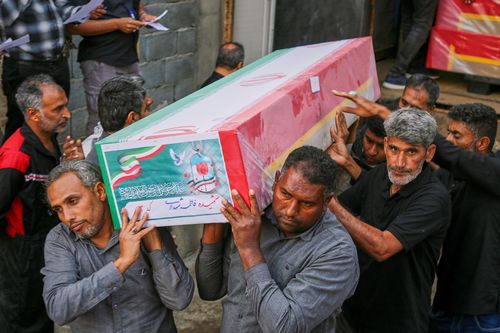
Complicating any assessment of the incident is the lack of images of bomb fragments from the blast. No independent agency has reached the site during the war to investigate.
Janina Dill, an expert on international law at Oxford University, wrote on X that even if the strike was a misidentification â and the attacker believed that the school had been a part of the neighboring IRGC base â it would still be “a very serious violation of international law”.
“Attackers are under an obligation to do everything feasible to verify the status of targeted object,” she wrote.
The Trump administration, however, strikes a different tone on international humanitarian law.
Speaking about the US operation at a press conference March 2, Hegseth said: “America, regardless of what so-called international institutions say, is unleashing the most lethal and precise air power campaign in history.”
“No stupid rules of engagement,” he said. “No politically correct wars. We fight to win, and we don’t waste time or lives.”
NEVER MISS A STORY: Get your breaking news and exclusive stories first by following us across all platforms.