
Share this @internewscast.com
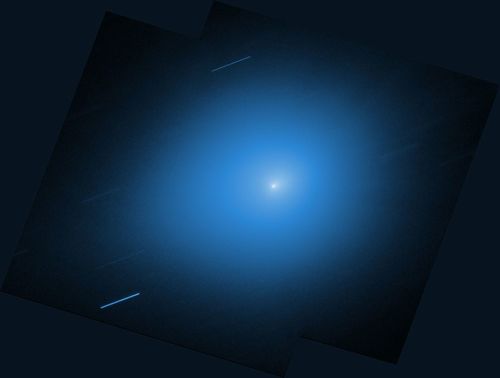
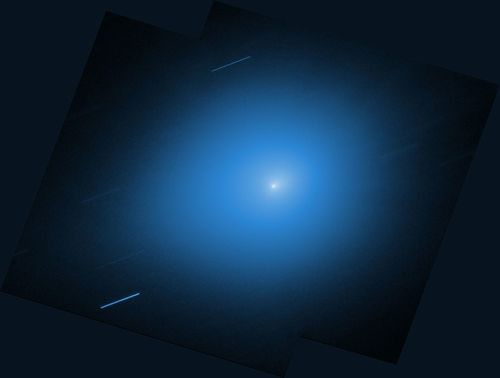
In an exciting development for astronomers, both the Hubble Space Telescope and the Jupiter Icy Moons Explorer have recently provided new images of an interstellar comet as it prepares for its closest approach to Earth this month.
Discovered in July, Comet 3I/ATLAS has piqued the interest of scientists worldwide. Originating from beyond our solar system, its unexpected journey through our cosmic neighborhood makes it a rare spectacle. So far, it is only the third interstellar object to have been observed traversing our solar system, prompting a flurry of focused astronomical studies.
On November 30, astronomers utilized Hubble’s Wide Field Camera 3 to capture a sharper image of 3I/ATLAS from a distance of 178 million miles (286 million kilometers) away from Earth. This enhanced observation offers a clearer view of the comet’s features.
Adding to the intrigue, the European Space Agency’s Jupiter Icy Moons Explorer, or Juice, which is currently on its way to study Jupiter and its icy moons, has also snapped a fascinating image of the comet. This mission aims to explore the potential habitability of Jupiter’s three largest moons: Ganymede, Callisto, and Europa.
Meanwhile, an image taken by the European Space Agency’s Jupiter Icy Moons Explorer, or Juice, mission en route to study Jupiter and its icy moons, shows intriguing activity around the comet.
The Juice mission will investigate the potential habitability of Jupiter’s three largest moons, Ganymede, Calliston and Europa.
The moons likely host subsurface oceans beneath their icy crusts that could support life.
But first, Juice has to reach Jupiter. The mission launched in April 2023 and is expected to arrive at its destination in July 2031.
And at the beginning of November, Juice was in a prime position to observe 3I/ATLAS from about 41 million miles (66 million kilometres) away from the comet.
The spacecraft used five of its scientific instruments, as well as its onboard Navigation Camera, or NavCam, to glimpse the comet.
Most of Juice’s data won’t arrive on Earth until February because the spacecraft is using its main antenna as a heat shield to protect it from the sun during its long journey to Jupiter.
A smaller antenna is sending back data at a fraction of the rate.
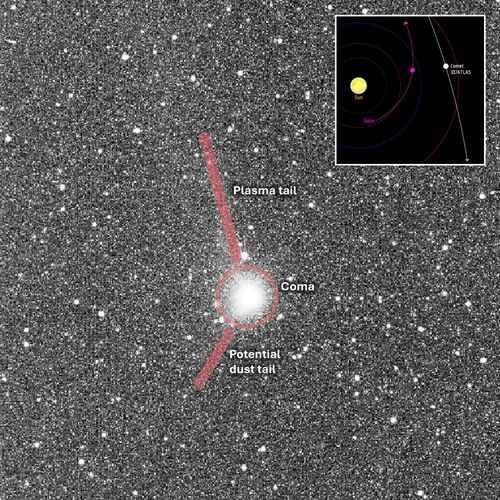
The Juice team didn’t want to wait that long, so they downloaded a quarter of a single image taken by NavCam.
The image shows heat-driven activity on the comet during its close pass by the sun.
The newly released image shows a coma, or a glowing halo of gas surrounding the comet, as well as two tails: a plasma tail composed of electrically charged gas, as well as a faint dust tail of solid particles being released.
Comets that originate in our solar system typically have both of these tails, as well as a hazy coma surrounding a solid core made of rock, gas, dust and ice leftover from the formation of the sun, planets or other celestial bodies.
As comets approach stars like our sun, they heat up, forming tails of sublimating material that streak behind them.
Comet 3I/ATLAS will come within 167 million miles (270 million kilometres) of Earth on December 19, but it will be on the other side of the sun and poses no risk to our planet.
For reference, Earth is about 93 million miles (150 million kilometres) from the sun.
The comet is expected to remain visible to telescopes and space missions for a few more months before exiting our solar system, according to NASA.
The rest of the Juice data from the comet’s flyby, expected between February 18 and 20, should include images from the spacecraft’s high-resolution optical camera, as well as composition and particle data that could provide more clues about where the interstellar object originated.