
Share this @internewscast.com
With food waste driving a measurable share of Australia’s emissions, efforts to divert it from landfill start in unexpected places — including a Sydney warehouse where startup founder Olympia Yarger is busy sweeping up mouldy bread.
Yarger is hands-on at her factory in the city’s west, where piles of discarded vegetables and stale loaves arrive daily from supermarkets and food producers.
Yarger, a sheep farmer turned entrepreneur, has built her business around keeping this waste out of landfills.
“We’ve developed a technical system that accepts and manages food waste using insects,” she told SBS News.

At the heart of a pioneering initiative are automated, modular farms employing black soldier fly larvae, more commonly known as maggots, to transform food waste into valuable animal feed and fertilizer.
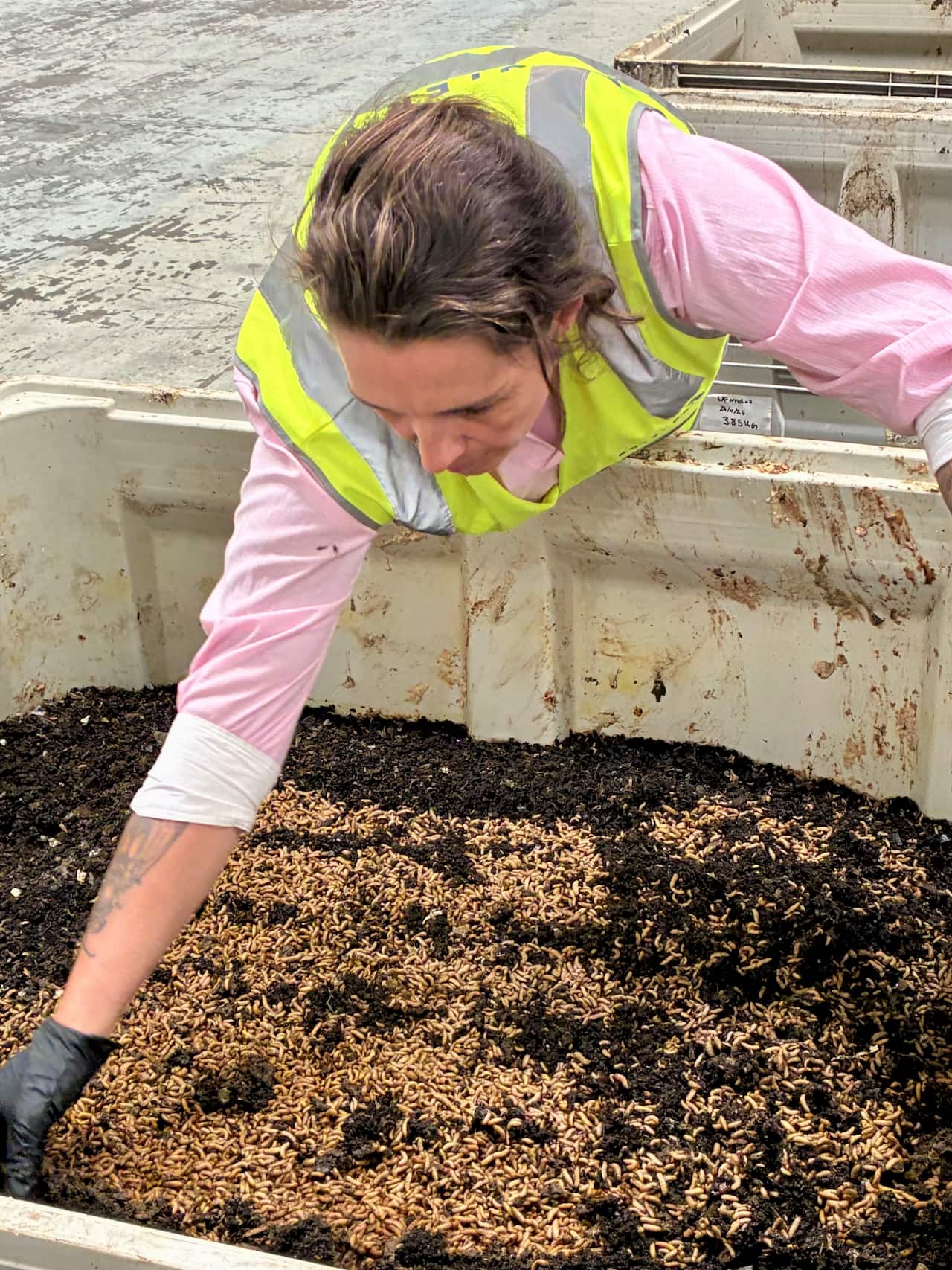
A woman in a pink shirt and hi vis vest leans over a white plastic crate filled with maggots.

Olympia Yarger, who transitioned from sheep farming to entrepreneurship, has established a business aimed at diverting food waste from landfills. Her efforts focus on sustainable solutions to reduce environmental impact.

Yarger acknowledges that the idea of using maggots might make some people uneasy. However, the environmental benefits speak for themselves.
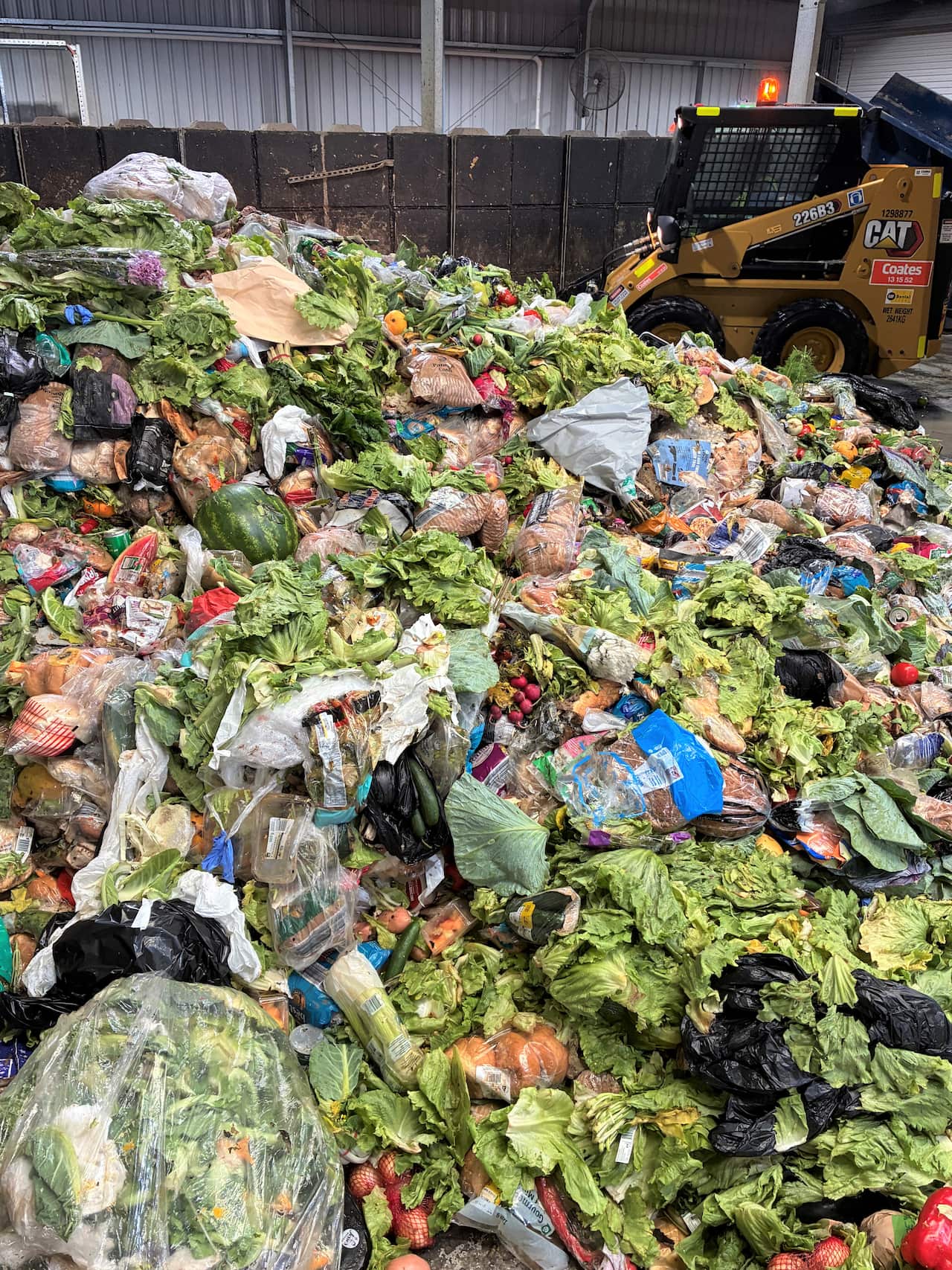
A mound of food waste including green vegetables and bread.

According to the Department of Climate Change, Energy, the Environment and Water, food waste is responsible for roughly 3% of Australia’s yearly emissions. This significant statistic underscores the urgent need for effective waste management solutions.

Australia faces an enormous challenge with over 7.6 million tonnes of food waste produced annually, which incurs a staggering economic cost of more than $36.6 billion each year.

Australia is facing ‘a landfill crisis’

One reason for the shift is simple: we are running out of space.
“There is a landfill crisis and we will run out of landfill capacity by 2030,” Geddes said. 

“Between one quarter and one third of all the waste generated is food waste. We need to keep this out of landfills.”

According to federal government projections, halving food waste by 2030 could deliver a net economic benefit of $58 billion.
For Yarger, that transition is already evident on her factory floor, where tonnes of spoiled produce arrive each week. The work starts with shovelling and sorting — and ends with waste that never reaches landfill.
At the company’s Wetherill Park facility, portable crates full of fly larvae grow fat on the leftover food.
“The insect part is not unique; there are great companies across the world that have been using insects as a food waste solution. However, we are the first in the world to commercially manage food waste as a boxed solution,” Yarger said.
“We created a box that’s a unit of processing capacity. So, one box can process 1.7 tonnes of food waste a day. 
“We can take a box to someone’s business and manage their waste on site.”

The clever system allows her business, Goterra, to address the food-waste problem while also turning a profit.
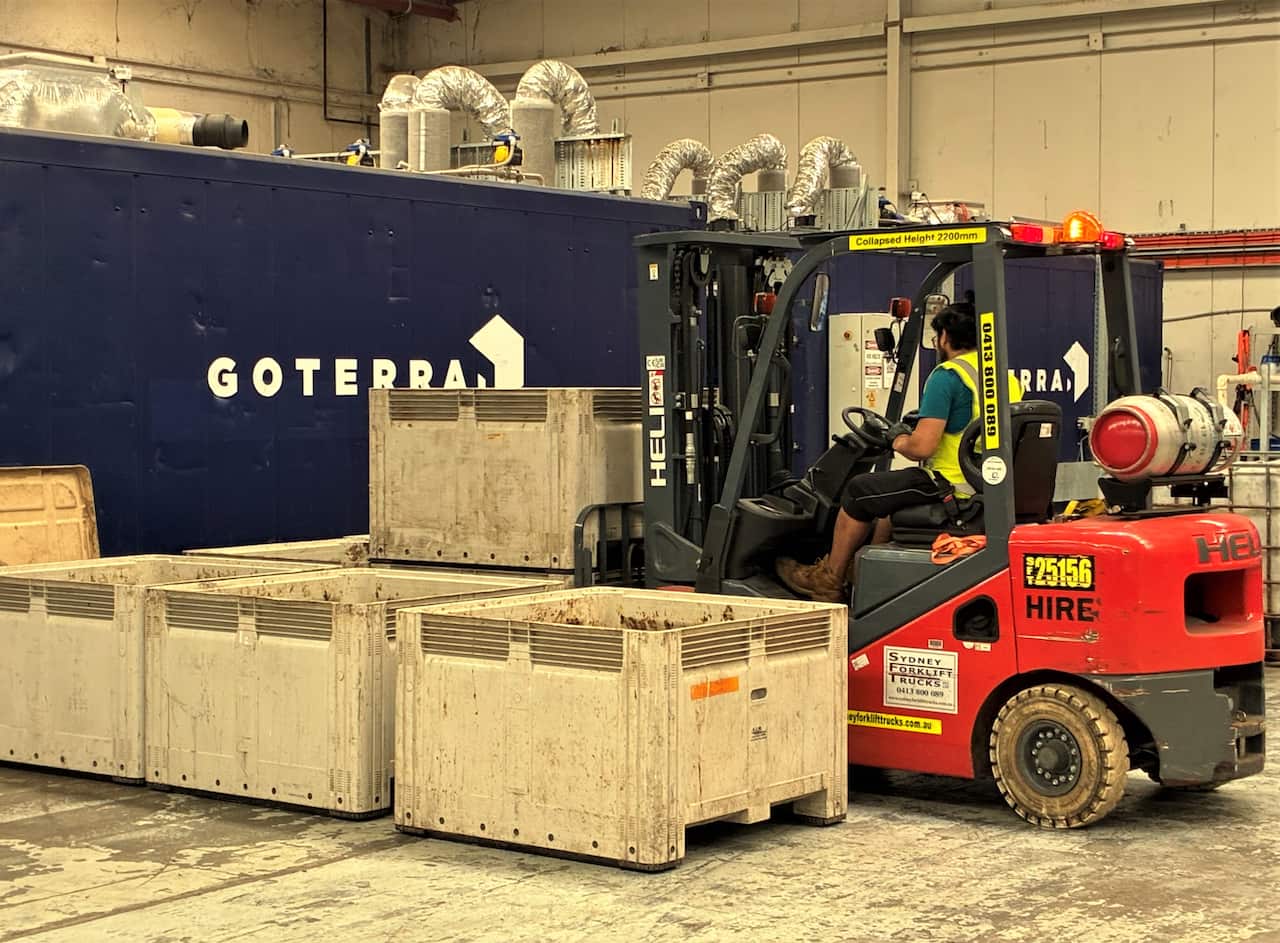
A bobcat moves white crates around a factory floor.

Halving food waste by 2030 is expected to deliver a net economic benefit of $58 billion, according to government projections. Source: SBS / Sandra Fulloon

Larvae are placed into crates at five days old and, over 12 days, produce nutrient-rich fertiliser for farms. Before the larvae mature into flies, they are converted into poultry feed.

Justin Frank, Goterra’s chief sustainability officer, told SBS News: “The chickens love it. They are designed to eat larvae and bugs, and the feed is really good for their gut health.”

“The feed is also full of amino acids which are essential for chickens to produce eggs.”

The ‘biggest’ problem is contamination

Despite the benefits of turning food waste into fertiliser and feed, the sector faces significant challenges.
“The biggest problem for food waste treatment and management is contamination,” Bai said. 
“Contamination levels are rising. We’re not just finding metals and glass in the waste, we are also seeing PFAS and microplastics. And this is introducing a real risk for composting and anaerobic digestion.”
This is why the EPA is calling for better sorting habits.
“The rules are incredibly clear. Only food waste and food scraps go into source separation — no plastics, no metals, nothing else,” Geddes said.

“This is what businesses must do when mandates come in next year because it is so important to keep the stream of organic material clean for products like compost.”
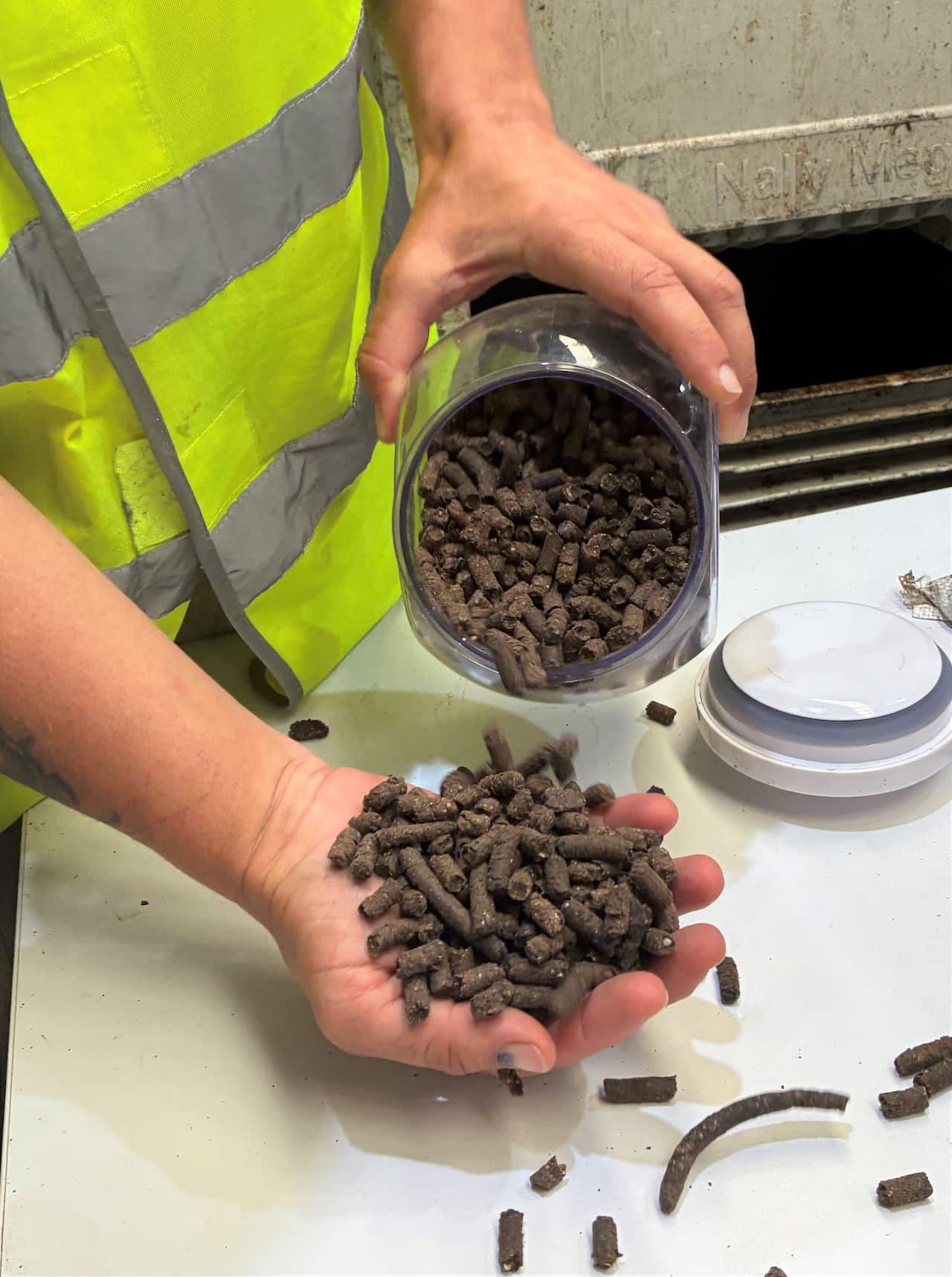
A hand holds brown pellets of fertiliser being poured from a glass jar.

Fertiliser produced by fly larvae can be used on farms and gardens. Source: SBS / Sandra Fulloon

Yarger is now preparing for major national expansion. From one small bucket in her garage in 2016, her business has grown to seven sites across four states.

“Next, we are expanding in Victoria and building out the network in Sydney with three new sites and then we are going into Western Australia,” she said.
Yarger is flipping the script on Australia’s waste of a food resource that is costly to produce and then costly to dispose of.
“So, if we can leverage technology to create a circular economy, we win at both ends of our value chain,” she said.

Share this @internewscast.com
You May Also Like
Strait of Hormuz

Iran Escalates Tensions with Strategic Strait of Hormuz Assault: What This Means for Global Diplomacy

Iran fired on three ships in the Strait of Hormuz on Wednesday,…
These photos of Harry and Meghan could land Aussies in hot water

Aussies Face Legal Risks Over Unauthorized Harry and Meghan Photos: What You Need to Know

Exclusive: Small businesses jumping on a seemingly harmless celebrity AI trend could…
Minister for Health and Ageing and Minister for Disability and the NDIS Mark Butler ahead of an address to the National Press Club of Australia in Canberra on Wednesday 22 April 2026. fedpol Photo: Alex Ellinghausen

NDIS Implements Major Crackdown to Combat Fraud and Misuse

Health Minister Mark Butler delivered the sweeping changes in a National Press…
How nuclear power plant neighbours could be in for a cash windfall: Peter Dutton reveals specific details of his energy plan - as the seven Aussie sites are named

Peter Dutton Unveils Energy Plan: Find Out Which Aussie Towns Near Nuclear Sites Could Benefit Financially

Dutton’s pitch to the public: ‘A long term energy plan’ Peter Dutton…
Millions of Aussies will commemorate Anzac Day this Saturday

Melbourne Nightclub Defends Controversial Anzac Day Event Amid Public Criticism: ‘It’s Within Legal Rights

A well-known nightclub is responding to criticism regarding its controversial decision to…

Wong’s Diplomatic Blitz: Albanese Cautions Australians on Prolonged War Impact

IN BRIEF Penny Wong has held urgent talks with global counterparts as…
Man sentenced to 11 years in prison over unprovoked stabbing spree

Justice Served: Man Receives 11-Year Sentence for Shocking Unprovoked Stabbing Rampage

A man who carried out a series of unprovoked stabbing attacks on…
Paolo Zampolli is a long-time friend of Donald Trump.

Trump Envoy Proposes Bold World Cup Swap: Italy to Replace Iran in Global Tournament

Paolo Zampolli, acting as a special envoy for global partnerships, recently shared…

Iran Holds Off on US Peace Talks: Uncertainty Looms Over Potential Dialogue

in brief Iran has lifted and then reimposed its own blockade of…

Renters Reach Breaking Point Amid Significant Market Shift

Brief Renters have hit an affordability ceiling, signalling a market shift, according…
Mr Mohamed was in Hawaii  for the Festival of Pacific A

Anthony Albanese’s Early Confidence in the Voice: Creating an Ambassadorial Role for Global Advocacy Before Australia’s Rejection

Anthony Albanese was so sure of the Indigenous Voice to Parliament’s success…
Eddie Osei-Nketia has recorded the fastest-ever 100 metre sprint time by any Australian in history

Meet the Record-Breaking Aussie Sprinter Who Achieved Lightning Speed Chasing His American Football Dream

Australia’s sprinting scene has found a new star in Eddie Osei-Nketia, who…