
Share this @internewscast.com
In the wake of internet blackouts and restricted phone communications within Iran, assessing the scale and intensity of the ongoing protests from an international perspective has become increasingly challenging. Despite these communication barriers, reports from the US-based Human Rights Activists News Agency indicate that the death toll from the protests has risen to at least 72, with over 2,300 individuals detained.
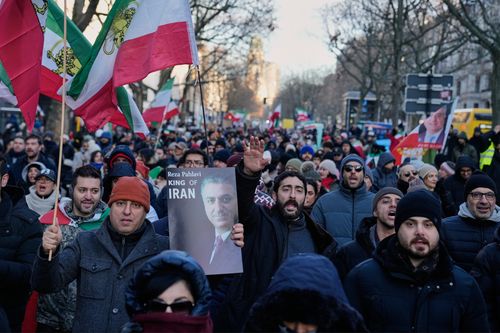
Amidst the turmoil, some protesters have been encouraged to display Iran’s historical lion-and-sun flag and other national symbols reminiscent of the pre-1979 shah era. This call to action aims to reclaim public spaces and express dissent against the current regime.
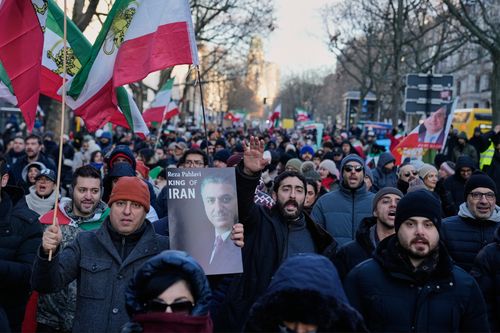
However, the involvement of Reza Pahlavi, son of the former shah, has stirred controversy. His past support from Israel, particularly following the recent 12-day conflict, has been a point of contention among critics.
While chants in favor of the shah have been heard during some demonstrations, it remains ambiguous whether these slogans reflect genuine support for Pahlavi himself or a nostalgic longing for the era preceding the Islamic Revolution.
Despite the challenges in communication, online videos suggest that protests persisted into Saturday night, showcasing the resilience and determination of the demonstrators.
Online video purported to show protests ongoing on Saturday night as well.
The demonstrations began on December 28 over the collapse of the Iranian rial currency, which trades at over 1.4 million to $US1 ($1.50), as the country’s economy is squeezed by international sanctions in part levied over its nuclear program.
The protests intensified and grew into calls directly challenging Iran’s theocracy.
Airlines have cancelled some flights into Iran over the demonstrations. Austrian Airlines said Saturday it had decided to suspend its flights to Iran “as a precautionary measure” through Monday.
Turkish Airlines earlier announced the cancellation of 17 flights to three cities in Iran.
Meanwhile, concern is growing that the internet shutdown will allow Iran’s security forces to go on a bloody crackdown, as they have in other rounds of demonstrations.
Ali Rahmani, the son of Nobel Peace Prize laureate Narges Mohammadi who is imprisoned in Iran, noted that security forces killed hundreds in a 2019 protest “so we can only fear the worst”.
“They are fighting, and losing their lives, against a dictatorial regime,” Rahmani said.