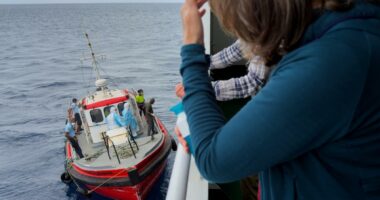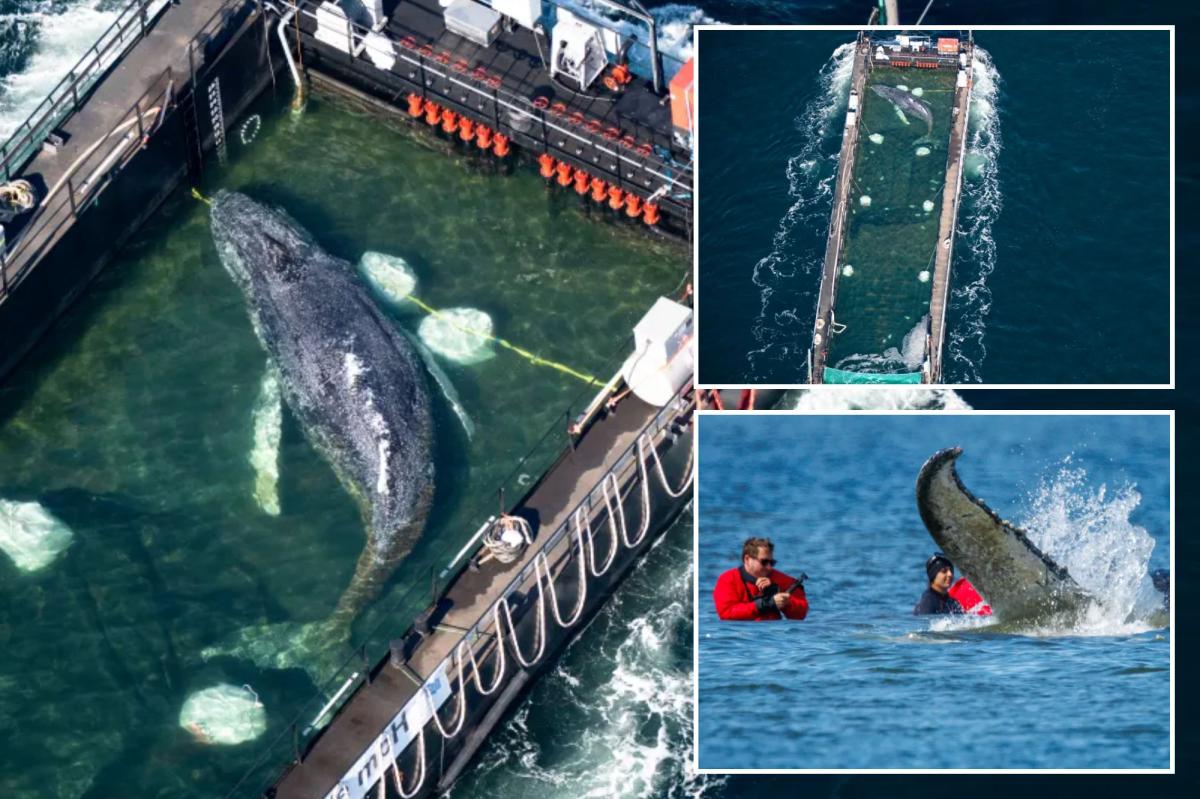


On Saturday, a rescue team successfully freed a humpback whale that had been trapped on a barge in the North Sea, after being stuck in shallow waters near Germany since March, according to eyewitnesses.
The whale, affectionately named Timmy by local German media, was first observed on March 3 swimming near Germany’s Baltic Sea coastline, far from its usual home in the Atlantic Ocean.
Timmy’s health began to decline as he repeatedly became stranded in the shallow waters close to Wismar, a coastal city. Efforts to guide him back to deeper waters were broadcast live worldwide, capturing global attention.
Despite some scientific concerns that the rescue effort might overwhelm the whale, the environment minister of Mecklenburg-Western Pomerania in Germany approved the rescue plan put forward by a private group.
Jens Schwarck, a participant in the rescue initiative, reported to the German news agency dpa that the whale was released at approximately 9 a.m. local time.
According to the agency, the whale was set free about 70 kilometers, or roughly 45 miles, off the coast of Skagen, Denmark.
Drone footage showed a whale swimming and spouting water near the barge, though it was not immediately confirmed that the animal was indeed Timmy.
A debate emerged about whether to let the whale die in peace or try to assist its return to the Atlantic Ocean.
Activists staged protests on the beach in Wismar calling for its liberation, while others have supported new ideas about how the whale could be transported.
Some scientists believe the whale had searched for shallow waters because it was weak and needed rest. The veterinarians of the private initiative, however, considered the animal fit for transport.
Before the release, a GPS transmitter was reportedly attached to track the whale’s future location, according to dpa.
It is not clear why the whale swam into the Baltic Sea, far from its natural habitat in the Atlantic Ocean.
Some experts say the animal may have lost its way while swimming after a shoal of herring or during migration.
Since then, the mammal became repeatedly stranded in shallow waters. It was in clear distress, breathing irregularly and often barely moving for days.
Timmy also suffered from a bad skin condition, related to the Baltic Sea’s low salt content, and rescuers applied pounds of zinc ointment.
Local media produced dayslong livestreams to feed the outsized public attention over the fate of the whale.
Online newspapers blasted push alerts with the smallest developments about Timmy’s health.