
Share this @internewscast.com
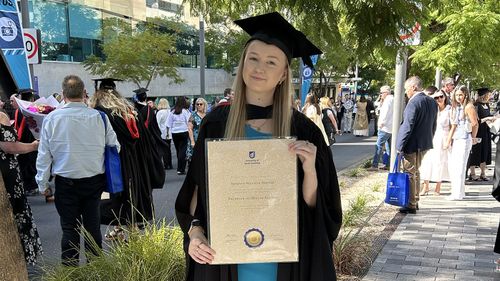
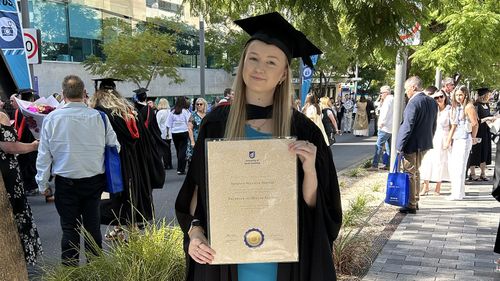
Sharyce Helyar looks perfectly healthy but she hasn’t been able to work in years.
The 27-year-old from Adelaide lives with arthritis, which stands as the second most common reason for taking time off work in Australia, right after traumatic injury.
It’s also the second most common cause of early retirement due to ill-health.
By 2030, the loss of personal income due to arthritis is projected to hit $2.6 billion.
However, many Australians still erroneously believe that someone Helyar’s age couldn’t possibly have arthritis, even though she’s been managing the condition for more than 20 years.
Nearly 65 percent of Australians incorrectly assume that arthritis predominantly affects individuals over 65, as revealed by new YouGov polling commissioned by Arthritis Australia.
But two-thirds of the 4.11 million cases in Australia are in working-age adults, young people and children.
In fact, Helyar was just four when she was diagnosed with juvenile idiopathic arthritis.
She was later diagnosed with psoriatic arthritis as well and has been been managing joint pain, swelling, stiffness, and fatigue ever since.
This ailment held her back during school, and although she made efforts to persevere at university, it eventually compelled her to discontinue her degree in medical radiation science.
“I think there was a lot of pressure I put on myself because I wanted to be a normal young adult, and I wanted to have the uni experience,” Helyar shared with 9news.com.au.
“I didn’t want my arthritis, my disability to stop me from doing that.”

More than 70 percent of Australians underestimate the impact of arthritis and fail to recognize that it, along with other musculoskeletal conditions, is a leading cause of time taken off work.
For almost four years of study, Helyar underestimated it too.
She thought she was managing her pain and fatigue well at uni, only to land in the emergency department in her fourth year.
Her body could no longer keep up with the physical demands of her degree placements.
Ultimately, Helyar had to give up on her dream of a career in medical radiology.
“My body just wasn’t able to do what I physically wanted it to do,” she said.
“I had to reassess everything in my life, which was really confronting and scary, and a lot of grief went with it, because I had my life mapped out out and now it all had to change.”
The five qualifications in hot demand for Australia’s future jobs
The university worked with Helyar to help her graduate with a different degree but her arthritis has made it impossible for her to enter her chosen industry.
She’s also been unable to return to part-time or gig work she did while studying.
After 22 years with arthritis, permanent damage has been done to her joints and the pain and stiffness she experiences has become harder to manage.
The fatigue has become so severe Helyar can usually only leave the house twice a week before her body gives out.
”I’m unable to work until I find a solution,” she said.
“And there might not be a solution for my pain, and my fatigue might not get better.”
Arthritis is incurable, so Helyar’s chances of entering the workforce are limited by her treatment options.
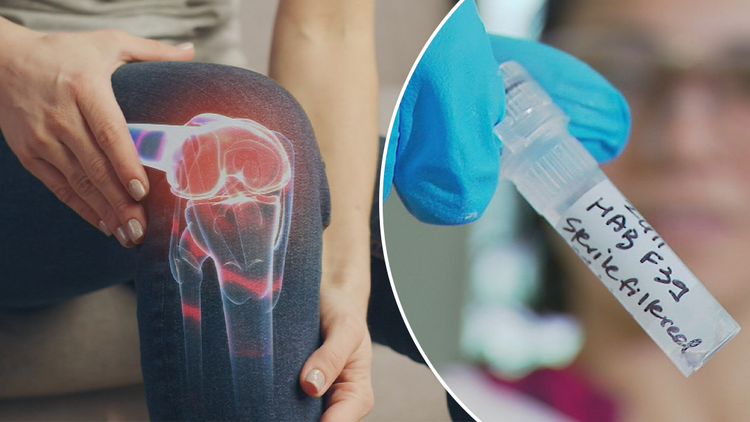
But funding for arthritis research is limited and not being able to earn a living in a cost of living crisis is a scary prospect.
Helyar is just one of the 2.8 million working-age Australians living with arthritis who face uncertain futures.
By 2030, the loss of personal income due to arthritis is projected to hit $2.6 billion, costing the government more than $1.1 billion a year in extra welfare payments and lost taxation revenue.
Lost GDP from arthritis-related early retirement is expected to reach $9.4 billion a year by 2030 as well.
Even if Helyar was able to work, there’s no guarantee that employers would be undersanding of her health needs.
In the past, Helyar chose not to disclose her condition to employers out of fear they would make assumptions about her ability to do a job.

”People make the assumptions and you can see that they’re thinking something, even if they don’t actually say it,” she said.
“There’s definitely a lot of misconceptions about arthritis being an ‘older person’ condition, people just aren’t aware that it affects people of all ages and in a variety of ways.”
Those misconceptions go beyond the workplace as well.
Some people assume that because she’s young, her arthritis must be less painful or more manageable.
Others judge her when they see her using mobility aids like a wheelchair when her symptoms make it hard to walk.
But arthritis can be just as debilitating for a 20-something as it can be for someone in their 80s.
Since her health declined at uni, Helyar has had to move back home and currently relies on her family for support with everyday tasks like cleaning, shopping and laundry.
It’s a far cry from the radiology career she had envisioned for herself, but she’s found new purpose through advocacy.
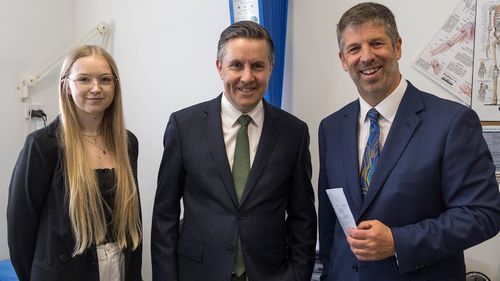
This week she even attended a parliamentary event alongside Prime Minister Anthony Albanese to raise awareness of the impact arthritis has on Aussies of all ages in recognition of Arthritis Australia’s 75th anniversary.
“We need more awareness that it does affect people of all ages, and it is a disability, it’s not just a small condition that doesn’t impact life in a big way,” Helyar said.
“The more people talk about it and are open about their experiences with it, the more people will learn.”