
Share this @internewscast.com
Key Points
- Shigeru Ishiba has resigned after election defeats, leaving Japan facing economic and political uncertainty.
- LDP leadership race starts, with Takaichi and Koizumi emerging as frontrunners for the role.
- Successor must navigate fragile coalition, market jitters, and rising regional security tensions.
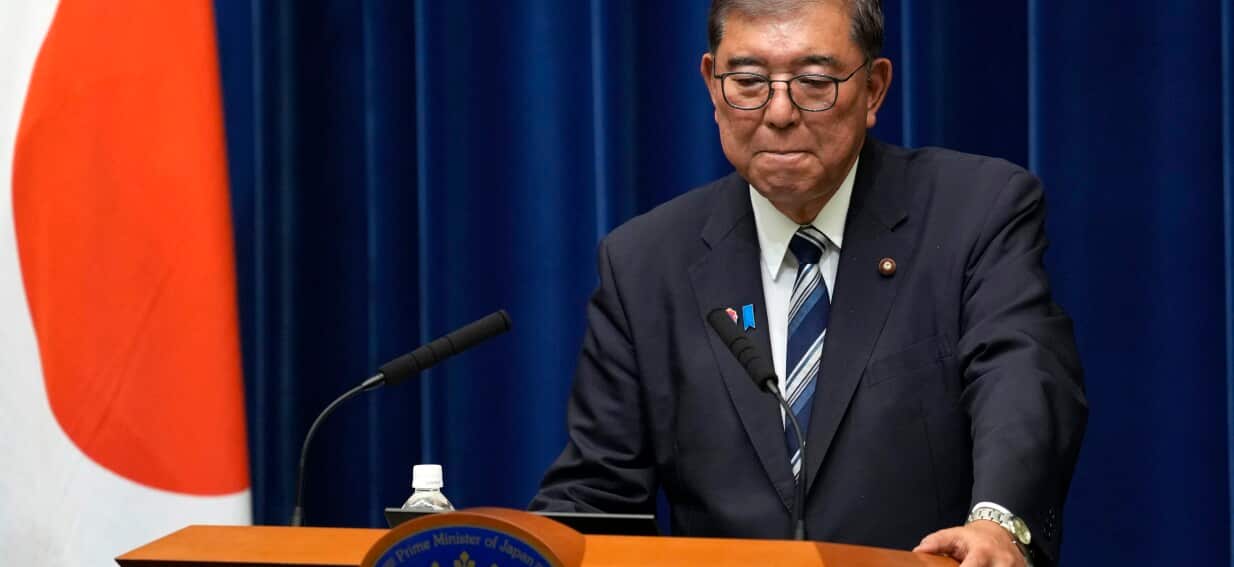
Japanese Prime Minister Shigeru Ishiba resigned on Sunday, setting in motion a leadership contest that could reshape the country’s political and economic trajectory at a fragile moment for the world’s fourth-largest economy.
His departure follows a string of bruising electoral defeats for his Liberal Democratic Party (LDP) and its coalition partner, which lost its majorities in both houses of parliament under his brief tenure.
The 68-year-old leader said he must take responsibility for his party’s election defeats. His decision follows voter anger over rising living costs, despite his recent success in finalising a trade agreement with the United States.
That deal, worth US$550 billion ($840 billion) in Japanese investments in exchange for reduced tariffs, was seen as a key achievement.
“With Japan having signed the trade agreement and the president having endorsed the executive order, a significant barrier has been overcome,” Ishiba informed reporters. “I am eager to hand over the responsibilities to the next generation.”
Markets reacted nervously, with the yen and long-dated government bonds under pressure amid speculation that a successor might push looser fiscal and monetary policy.
Attention is turning to potential frontrunners: Sanae Takaichi, a party veteran who has criticised recent interest rate rises, and Shinjiro Koizumi, the youthful farm minister and son of a former prime minister.
Analysts say Koizumi is unlikely to shift policy dramatically, while Takaichi’s expansionary stance could unsettle investors.
How will Japan pick its next leader?
The process of choosing Ishiba’s replacement is intricate. First, the LDP will hold an internal leadership race. Candidates must secure 20 nominations from members to be eligible to campaign nationwide.
In the initial round, both politicians and regular members cast their votes; if no candidate achieves a majority, a run-off is conducted between the two leading candidates, where politicians have the greatest sway in the second round.
But unlike past contests, the winner of the LDP presidency is not automatically assured the premiership. Without a parliamentary majority, the party must rely on forming a coalition. The lower house usually prevails if the chambers disagree, but opposition parties could complicate the process.
Historical precedent shows unexpected outcomes can occur. In 1994, the LDP supported Socialist Tomiichi Murayama as prime minister in an effort to regain influence through a coalition.
Whoever emerges may call a snap general election to seek legitimacy. Yet a Kyodo poll published on Sunday found 55 per cent of respondents opposed holding one soon. Even so, the July upper house vote highlighted voter discontent, with the far-right Sanseitō party making significant gains and shifting once-fringe positions into the mainstream.
Business leaders are urging quick action. Yoshinobu Tsutsui, chair of Keidanren, Japan’s largest business lobby, said there was “no time to lose” in stabilising politics and addressing economic and security challenges.
Ordinary citizens share that urgency.
“With all the turmoil around tariffs right now, I hope the next prime minister will be someone who can properly manage the issues and handle diplomacy more effectively,” said Maki Utsuno, a chemistry researcher in Tokyo.
Ishiba, an outsider who only won leadership on his fifth attempt last year, exits having secured a critical trade deal but leaving behind political instability. His successor faces not only economic headwinds but also a volatile security environment, underscored by last week’s meeting of Chinese, Russian and North Korean leaders in Beijing.