Across Australia, Aboriginal and Torres Strait Islander communities have come together for their customary gatherings on January 26. These events, held nationwide, offer a platform for both commemoration and cultural celebration.
From major cities to smaller towns, gatherings such as Invasion Day, Survival Day, WulgulOra, and Yabun serve as venues where Indigenous cultures are celebrated, while also providing space for reflection and protest. These occasions highlight the enduring impact of colonization on First Nations peoples, advocating for awareness and change.
The movement to alter the national holiday’s date is a prominent theme at these events, echoing the voices of many who seek to acknowledge the historical and ongoing challenges faced by Indigenous communities.
“For Aboriginal people, January 26 is a poignant day to honor our ancestors’ sacrifices and to persist in resisting colonial influences that perpetuate genocide and racism,” expressed Paul Silva.
He emphasized the importance of non-Indigenous participation, inviting them to engage and understand the realities First Nations people face under current governmental policies.
Silva, belonging to the Dunghutti nation, plays a key role in the Blak Caucus, which spearheads the Invasion Day march in Sydney.
Silva said Blak Caucus’ position extends beyond changing the date, instead advocating to abolish Australia Day celebrations.
“We’ve changed the date in relation to Australia Day many times, and it hasn’t rectified the problem,” he told NITV.
“No date should be celebrated when mass murder and genocide happen upon another human being.”
Contrary to accusations the debate around the national day is ‘divisive’, Silva said it could be an opportunity for unity.
“That would be a step within the right direction, by recognising the inhumane treatment upon First Nations people … many non Indigenous people and people of British descent say that their ancestors were treated inhumanely as well.
“So it’s more of coming together as a collective, recognising the system both treated both individuals inhumanely and ensuring that the history doesn’t carry on.”
The Warriors of the Aboriginal Resistance, who organise Naarm Melbourne’s annual Invasion Day Rally, have called for the Australia Day public holiday to be replaced.
“We are calling for a National Day of Mourning today and for that to be recognised as First Nations people so that we can come together and grieve the loss of the massacres and genocide,” said organiser Tarneen Onus Browne.
“Everybody deserves dignity and respect, and First Nations people aren’t getting that at the moment in this country.
“We’re being killed by police and prison guards, our land is being ripped up by billionaires, also our children are being taken from us at an alarming rate.”
Protestors are also urging the federal government to establish a national truth telling process, after the success of Victoria’s Yoorrook Justice Commission.
“We’re also here to call for a national truth telling process … and we want to protect the treaty process in this state and call for a national treaty as well,” Onus Browne said.
Changing the date ‘not necessary’
The subject of changing the date is not without contention, however (beyond summary dismissals by certain sections of the media).
Renowned constitutional law professor Megan Davis, one of the architects of the Uluru Statement from the Heart, says the date debate can be “a distraction” from the larger issue of First Nations rights and recognition.
“It can be frustrating to see debates over Australia Day treated as a serious and substantive reform issue when it is, in fact, low-hanging fruit,” she said.
“I don’t recognise the day and changing the date is not necessary nor responsive to the underlying grievance raised by Aboriginal people.
“Change the date and the protest will follow to the new date … because the foundations do not change and the underpinning structural conditions do not change.”
Professor Davis has argued the push for constitutional recognition and a national Indigenous advisory body was not going away despite the Voice to Parliament’s rejection in the 2023 referendum.
“The story of dispossession is central to Australian history yet routinely excluded from our education systems and political discourse,” she said in a statement with fellow Uluru Statement co-chair Pat Anderson AO.
“In 2026 … the race hate directed toward First Nations peoples, although notably absent from the debate over proposed hate
speech criminal laws, is not new. It is constant.
“The Uluṟu Statement from the Heart was a gesture of goodwill, an olive branch, a sign of peace to the Australian people.”
Hanson condemned, silence for domestic violence victims
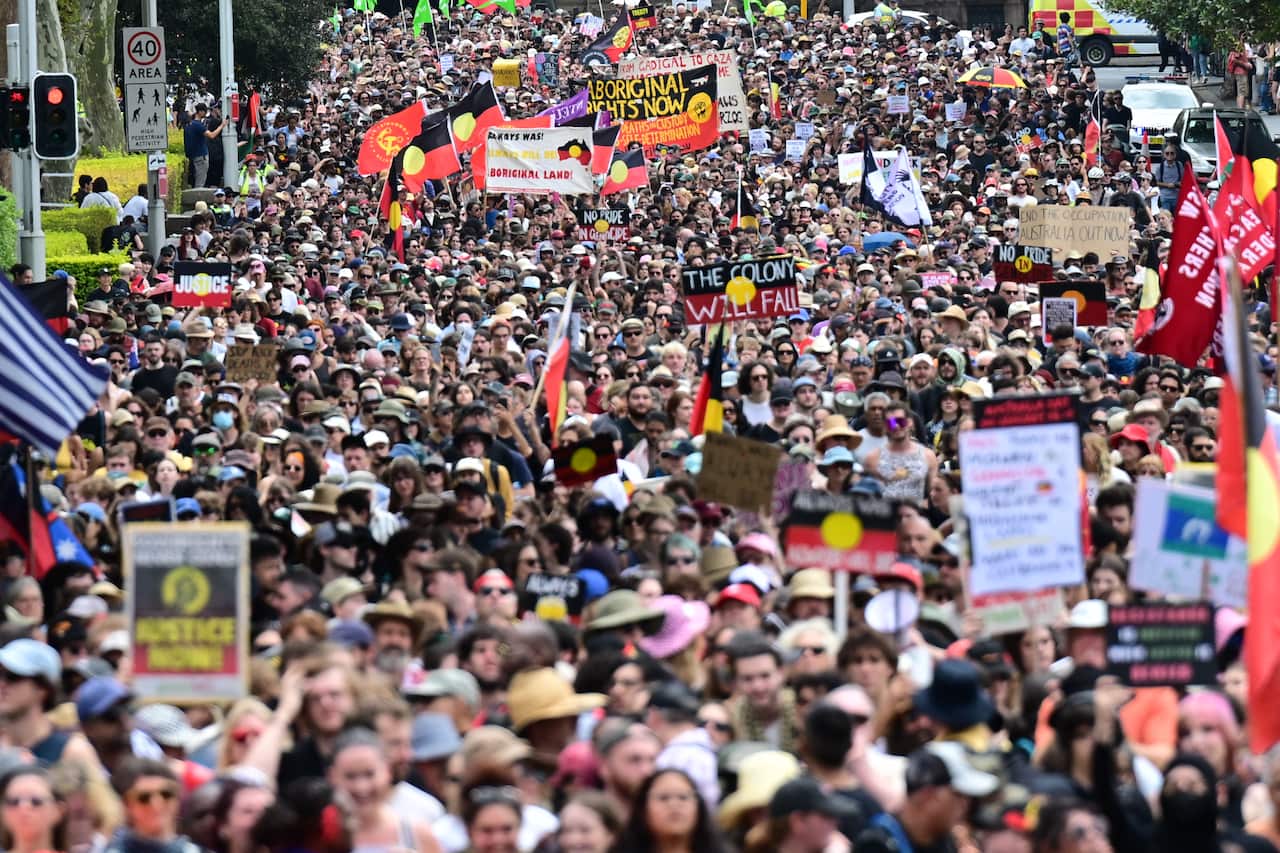
Protesters march through the CBD during the Invasion Day rally in Sydney. Source: AAP / DEAN LEWINS/AAPIMAGE
The rally in Sydney also held a minute’s silence, with attendees holding their fists aloft, for the three victims of an apparent domestic violence attack in Lake Cargelligo last week.
Sophie Quinn, who was pregnant, died when her former partner, subject to an AVO and bail conditions, allegedly shot her and two others in a rampage before fleeing.
NSW police are currently undertaking a massive man hunt in the area.
Protestors also condemned Pauline Hanson, whose One Nation party has seen a massive surge in support in recent polls.
In Brisbane, Goenpul Goorie man Dale Ruska compared the response of the federal government to the Bondi massacre with the lack of action on violence suffered by First Nations peoples.
“Australia is an historical crime scene. It is an historical crime scene, and it is worth the same sort of effort that the people that suffered Bondi are given.”