Share this @internewscast.com


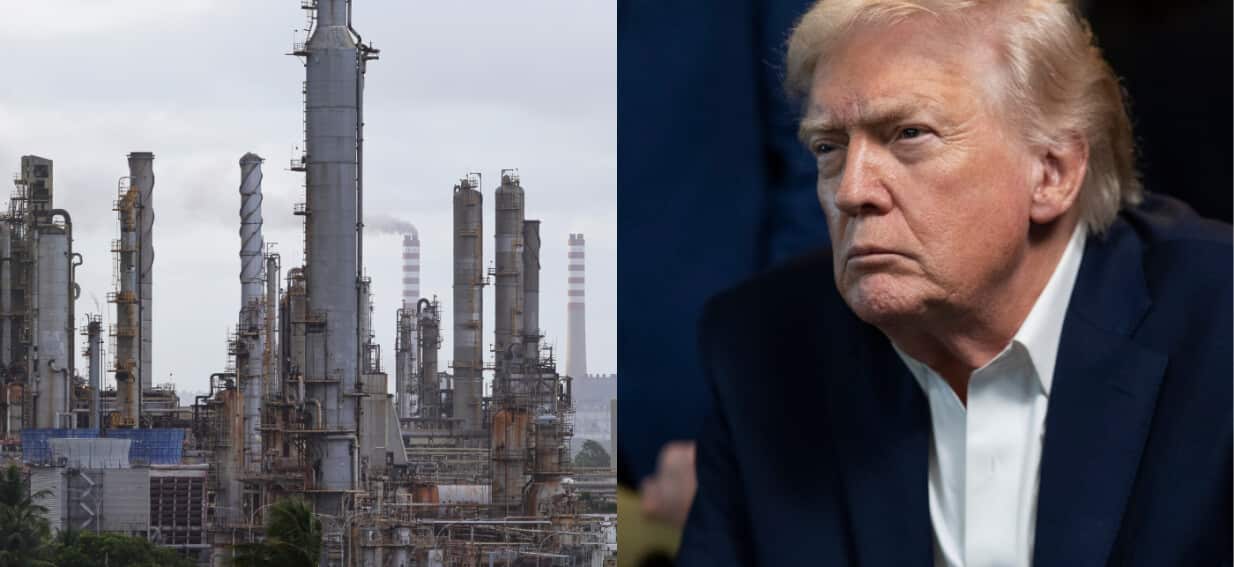
Donald Trump’s announcement that the United States is going to “start making money” from Venezuela and take control of the South American nation’s massive oil reserves could potentially amount to a “hostile occupation” of a sovereign country, experts say.
As he confirmed the capture by US forces of the country’s president, Nicolas Maduro, and flagged plans to put Venezuela under temporary American control, Trump also announced he would green-light major US oil companies to move into the country.
“We’re going to have our very large United States oil companies, the biggest anywhere in the world, go in, spend billions of dollars, fix the badly broken infrastructure,” Trump said.

“We’re planning to sell substantial quantities of oil,” announced President Trump, sparking a debate about the legality of these intentions.

Trump emphasized that the United States intends to manage Venezuela’s natural resources efficiently, drawing investment from “the greatest oil companies in the world” who are expected to inject billions of dollars. The funds generated would be utilized within Venezuela.

An expert speaking to SBS News remarked, “In the short term, it’s challenging to envision how this plan will unfold without some level of cooperation and constructive interaction with Venezuela’s current government.”

Venezuela has the world’s largest oil reserves — with 303 billion barrels or 17 per cent of global reserves — according to the London-based Energy Institute.
However, in recent years, the country’s oil industry has faced challenges, including production. The industry accounts for approximately one per cent of global production.
The US government has not provided any details on how it will implement its plan yet.

Venezuela remains indebted to China by approximately $10 billion, with repayments being made through crude oil shipments. These shipments, carried by three large oil tankers previously co-owned by Venezuela and China, contribute to the 80 percent of Venezuela’s oil exports that China imports, as noted by Reuters last month.

“We’re going to get the oil flowing the way it should be,” he said.
“We’ll be selling large amounts of oil to other countries, many of whom are using it now, but I would say many more will come.”
Raul Sanchez-Urribarri, associate professor of legal studies at La Trobe University, says it’s unclear what this will mean in practice.

Without voluntary consent and authority from the local government, such actions could be deemed a hostile occupation.

US oil giants have not confirmed these comments and Chevron — the only US oil company still operating in Venezuela — has said it is focused on the safety and well-being of its employees, as well as the integrity of its assets.
There are also other factors that might impact the US plan to control Venezuela’s oil — including China, the leading destination of Venezuela’s oil in the last decade.
“There are other players as well in all this saga. We’re talking about different countries that have engaged with the oil business in Venezuela,” Sanchez-Urribarri said.

Venezuela owes about $10 billion to China and repays loans with crude oil transported in three very large crude oil carriers previously co-owned by Venezuela and China. Last month, Reuters reported that China imports 80 per cent of Venezuela’s oil exports.

‘Strong evidence of occupation’

Even if the US effectively gains control of Venezuelan oil, concerns remain about whether such a move will comply with international law.
Under international law, when a territory is placed under the authority of a hostile army, it is considered an occupation and it is not related to a specific resource.
But Shannon Brincat, lecturer in politics and international relations from the University of the Sunshine Coast, said there is “no precedent for a state to take control over parts of another, specifically in this case, for one resource for its own use”.
“Foreign management of oil in this case, after regime change, would be potentially, strong evidence of occupation, which incurs a range of duties on that occupying power,” he told SBS News.

“Without the local sovereign’s freely-given consent and authority, that would seem to be a hostile occupation.”

Brincat said that according to international law, the US “would have to use that natural resource for the benefit of Venezuela and Venezuela’s people” and “they could not treat that resource as its own property”.
In his press conference, Trump said the wealth extracted would go “to the people of Venezuela” but also to the US in the form of “reimbursement” for the US takeover.
He also claimed Venezuela had “stolen” the US oil, and that the US built “the whole industry” in Venezuela and “they just took it over like we were nothing”.
Brincat said it’s difficult to assess Trump’s comment.
“It’s a vague suggestion that they had rights to this oil, which I can’t see any legal basis for, other than potentially the joint partnership work with Chevron.”
In November, a US court authorised the sale of the Venezuelan oil company Citgo in the US to pay off billions of dollars in debt.
“There might be contracts around that that they could be using, [like] trade rules around to enforce, but to say the US owns it is stretching plausibility,” Brincat said.

“Obviously, a country’s resources are its own.”

How has oil been managed under Maduro?

Venezuela nationalised its oil industry in the 1970s, creating Petroleos de Venezuela S.A. (PDVSA), which later opened to foreign investment by establishing ventures with companies such as Chevron, China National Petroleum Corporation, ENI, Total, and Russia’s Rosneft.
“Under Maduro, in particular, how they’ve managed the oil production is through centralised control under the state companies … the PDVSA relies on joint ventures with some other companies,” Brincat said.
In recent years, the company has become politicised under the Chavismo brand, a left-wing populist ideology linked to former Venezuelan president Hugo Chavez.
With several investigations, PDVSA has long been accused of corruption.
In 2016, a report by a Venezuelan congressional commission said about US$11 billion ($A16.4 billion) of its funds went missing between 2004-14.

“The Venezuelan government has used … a shadow fleet of tankers, false flagships to transfer oil shipments, often into … China, Malaysia and other parts of Asia,” Brincat said.

While Venezuela has the world’s largest oil reserves, its crude output remains at a fraction of capacity due to mismanagement, lack of investment and sanctions, according to official data.
“We should remember that history shows us that forced regime change does not stabilise oil supply quickly. This is going to be a long-term fix, if anything,” Brincat said.
“The instability caused by regime change like this … And whatever President Trump is trying to set here, sets up a whole range of governance issues as well.”
— With additional reporting by Reuters

Share this @internewscast.com
You May Also Like

US Supports Europe’s Commitment to Binding Security Guarantees for Ukraine

The United States has for the first time backed a broad coalition…
McDonald's

McDonald’s Challenges Council Decision to Deny New 24-Hour Location on Popular Street

Residents and businesses in Northcote fiercely opposed the plan to transform a…
People enjoying a warm sunny morning at the Albert Park beach on an extreme hot day in Melbourne. 7 January 2026. Photo: Eddie Jim.

Record-Breaking Heatwave Set to Scorch the Capital City – Stay Prepared!

Melbourne is bracing itself for an unprecedented heatwave as it becomes one…
US President Donald Trump

Trump’s Alleged Role in Venezuela Sparks Unanswered Questions After Congress Briefing

Against a backdrop of broad but vague assertions by US President Donald…
AI dominates as Australia's fastest-growing jobs revealed

AI Careers Surge: Australia’s Fastest-Growing Job Sector Unveiled

The position of AI engineer has seen the most significant growth over…

Discover Why More Women Are Embarking on Solo Road Trips

Judi Tarn was halfway up a “treacherous” mountain trail in the French…
Cash rate hike fears eased after inflation slows

Concerns Over Cash Rate Increase Alleviated as Inflation Decelerates

Mortgage holders are likely to be spared an interest rate hike next…
NSW Police Commissioner Mal Lanyon has chosen to extend the state terrorism declaration to ban protests following the attack at Bondi Beach.

NSW Police Commissioner Clarifies Intent Behind Extended Protest Ban: ‘This Isn’t About Curbing Free Speech

In response to heightened security concerns following last month’s terror incident at…
Normary Chudnovsky fled the Maduro regime a decade ago arriving in Australia.

Australian Venezuelans Rally for Freedom Amid Caracas Raids: Voices Rise for a Free Venezuela

Despite being 15,000 kilometres away from Caracas, Australia‘s Venezuelan community has been…

Swiss Authorities Disclose Details on Venue Linked to New Year’s Eve Fire Tragedy Resulting in 40 Fatalities

Swiss authorities admitted Tuesday that fire safety inspections had not been carried…

Melbourne Arson Attack: Police Probe Potential Antisemitism Motive in Recent Arrest

A 47-year-old man has been detained and is currently waiting to be…
CES, the biggest technology show in the world, is happening this week in Las Vegas.

Discover the Future of TV: Sleek Ultra-Thin Screens and Massive 130-Inch Displays

CES, the biggest technology show in the world, is happening this week…