
Israel has been accused of using a military tactic known as a ‘double-tap’ strike after a bombing this week on one of the largest hospitals in Gaza, Nasser Hospital.
Israel bombed the hospital once, killing at least one person. Several minutes later, as medics, journalists and emergency crews rushed in, it was hit again. The second blast killed at least 20 people — including five journalists and several medical staff treating victims from the first strike, according to Gaza health authorities.
Israeli Prime Minister Benjamin Netanyahu described the incident as a “tragic mishap”. But critics, including human rights groups and UN officials, say it bears the hallmarks of a double tap, a tactic that some argue could constitute a war crime.

Experts caution, however, that proving a double-tap strike under international law is far from straightforward and say there could be multiple explanations for the attack.

What are double-tap strikes?

A “double-tap” is when two attacks are launched in quick succession against the same target.
The first strike is intended to kill or destroy the initial target. The second — sometimes minutes later — hits those who arrive at the scene, including rescue workers, journalists and civilians.
Dr Eyal Mayroz, a senior lecturer in peace and conflict studies at the University of Sydney, says that under international law, such strikes are “very controversial”.

“It’s forbidden, and it’s forbidden for a very good reason — trying to protect rescue workers and rescue efforts and wounded people,” he told SBS News.

Rescue efforts are protected under the Geneva Convention. Should a second attack be aimed at killing rescue workers or preventing the wounded from accessing care, it would be constituted as a war crime, the international treaty states.

Condemnation from the UN and EU

The attack on the Nasser Hospital has drawn international criticism, including from the European Union and the United Nations.
Anouar El Anouni, EU Spokesman for foreign affairs and security policy, said the killing of journalists, health workers and civilians in the Nasser Hospital strike was “completely unacceptable”.
The UN Special Rapporteur on the occupied Palestinian territories, Francesca Albanese, called the bombings “abominable”.
“Why did it hit a hospital in the first place and why did it hit it when there were rescuers and journalists on top of patients and medical personnel? This is what Israel is doing in the occupied Palestinian territory,” she said.

“So it’s shocking — and it’s even more shocking that there is no robust political response.”

Human rights organisation Amnesty International named the incident as a double-tap strike, writing on X that it was “the latest violation of international law under Benjamin Netanyahu”.
Five journalists were killed in the bombing, including those who worked for the Associated Press, Al Jazeera, and Reuters.
It is against international law to kill journalists unless they are actively participating in military activities.

Since October 7, at least 240 journalists have been killed in Gaza, according to the Palestinian Journalists Syndicate.
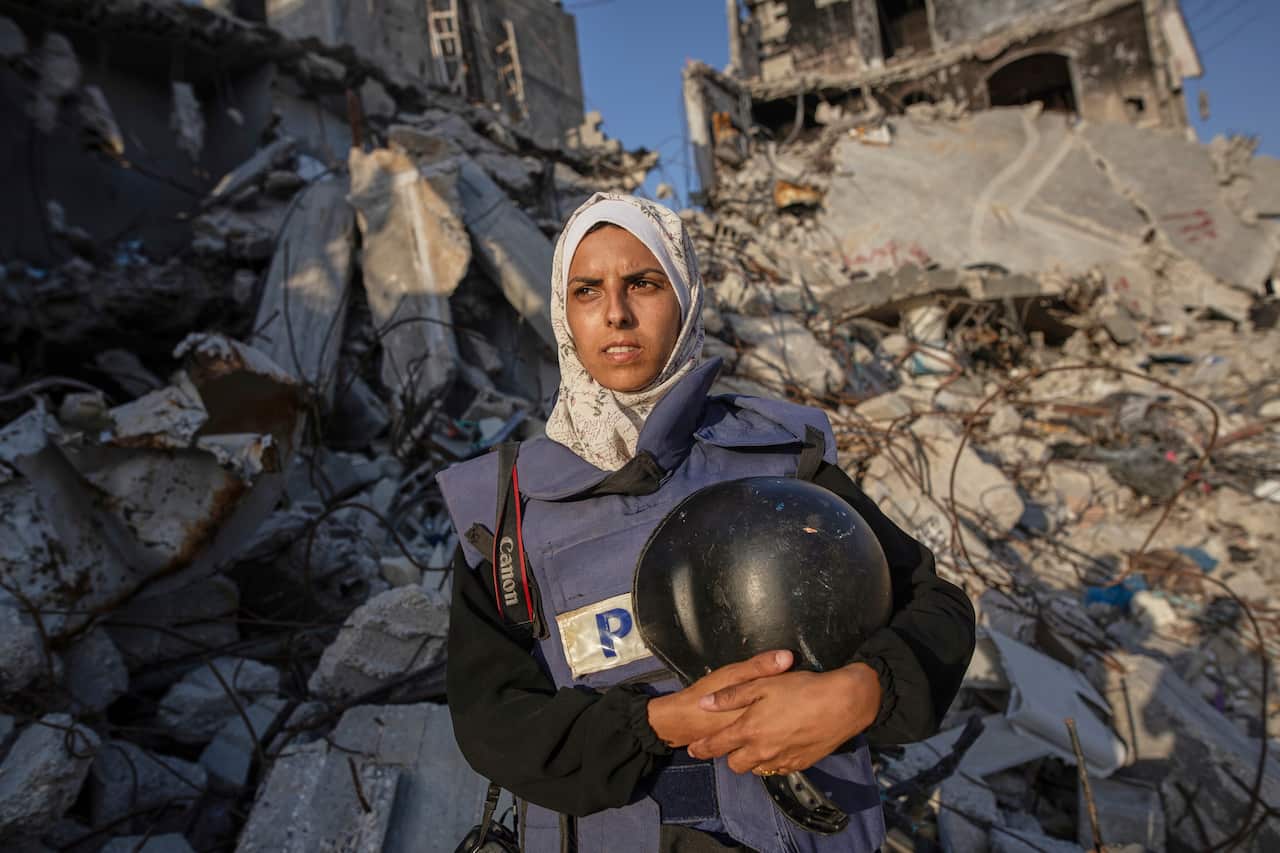
A journalist wearing a press vestposes for a photo holding a helmet

Freelance journalist Mariam Dagga, 33, who had been working with the Associated Press and other outlets during the Gaza war, poses for a portrait in Khan Younis, southern Gaza Strip, on 14 June 2024. Source: AP / Jehad Alshrafi

‘A horrible and tragic mistake’, says academic

Netanyahu said Israel “deeply regrets the tragic mishap” and reiterated that its war is against Hamas, not civilians.
“Israel values the work of journalists, medical staff, and all civilians,” he said. “The military authorities are conducting a thorough investigation. Our war is with Hamas terrorists. Our just goals are defeating Hamas and bringing our hostages home.”
Israel’s military said six Hamas members were killed in the strike, and that none of the journalists were the intended targets.

“Our goal is to fight terrorists, not journalists, not anyone who is not involved in terrorism,” Israel’s UN ambassador Danny Danon said.

Dr Ran Porat, from the Australian Centre for Jewish Civilisation at Monash University, said the attack was not a deliberate double-tap.
“What happened in the Nasser Hospital is that there was a malfunction or breach of orders … this was not a classic case of the double tap,” Porat told SBS News. “It’s a horrible and tragic mistake, but I think it’s not even close to the intentional killing of innocent people.”
He said it was important to take into account the “methodology” of Israeli strikes.

“In a case like this, you don’t fire again unless there is a reason to believe that the first attack did not complete the mission … that’s possibly where there was an incoherence which possibly led to the other attack.”

In a statement issued later on Tuesday, Hamas challenged the Israeli account of the hospital casualties, denying that any of the Palestinians killed were militants.

Double-tap, roof knock, or fatal error?

Israel has described another tactic it has used in the conflict as “roof knocking”.
Roof knocking is when a small munition is fired at a building as a warning before a larger strike. Unlike double taps, the purpose is to urge civilians to evacuate.
Porat said the technique is not commonly used by other armies because it involves giving your enemy a warning.
But Mayroz said the practice, once commonly used by Israeli forces in Gaza, has largely been abandoned now after consistent concerns it was a violation of international law.

“The idea is very questionable because often, the people are not given enough time,” Mayroz said, noting the practice was particularly harmful for unaccompanied children or those less mobile. “It’s a very questionable way of trying to later justify the killing of civilians as collateral damage.”

He stressed the distinction: roof knocking is framed as a warning; double-tapping is a way of obstructing rescuers. But he added a third possibility: human error.
“The target of the first attack could still have been intact and was not hurt, and therefore they had a desire to complete the mission — either regardless of collateral damage to rescue workers or by mistake, thinking that the rescue workers were not there yet.”
Mayroz said only a court could decide a ruling on the attack — but international prosecutions are slow and rare.
“Only a competent court can do that: to prove legally whether the second attack was targeting the response teams and rescue efforts — which is illegal under international law — or if there was a different reason for it that may be considered legitimate.”
He says the burden of proof is extremely high. Investigators would need intercepted communications or credible whistleblower testimony showing intent, as well as detailed analysis on the type of ammunition used and the decision-making process.
Still, he said, it is fair to ask the question: “This has happened more than once where rescue workers were either killed or wounded during rescue efforts. It’s legitimate to raise the question of why did that happen?”

You May Also Like
Six 'ISIS brides' and 14 children set to arrive in Australia tomorrow

Australian Return of Six ‘ISIS Brides’ and Their 14 Children Scheduled for Tomorrow

A second cohort of so-called ISIS brides is expected to soon arrive…

Iranian Diplomat Engages in Peace Negotiations in Qatar Amid US and Iran’s Tempered Expectations

In a stunning feat of athleticism and strategy, the recent showdown on…

Israel’s ‘TikTok Minister’: Unraveling the Controversial Past and Future of This Social Media Maverick

A ‘fringe figure’ with growing youth support READ MORE Ben-Gvir has often…
Kelsey Waghorn was a 25-year-old tour guide and one of 47 people on New Zealand's White Island when it erupted on December 9, 2019. She has written a book about that day and its aftermath. She is pictured IN April 2020 showing some of her injuries

Surviving White Island: Kelsey Waghorn’s Harrowing Tale of Resilience Amidst Tragedy

WARNING: GRAPHIC IMAGES Deep within the island lies a duo of streams…
Alice Springs Police

Lidia Thorpe Emotional as Police Decide Against Charges in Custody Death Investigation

Nearly a year after the tragic death of Kumanjayi White while in…
Prime Minister Anthony Albanese during a press conference at Parliament House in Canberra.

Comprehensive Business Consultation on Tax Reform Initiated by Labor in Response to Mounting Criticism

The federal government is expanding its consultation on proposed tax reforms to…
Trump's demand stuns Arab leaders into silence

Trump’s Bold Request Leaves Arab Leaders Speechless

On Monday, President Trump paid tribute to U.S. service members at Arlington…

Tragic Gaza Strike: Israeli Attack Claims Lives of Six-Year-Old Girl and Woman

IN BRIEF The airstrike hit a tent encampment of displaced families in…
Parliament House security and AFP remove pro-Palestine protestors from the marble foyer of Parliament House in Canberra on Tuesday 26 May 2026.

Demonstrators Halt Parliament House Operations: Unprecedented Protest Disrupts Proceedings

Around 50 demonstrators gathered at Parliament House in Canberra, prompting authorities to…

Tokyo Shopping Center Incident: Suspected Spray Attack Hospitalizes 24

IN BRIEF More than 25 people were taken to the hospital after…

Tragic Collision in Belgium: Train Accident with School Bus Claims Four Lives

‘Barrier closed’
Scott Morrison has delivered a concession speech to devastated Liberal supporters after calling Anthony Albanese to congratulate him on Labor winning power for the first time since 2013

Historic Shift: Scott Morrison Concedes in Australia’s 2022 Election Upset

Scott Morrison addressed a heartbroken crowd of Liberal Party supporters with a…