Share this @internewscast.com
IN BRIEF
- Iran’s leadership has been hit, but experts say the regime itself remains firmly in place.
- Trump hints at ending the war soon, despite uncertainty over whether goals were achieved.
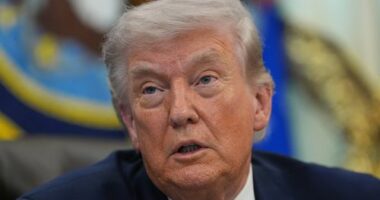
President Donald Trump and several officials within his administration have hinted at a significant shift in Iran’s leadership, suggesting a potential regime change that aligns with one of the prominent U.S. objectives in its ongoing conflict with the nation.
Despite these assertions, experts remain skeptical, suggesting that Trump might be attempting to redefine the situation to facilitate the United States’ withdrawal from its military engagements in Iran. This conflict has expanded into a broader regional confrontation following joint U.S.-Israeli military actions in late February.
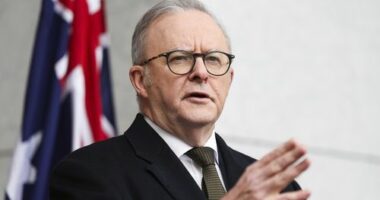
This perspective seems to contrast with the views held by some U.S. allies, including Australia. During a confidential meeting on Tuesday, Australian Prime Minister Anthony Albanese acknowledged Trump’s three stated goals: preventing Iran from acquiring nuclear capabilities, reducing its potential to inflict harm, and instigating regime change. While he conceded that the first two objectives might have been met, he expressed doubts about the occurrence of regime change, given historical challenges in achieving such outcomes.
In the meantime, Israeli Prime Minister Benjamin Netanyahu has declared that the battle against Iran is far from over, with Israel’s military committed to continuing its efforts to dismantle what it perceives as Iran’s terror regime.
President Trump is scheduled to address the nation at 9 p.m. local time on Wednesday (12 p.m. Thursday AEDT), promising to deliver an important update regarding the situation in Iran.
Trump is poised to address the nation 9pm local time on Wednesday (12pm Thursday AEDT) “to provide an important update on Iran”.
The US has zigzagged on whether Washington plans to further escalate the war that has roiled the world economy — possibly by deploying US ground forces — or try to end it through negotiations with Iran.
In recent days, though, Trump has suggested the US is eyeing a swift end to the war — even without a deal.
He told reporters at the White House on Tuesday the US would “be leaving very soon” — possibly “within two weeks … maybe three”.
“Iran doesn’t have to make a deal, no,” he added. “No, they don’t have to make a deal with me.”
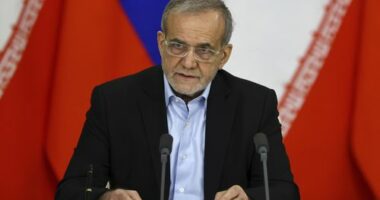
Iranian President Masoud Pezeshkian has said his country has the “necessary will” to end the war provided its enemies guaranteed it would not flare up again.
Trump’s ‘regime change’ claim questioned
Trump told reporters aboard Air Force One on Sunday US officials are now dealing with “much more reasonable” people in Iran, and that was “truly … regime change”.
This is despite the fact the Islamic regime, which has ruled Iran since the 1979 revolution, remains in power.
Supreme leader Ayatollah Ali Khamenei was killed in the initial US-Israeli strikes but was replaced by his son Mojtaba Khamenei — widely viewed as a hardliner. He has not been seen since the war broke out.
Many top figures have been killed but the Islamic republic has a complex, but resilient, hierarchy.
Research scholar at the Australian National University’s Centre for Arab and Islamic Studies, Ian Parmeter, said the Trump administration’s idea of “regime change” was a stretch.
“You need to distinguish between regime change and change in the regime. The US has achieved a change in the regime by killing the former supreme leader and other officials, but the regime itself is still intact, clearly,” Parmeter told SBS News.
Associate professor of international relations at the University of NSW, Jessica Genauer, said the US “definitely” had not achieved regime change in Iran.
“Whilst a top strata of political and security leaders have been killed, the infrastructure of the regime and the instruments of the regime have remained very much intact,” she told SBS News.
Framing a victory narrative
Genauer said the apparent motivations behind Trump’s claims that the regime had been toppled were two-fold.
“Trump is increasingly desperate to tell a good news story for a domestic US audience,” she said.
“While he still has the support of his core constituency, even those people are starting to question whether the mounting costs are worth it.
“The pressure is on, and Trump is increasingly needing to tell a story of victory.”
Polls suggest Americans are against a protracted war with Iran, and experts say it could cost Trump at the November midterm elections.
By trying to frame it as a victory, Trump is seeking to counter claims the mission remains incomplete while the Iranian regime endures, Genauer said.
Parmeter says it’s unclear what Trump is aiming for.
“It’s hard to know with President Trump because what he says varies from day to day,” he said. “It seems Trump does want to end the war on his terms, but the Iranian regime won’t end the war unless it’s on its own terms, which would include provisions that the US will not attack Iran again, which the US will refuse to give.”
He said that both the US and Israel would try to claim the intervention as a victory, with Israel also set to hold elections this year.
“It’s quite possible that if Trump sees a way to conclude victory and end the war, it may not be a time that is suitable for Netanyahu’s electoral strategy,” Parmeter said.
“But we don’t know if Trump is prepared to make that declaration.”
Is a regime change in Iran possible?
Regime change is highly contentious and experts argue international law does not support such moves.
Benedict Moleta, a PhD student at The Australian National University’s Department of International Relations, said that if Trump’s idea of regime change was toppling a clerical government with violence and bloodshed, it was unlikely to work in Iran.
“Iran is a big country. For the last 40 years, it’s had a type of government that is intolerable to America. It might be criticised as so-called theocratic, but it is a structured and clear form of government. Now, that means that the so-called bad person at the top is not the person who sustains that country and that government,” Moleta told SBS News.
“So it’s not going to work simply by removing that person. And what has happened since the assassination of Ali Khamenei is that a perhaps more uncompromising son has taken his place. But also, the military and the IRGC [Islamic Revolutionary Guard Corps], have become less compromising and more forthright than ever.
“Regardless of the facts, I think it’s safe to say that’s a very dangerous approach to foreign policy, where you decide to intervene at a large scale and in a way that unleashes very great regional disorder, and then claim that your country has been successful regardless of what happens.”
For Genauer, the Iranian regime’s total control over the country’s security architecture meant regime change was “unrealistic”.
“The Iranian regime has such significant control over the security infrastructure in Iran, which includes the Islamic Revolutionary Guard Corps, which is a very ideologically motivated force, the Basij, or Iran’s civilian militia, who are very much committed to ensuring the survival of the regime, and the military,” she said.
“Even though Iran’s leadership has been decimated, these systems underpin the security infrastructure and allow the regime to stay alive. Whilst those structures remain in place, regime change is not likely.”
“We might see a fracturing of the regime into civil conflict, but a total collapse and a total economic and security structure is not realistic at this stage, because there are no institutional alternatives that have developed in the Iranian landscape.”
For the latest from SBS News, download our app and subscribe to our newsletter.