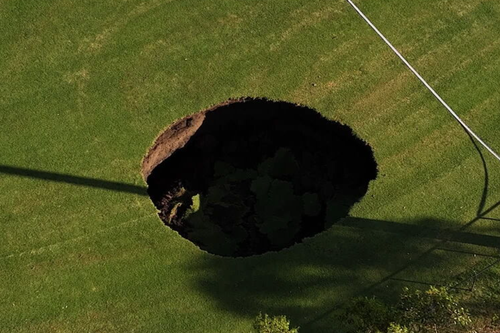

Suburban sinkholes are becoming a growing concern, with both natural and human factors contributing to their formation.
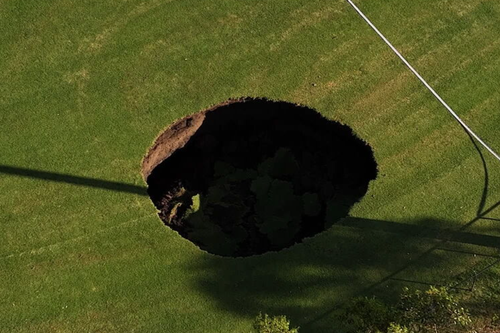
Experts warn that the increasing frequency of extreme weather events may lead to a rise in the number of these geological phenomena.
One of the primary culprits is water, which gradually erodes the bedrock, creating underground voids that can eventually collapse.
Environmental scientist Chow notes, “Water and temperature are significant agents of chemical weathering. In limestone-rich areas, climate change-induced shifts in temperature or rainfall patterns can speed up rock dissolution, elevating the risk of sinkholes.”
Studies indicate a connection between sinkholes and climate change, highlighting how droughts and floods can exacerbate the situation.
Research has found there is evidence linking sinkholes to climate change, including droughts and floods.
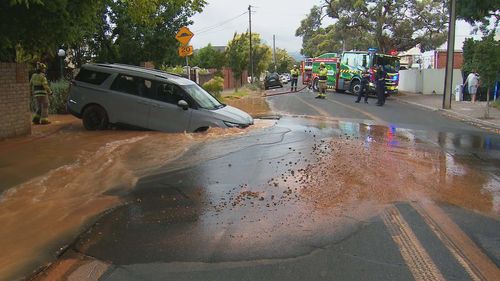
“Additionally, rising water tables â driven by increased rainfall and storm frequency â may further destabilise ground,” the research states.
Heatwaves and drought can also contribute to sinkholes.
“It has been shown that sinkhole frequency in karst environments of north-east Spain increase[s] during drought,” the journal notes.
Countries such as China and Iran have karstic landscapes, which are at high risk of sinkholes.
In China alone, there is around 600,000km² of ground which could collapse.
Some metropolitan areas in Australia may be under threat of sinkholes developing suddenly due to plumbing issues or movement weakening the ground above old mine shafts.
Business development manager at Rectify Group Phil Irwin said “people have no idea” of how many areas are at risk.
There could be countless undocumented mine shafts that authorities do not know about, he said.
“Sinkholes can develop anywhere, anytime,” Irwin said.
“Some of the mine shafts are recorded, not all of them were, because you just had people digging holes left, right and centre.
“We’ve encountered them when we’ve been trying to treat people’s properties.”
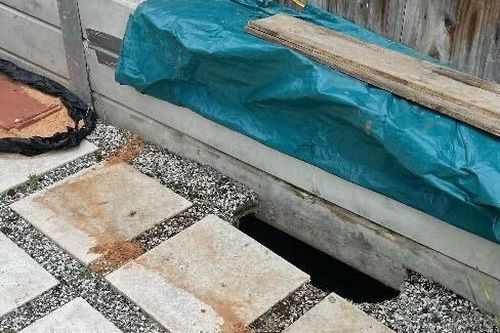
Irwin warned sinkholes can pop up in your backyard during construction work.
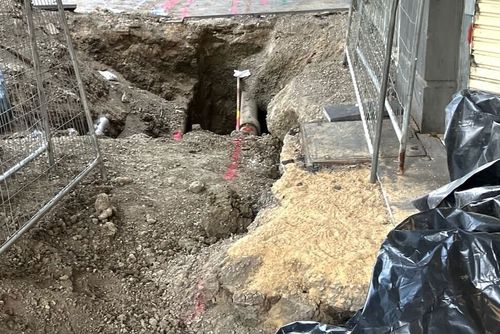
“If you’ve got a pipe that’s cracked and a bit of soil falls into the pipe, it could bubble out and collapse,” he said.
“We’ve had plenty of those in the past but they’re easily rectified because they’re typically not very deep.
“But it’s when you’ve got something that’s a little bit larger and it’s involving infrastructure like roads, that’s where it’s a little bit more significant.”
What are the early warning signs of a sinkhole?
There are a few signs that point to an eventual sinkhole.
This can include structural issues such as cracks in the walls and floor, or doors and windows that don’t close properly.
On the ground, evidence of sinkholes can be buried items becoming visible, small ponds forming, depressions spots on the fround or slumping trees and fences.
How do you get rid of sinkholes?
Irwin recommends resin injection, which involves stabilising the ground by injecting expanding polyurethane resin into the soil through small holes.
Bigger sinkholes, such as collapsed mine shafts, can usually be fixed by pumping cellular concrete into the cavity.