A US federal trade court has blocked President Donald Trump from imposing sweeping tariffs on imports under an emergency-powers law.
The decision from a panel of three judges on Wednesday (Thursday AEST) followed multiple legal challenges claiming that Trump overstepped his authority, leaving US trade policy subject to his discretion and causing economic turmoil.
At least seven lawsuits are challenging the levies, the centrepiece of Trump’s trade policy.
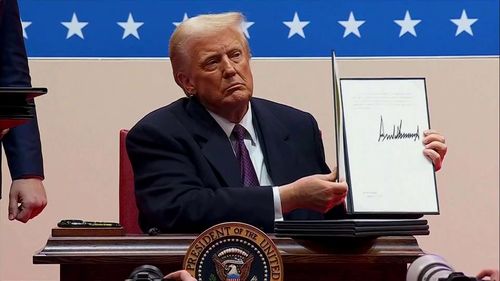
Normally, tariffs require Congressional approval, but Trump asserts that he possesses the ability to act independently due to the nation’s trade deficits being deemed a national emergency.
“The Worldwide and Retaliatory Tariff Orders surpass any authority granted to the President by IEEPA to regulate importation using tariffs,” stated the court, referencing the 1977 International Emergency Economic Powers Act.
The White House did not immediately respond to a message seeking comment.
The Trump administration is expected to appeal.
The plaintiffs argued that the emergency powers law does not authorise the use of tariffs, and even if it did, the trade deficit does not meet the law’s requirement that an emergency be triggered only by an “unusual and extraordinary threat”.
The US has run a trade deficit with the rest of the world for 49 consecutive years.
Trump imposed tariffs on most of the countries in the world, including Australia, in an effort to reverse America’s massive and longstanding trade deficits.
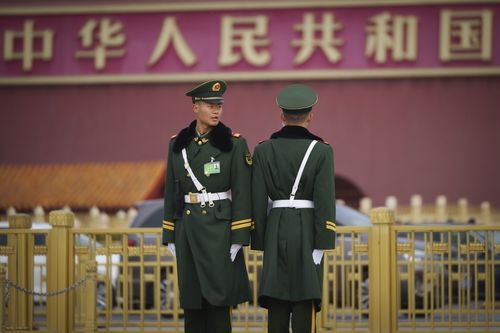
He earlier plastered levies on imports from Canada, China and Mexico to combat the illegal flow of immigrants and the synthetic opioids across the US border.
His administration argues that courts approved then-president Richard Nixon’s emergency use of tariffs in 1971, and that only Congress, and not the courts, can determine the “political” question of whether the president’s rationale for declaring an emergency complies with the law.
Trump’s Liberation Day tariffs shook global financial markets and led many economists to downgrade the outlook for US economic growth.
So far, though, the tariffs appear to have had little impact on the world’s largest economy.
The lawsuit was filed by a group of small businesses, including a wine importer, V.O.S. Selections, whose owner has said the tariffs are having a major impact and his company may not survive.
A dozen US states also filed suit, led by Oregon.
“This ruling reaffirms that our laws matter, and that trade decisions can’t be made on the president’s whim,” Attorney-General Dan Rayfield said.
President lashes reports of ‘TACO acronym’ used among traders
There’s a new type of trade taking hold on Wall Street: TACO, short for Trump Always Chickens Out.
In other words, don’t fret too much about Trump’s latest tariff threat and go on a selling spree, because eventually he’ll back down and a relief rally will ensue.
Trump said he first learned of the term, coined by Financial Times commentator Robert Armstrong, on Wednesday when a reporter sought his reaction to it.
“I chicken out? Oh, I’ve never heard that. You mean because I reduced China from 145 per cent that I set down to 100 and then to another number?” Trump said, referring to tariff rates he imposed on imported Chinese goods.
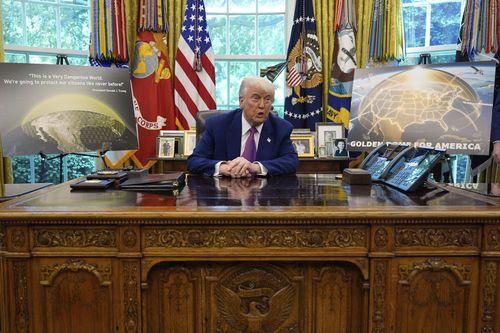
The rate is now 30 per cent, after Trump raised it as high as 145 per cent last month, much to investors’ dismay, only to reduce it a few weeks later.
Last week, Trump threatened to impose 50 per cent tariffs on goods from the European Union come June 1.
Stocks turned lower after his threat, which he doubled down on later in the day, claiming there was no room to negotiate.
Two days later, he said he’d wait until July 9 to levy a 50 per cent tariff on EU goods following promising talks.
When US markets reopened after Memorial Day, stocks closed well in the green.
Trump said he was willing to delay the move because EU counterparts called him up saying, “Please, let’s meet right now.”
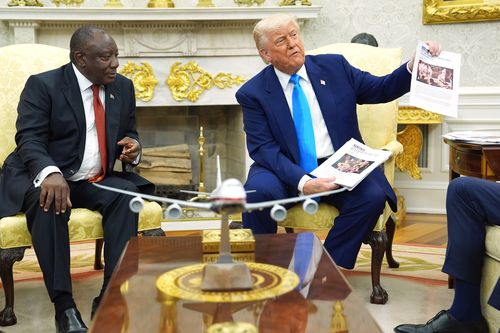
”You call that chickening out?” Trump responded to a reporter at an Oval Office event overnight, referring to his recent announcements on EU and Chinese tariff rates.
“It’s called negotiation,” Trump added, saying that part of his tactic can include setting “a ridiculous high number” for tariff rates and going down if he gets other nations to give in to his demands.
“Don’t ever say what you said,” Trump told the reporter, calling it “the nastiest question”.