Share this @internewscast.com
Each summer in Switzerland, families, leisure-seekers and commuters pack their dry bags and head to the river, ready for a float.
Viral videos, largely taken at the city of Bern’s Aare River, show workers swimming to get home from the office. For the many Australians sweating their way home on hot buses, crowded trains or congested roads, it’s an idyllic vision.

Urban swimming is a popular activity across Switzerland today, but this wasn’t always the case. The trend of floating home from work or enjoying a leisurely weekend swim has gradually become a part of Swiss lifestyle.

According to the latest annual report on bathing water quality, out of 160 sites tested in Switzerland, only one was deemed “poor.” This highlights the nation’s commitment to maintaining excellent water quality standards.

For decades, Switzerland’s rivers were contaminated by sewage and algae. In the 1960s, they were some of Europe’s most polluted, and swimming in a number of rivers — including the Aare — was banned. After years of campaigning by the public, the Swiss government created laws requiring wastewater to be treated.
An essential element of this is the country’s extensive sewer network. In recent years, the country has also turned its focus to removing micropollutants from the water. Now, Switzerland has the 14th cleanest swimming water in Europe, according to data from the European Environment Agency. Cyprus is No.1.

The primary concern revolves around the health of rivers and waterways. To establish more “safe” urban swimming spots, strict microbial standards must be met. This includes ensuring low levels of E. coli bacteria and monitoring for heavy metals, chemicals, and pathogens, as emphasized by Morrison.

Australia’s cities and towns are criss-crossed with waterways, from rivers and canals to lakes and harbours. So is there a future where Melburnians swim to work along the Yarra, Adelaidians commute along the Torrens and Brisbanites float down the Brisbane River?
Dr Nicky Morrison, professor of planning at Western Sydney University and the co-director of the Urban Transformation and Research Centre, said there are multiple factors Australia would have to contend with to achieve a similar situation to Switzerland.

Despite these challenges, there are successful models both internationally and locally that could be adopted to enhance access to urban swimming in Australia.

“Were talking about reliably clean [water] after rain, after storms, and throughout the summer,” she said.
“In Australia we get often heavy rainfall and that can flush huge volumes of polluted stormwater into rivers. And that probably is our biggest barrier. It’s not just sewage, it’s also the runoff from roads, roofs, industry, and degraded catchments,” she told SBS Dateline.
There are other safety factors to take into consideration too. According to Australia’s most recent national drowning report, there were 99 drowning deaths in rivers in 2024 and 2025, as compared to 82 beach drowning deaths. Things such as debris, both natural and from pollution, can pose risks, as can strong currents.
Morrison said Switzerland has an “extremely high investment in water treatment” and, unlike Australia, it also has “glacial-fed rivers with huge water flows”.
“They’ve got tightly controlled catchments and they’ve got very dedicated coordinated national policy. So in Australia we have a much more variable climate, floods, droughts. We do have intense stormwater pollution in cities.”

In New South Wales, the Beachwatch program provides valuable insights into water pollution levels. However, certain waterways in Australian cities, such as the Brisbane River and the Torrens, remain unsuitable for swimming due to various pollution concerns.

Urban swimming is a movement among swimmers, local communities and international campaigners to make the rivers and bodies of water in and around cities safe and accessible for swimmers.
In Sydney, for example, Barangaroo’s Marrinawi Cove was opened in 2023 after lobbying from community groups and water quality testing from the then Liberal state government. It was the first harbour swimming spot west of the Harbour Bridge to open in more than 50 years.
It’s an area that has historically been the site of much industry, and as a result, the NSW government still recommends people don’t eat any fish caught west of the Harbour Bridge.
“Being able to swim at Marranawi Cove is only possible because we have invested in cleaning up our harbour from industrial wastelands to aquatic playgrounds,” then minister for infrastructure, cities and active transport Rob Stokes said at the time.

Speaking with SBS Dateline, an expert noted that urban swimming not only offers recreational benefits but also fosters social connections among individuals.

The benefits of urban swimming

Interest in urban swimming is growing rapidly around the world. In June 2025, representatives from more than 20 countries attended a Swimmable Cities summit in Rotterdam, a Dutch city that has transformed a former industrial harbour into an unprecedented swimming spot.
Supporters of the Swimmable Cities movement are passionate about the benefits of urban swimming.
In general, it’s widely accepted that spending time in water has both physical and mental health impacts, and that accessing nature frequently can help reduce stress.
Dr Rebecca Olive is an RMIT researcher whose work focuses on informal sport and leisure practices, including urban swimming.

She told SBS Dateline that urban swimming can bring positive effects, including helping people build social relationships.

Increased awareness about river systems can also have a positive impact on waterways and other creatures that use them. But this requires thinking about “what’s good for the river”, rather than just thinking about swimmers.
“The river needs to be the first consideration. And we’re in Australia, Indigenous Australians have said that for a really long time,” Olive said.
“We have to put Country first.”
One of the important considerations for urban swimming in Australia is cultural safety, including respecting the fact that First Nations people might “ask us not to access certain places”.
Another essential factor to consider is ‘swimmability’, which covers everything from water quality to accessibility to literacy around water safety.

“One of the things I think that’s difficult for us all to get our head around is that rivers aren’t always going to be swimmable,” Olive said.

Swimming and safety

Morrison from Western Sydney University also raised the importance of education and awareness around water safety, including knowing when not to swim.
She said Switzerland has a number of water quality dashboards, for example websites where data about river water can be viewed. In her experience, people “won’t enter water unless they really trust the monitoring”.

“They put a lot of investment into real-time public information.”

Another safety measure the city of Bern has taken is a campaign called ‘Aare You Safe’. It includes an English-language website aimed at tourists with tips for swimming in the river, promoting hazard awareness, and a set of rules for safe swimming.

Switzerland’s model has seen consistent political, financial and community buy-in.

Creating a swimmable city

Morrison said we should be thinking “more creatively” about funding for projects to make waterways swimmable, particularly looking at long-term initiatives instead of short-term grants.
“Other countries … have long-term sustainable funding investment, whereas we do have that sort of political cycle — three years of federal government, four for state — and we have this beauty parade of grants.”

Amid a worsening climate crisis, addressing extreme urban heat is a political issue.

“When cities heat up, water becomes really our most important public asset,” Morrison said.
Outside of Switzerland, other projects investing in cleaning up rivers have made headlines globally. Olive pointed to the French project to make the Seine safe for swimming in time for the 2024 Summer Olympics in Paris.

Since July this year, the Seine has been open to the public for swimming across multiple sites. It’s an infrastructure project that has been decades in the making.
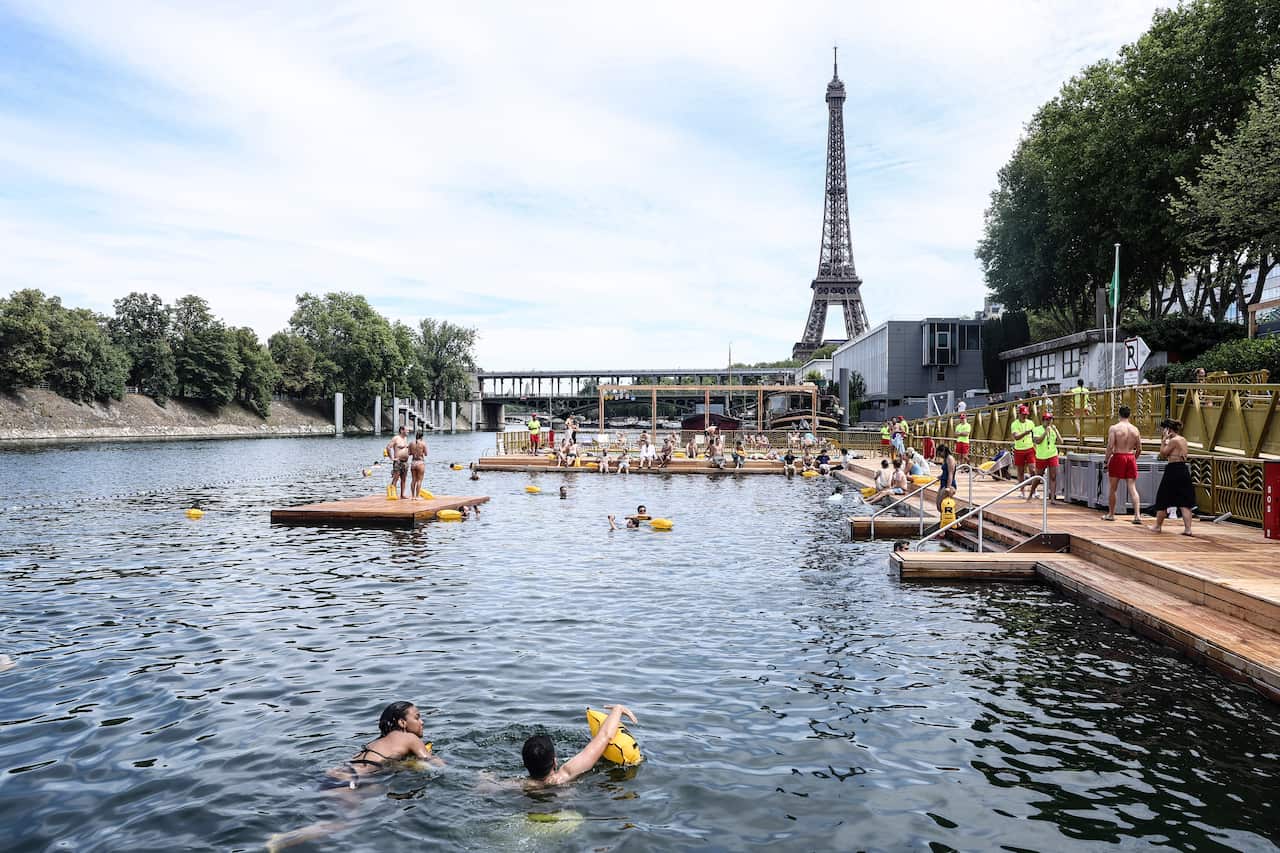
Swimmers in the river Seine use banana-shaped floating devices, while some stand or sit on pontoons and lifeguards in brightly coloured outfits can be seen to the side. In the background is the Eiffel Tower.

The Seine River opened up three safe swimming spots in July. Source: EPA / Source: AAP / EPA / Teresa Suarez

“What we saw in Paris, the triumph of the Seine, is that there are huge underwater stormwater overspill vats that allow the bacteria to die in the water and the water to clean up before it’s released back into the river,” she said.

“They [these infrastructure projects] take huge political and financial investments by politicians and bureaucrats in order to do this. It’s an investment of money, but it’s also an investment of time.”

There also needs to be sustained “community interest”, as there was in the Swiss case.

The importance of swimmable cities in Australia

Across Australia, there are already examples of urban swimming spots, like Streets Beach on Brisbane’s South Bank.
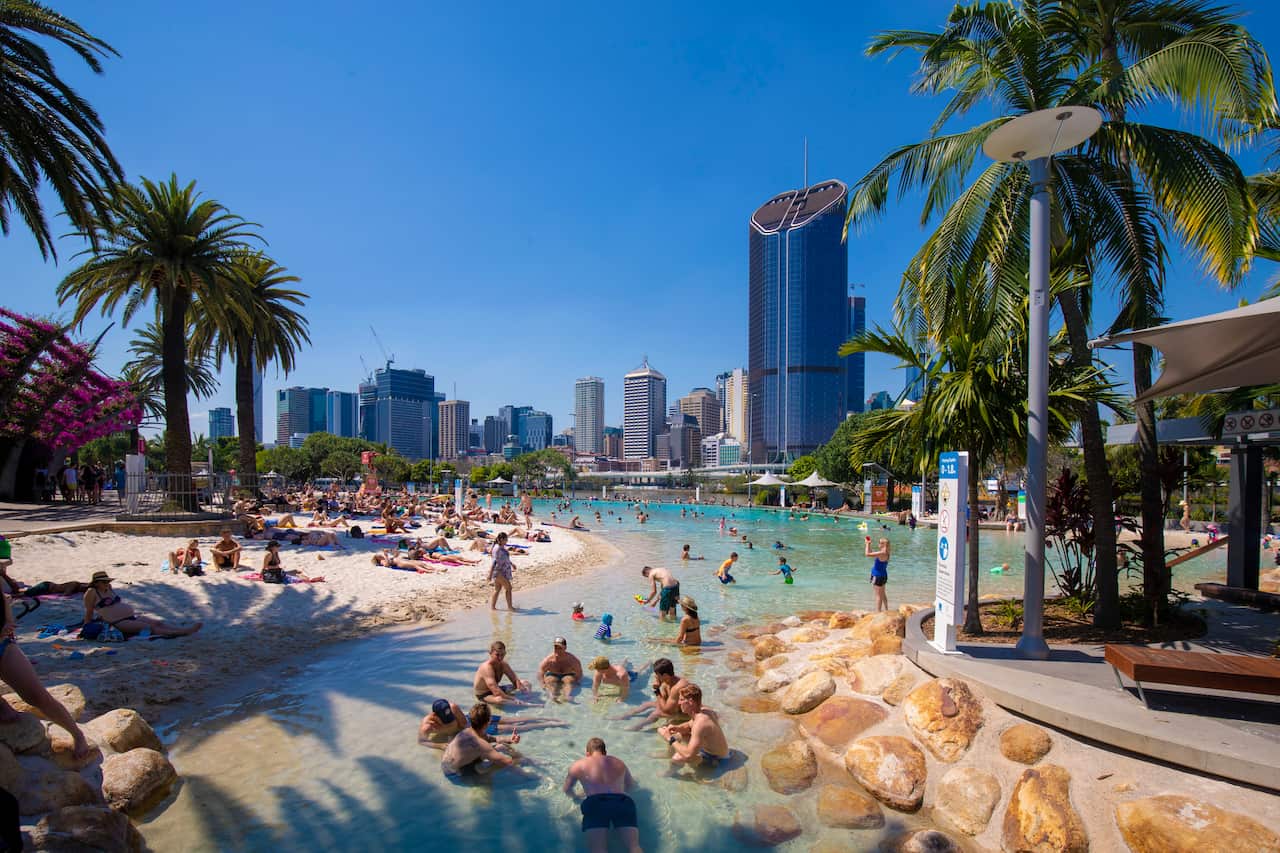
People gather at a beach with white sand and palm trees. Many are sat in the shallow water, while some lie on the sand. In the background, there are high rise buildings.

Streets Beach is a man-made inner-city beach on Brisbane’s south bank. It’s next to the Brisbane River, but uses chlorinated water rather than river water. Credit: Source: AAP / Glenn Hunt

Both Streets Beach and the Seine have lifeguards, increasing their accessibility.

“Even if you’re not a confident or experienced swimmer, you can still get in the water and have all those benefits and pleasures that come along with immersing yourself,” Olive said.
Perth’s Swan River has multiple dedicated swimming spots, including the Matilda Bay Reserve and Bicton Baths.
In Melbourne, the Yarra Pools initiative is a community-led push to introduce swimming to the lower Yarra River. Earlier this year, Melbourne Council commissioned a study to assess what would be required to make the Yarra River swimmable by 2050.
Another Australian example is western Sydney’s Penrith Beach, given the affectionate — or derisive, depending on your point of view — nickname ‘Pondi’, a play on the world-famous Bondi Beach in the city’s east. It’s a man-made beach located in the site of a former quarry next to the Nepean River.

The NSW government recently announced the beach would reopen for the third year in a row. As well as a place to swim, the beach also offers water safety and swimming lessons.
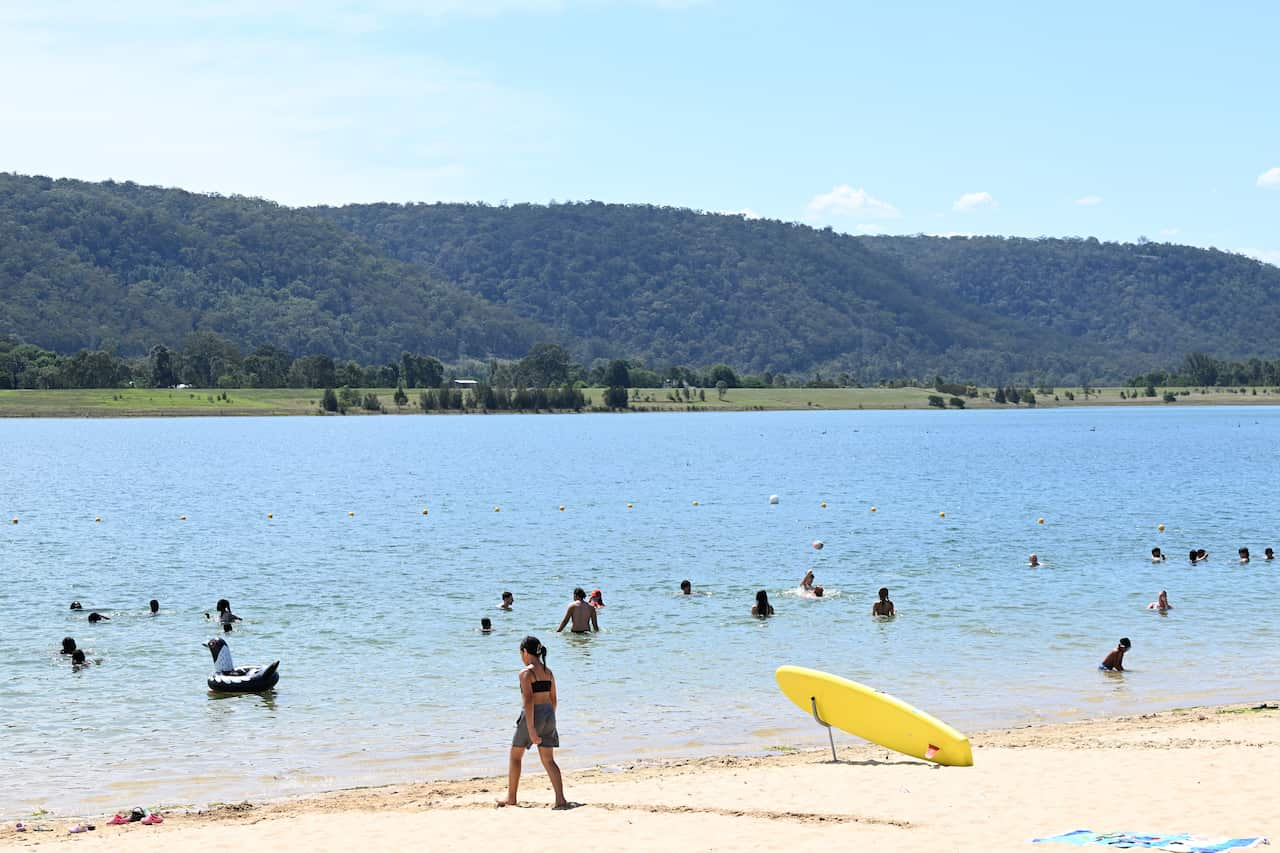
People swimming in a wide river. A yellow surfboard is on the sand in the foreground and in the distance there are green fields and forest.

Penrith Beach — also known as Pondi — provides people living in western Sydney with a more accessible place to swim than many of the city’s coastal beaches. Source: AAP / Source: AAP / Dan Himbrechts

Nicky Morrison was involved in the early stages of Penrith Beach’s development, providing supporting evidence for the Department of Planning and Environment’s places to swim grant program.

Projects like Penrith Beach help improve social equity, connectivity, “sense of belonging” and community pride, she said. It also provides an alternative for people in western Sydney so they don’t have to travel hours to the beach — an important consideration in Australia’s warming climate.


Western Sydney is an area of particular concern — it is typically 6 to 10 degrees hotter than the rest of the city when there’s extreme heat.
In this context, rivers are “an essential public infrastructure,” Morrison said.
“It is not a luxury. It’s a necessity.”
Share this @internewscast.com
You May Also Like
NSW Premier Chris Minns

Premier Addresses Planned Protests with Urgent Message on Public Safety

Chris Minns, who is pushing for parliament to grant “extraordinary powers” to…

Unraveling the Mysteries: What We Know and Don’t About the Alleged Bondi Gunmen’s Activities in the Philippines

Part of the investigation into Sunday’s Bondi Beach massacre involves the trip…
Chris Cairns is pictured with his estranged wife Melanie Crosser and their children before the triple health blow that almost killed him and left him paralysed

Cricket Legend Overcomes Cancer Struggles to Share Emotional Story of Marriage Split

Renowned cricket legend Chris Cairns has revealed details about the end of…
Aussies in one state to face public transport fare hike within days

Brace Yourself: Major Public Transport Fare Increase Looms for One Australian State

Starting January 1, commuters will face an additional 40 cents daily as…
Claudio Neves Valente, the suspect in Brown University shooting, at a rental car place in Boston, Massachusetts.

Reddit Sleuths Aid Police in Capturing Elusive Brown University Shooter: A Digital Manhunt

Police lights flashed for hours as law enforcement officers surrounded a storage…
Prince Andrew seen in Epstein files

New Epstein Documents Reveal Andrew Pictured in Controversial Lap Scene

A photograph of Andrew Mountbatten-Windsor lying on a couch has been released,…
PM orders review into law enforcement and intelligence agencies

Prime Minister Initiates Comprehensive Review of Law Enforcement and Intelligence Practices

Prime Minister Anthony Albanese has announced a review will be conducted into…
Albanese booed, Minns praised at Bondi Beach vigil

Albanese Faces Backlash, Minns Applauded: Bondi Beach Vigil Sparks Mixed Reactions

At Bondi Beach this evening, Prime Minister Anthony Albanese faced a mixed…
One teen said she made a new account to get around the ban

Albanese’s New Social Media Ban Faces Immediate Challenges as Students Find Ways to Circumvent Restrictions

Australia’s new social media restrictions for those under 16 are now in…

Donald Trump Confronts Internal Criticism Over Epstein Document Redactions

Extensive redactions and the partial release of documents related to convicted sex…

Misinformation Regarding Bondi Incident Leads to Vilification of Pakistani Australians

As misinformation tore through social media in the aftermath of the Bondi…
Inaccurate glucose readings pose direct risks. A falsely high reading may cause a diabetic to miss a dangerous low reading, while a falsely low reading can prompt an insulin overdose and severe hypoglycemia (stock)

Critical Alert: Faulty Diabetic Monitors Recalled Across 17 Countries – What You Need to Know

Abbott, a global leader in healthcare solutions, has initiated an extensive recall…