
Share this @internewscast.com
The bourbon boom appears to be losing its luster, as another American spirits company succumbs to financial woes, signaling a downturn in the once-thriving US whiskey and bourbon market.
Ohio-based AM Scott Distillery recently filed for bankruptcy on December 22, joining a growing list of distilleries struggling amid decreasing demand both domestically and internationally.
The decline in the industry has been further exacerbated by Canada’s retaliatory tariffs on American bourbon, a response to US trade policies.
Established in 2022 in Troy, Ohio, AM Scott Distillery produces a range of spirits including gin, vodka, and various bourbon and rye whiskeys. The company plans to continue its operations while undergoing a restructuring process and implementing cost-cutting measures.
This development follows closely on the heels of an announcement from Jim Beam, one of the most iconic bourbon brands in the United States. The company revealed it would be suspending production for at least a year at its storied distillery in Clermont, Kentucky—a significant move for a brand with nearly 230 years of history.
Its collapse comes just a week after Jim Beam, one of America’s most famous bourbon brands, announced it would halt production for at least a year at its historic distillery in Clermont, Kentucky — a rare retreat for a nearly 230-year-old name.
Together, the moves highlight a perfect storm battering the American whiskey industry.
For years, distillers raced to expand production, betting that demand for bourbon would keep climbing at home and abroad.

A sign urging shoppers to ‘Buy Canadian Instead’ in a Canadian retailer. US bourbon has been hit hard by a Canadian backlash linked to tariffs.
Instead, Americans are drinking less, younger consumers are turning away from booze, and exports have been battered by trade retaliation, with Canada leading the backlash.
Sales of American whiskey more than tripled between the early 2000s and the pandemic, fueled by cocktail culture, and a lockdown-era buying frenzy.
Distilleries expanded aggressively, laying down millions of barrels that must age for years before they can be sold. But that gamble is catching up with them.
Kentucky alone now has 16 million barrels of bourbon aging in warehouses — more than triple 15 years ago — just as Americans and others are buying less alcohol overall and retailers are sitting on excess stock.
Industry data show American spirits exports fell 9 percent year-over-year in the second quarter of 2025, with US whiskey hit especially hard.
The steepest drop came from Canada, once one of the industry’s most important markets, where exports collapsed by as much as 85 percent after trade tensions and retaliatory boycotts tied to policies under President Donald Trump.
Other major export markets are also buying less.
Shipments to the EU, the UK and Japan — which together account for the bulk of US spirits exports — have all fallen sharply this year, cutting off a key pressure valve for producers drowning in too much whiskey.

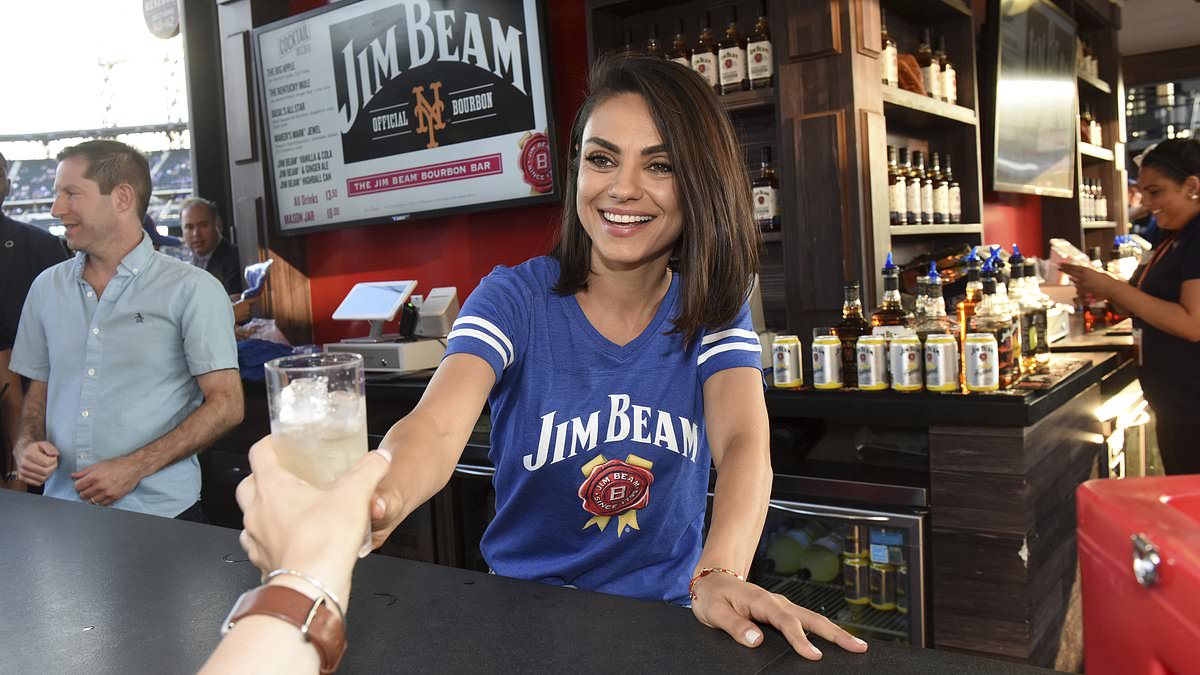
Mila Kunis, Jim Beam’s global brand partner, surprises fans at Citi Field’s Jim Beam Bourbon Bar during a New York Mets game in July 2018.

Well-known Kentucky whisky business Garrard County Distilling collapsed in the spring
Americans are also changing how they drink.
Polls show people are consuming less alcohol than they have in decades, driven by health concerns, rising prices, and competition from alternatives like ready-to-drink beverages, cannabis products and weight-loss drugs.
Younger drinkers, especially Gen Z, are drinking less frequently and tending to buy higher-end bottles in smaller quantities.
That shift is particularly painful for brands like Jim Beam, which still rely heavily on high-volume, lower-priced staples such as its White Label bourbon.
The slowdown is not limited to Jim Beam. In recent months, Diageo paused distilling at its George Dickel facility in Tennessee.
Brown-Forman, the maker of Jack Daniel’s, announced layoffs affecting about 12 percent of its workforce.
Several smaller whiskey companies have entered receivership, and contract distillers say orders have fallen sharply as brands pull back.
In August, Luca Mariano Distillery in Danville, Kentucky, filed for bankruptcy under the weight of roughly $25 million in debt.

The iconic Kentucky Owl whiskey, which was founded in 1879, fell into bankruptcy last year
Earlier in the year, the $250 million Garrard County Distilling operation was shut down after it failed to pay its lenders.
And in late 2023, the historic Kentucky Owl brand, founded in 1879, also collapsed, blaming falling sales and a cyberattack that brought production to a halt.
Whiskey expert Fred Minnick said the move echoes previous boom-and-bust cycles the industry has seen before.
‘It’s a sad day for bourbon, to be honest with you,’ Minnick told the New York Times. ‘For this to happen is a real punch in the gut.’