Share this @internewscast.com
WASHINGTON – In a move shrouded in secrecy, the Trump administration reinstated a policy that curtails the ability of Congress members to access immigration detention centers. This development follows closely on the heels of a tragic incident where a federal immigration officer fatally shot a woman in Minneapolis. On Monday, attorneys representing several Democratic lawmakers urged a federal judge to take swift action.
Three Democratic representatives from Minnesota found themselves barred from entering an Immigration and Customs Enforcement (ICE) facility in the vicinity of Minneapolis on Saturday. This occurred merely three days after the fatal shooting of Renee Good, a U.S. citizen, by an ICE officer in the city.
In a significant ruling last month, U.S. District Judge Jia Cobb, based in Washington, D.C., had temporarily halted ICE from enforcing its restrictive access policies on Congress members. On Monday, attorneys representing the affected lawmakers filed a request with Judge Cobb, seeking an emergency hearing to determine whether the reintroduced notice policy contravenes her prior ruling.
Judge Cobb’s decision on December 17 highlighted the probable illegality of ICE’s demand for a week’s notice from Congress members wishing to visit and examine conditions within ICE facilities. She noted that the seven-day advance notice requirement likely oversteps the statutory authority vested in the Department of Homeland Security (DHS).
The urgency of the situation is further underscored by ongoing negotiations over funding for DHS and ICE for the upcoming fiscal year, with current appropriations set to lapse on January 30. Lawyers pressing for an emergency hearing emphasize the importance of this moment for congressional oversight.
“This is a critical moment for oversight, and members of Congress must be able to conduct oversight at ICE detention facilities, without notice, to obtain urgent and essential information for ongoing funding negotiations,” the attorneys asserted in their filing.
Cobb didn’t immediately rule on the plaintiffs’ hearing request. Government attorneys also didn’t immediately respond in writing to it.
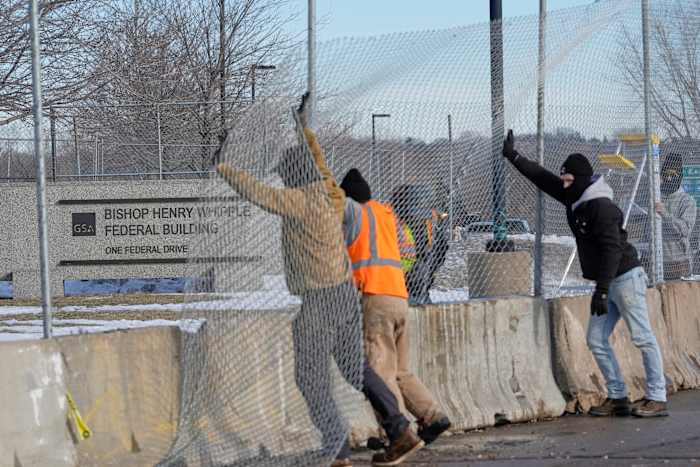
On Saturday, U.S. Reps. Ilhan Omar, Kelly Morrison and Angie Craig attempted to tour the ICE facility in the Minneapolis federal building. They initially were allowed to enter but then told they had to leave about 10 minutes later.
Officials who turned them away cited a newly imposed seven-day-notice policy for congressional oversight visits. Last Thursday, a day after Good’s death, U.S. Department of Homeland Security Secretary Kristi Noem secretly signed a new memorandum reinstating the same seven-day notice requirement, according to the plaintiffs’ lawyers.
Cobb, who was nominated to the bench by Democratic President Joe Biden, ruled last month in favor of 12 other members of Congress who sued to challenge ICE’s amended visitor policies after they were denied entry to detention facilities. Their lawsuit accused Republican President Donald Trump’s administration of obstructing congressional oversight of the centers during its nationwide surge in immigration enforcement operations.
Government attorneys had argued that the plaintiffs didn’t have legal standing to bring their claims. They also said it’s merely speculative for the legislators to be concerned that conditions in ICE facilities change over the course of a week. But the judge rejected those arguments.
“The changing conditions within ICE facilities means that it is likely impossible for a Member of Congress to reconstruct the conditions at a facility on the day that they initially sought to enter,” Cobb wrote.
A law bars DHS from using appropriated general funds to prevent members of Congress from entering DHS facilities for oversight purposes. Plaintiffs’ attorneys from the Democracy Forward Foundation said the administration hasn’t shown that none of those funds are being used to implement the latest notice policy.
Copyright 2026 The Associated Press. All rights reserved. This material may not be published, broadcast, rewritten or redistributed without permission.