
Share this @internewscast.com
NASA has undertaken its inaugural medical evacuation from the International Space Station (ISS), swiftly bringing a quartet of astronauts back to Earth due to a health emergency in space.
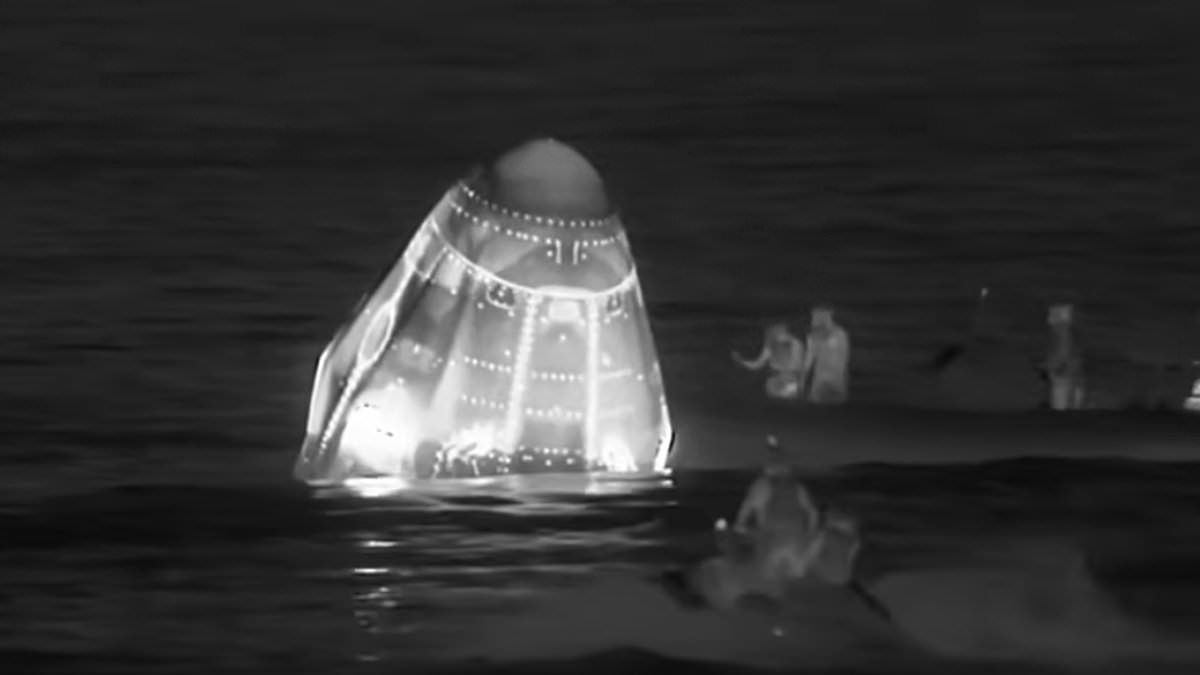
The Crew-11 spacecraft made a successful splashdown in the Pacific Ocean near San Diego, California, at around 3:41 a.m. ET on Thursday. This marked the conclusion of an approximately 10-hour journey back from the ISS, which the crew departed just a day earlier.
The urgency of the return was due to a medical condition that NASA’s flight surgeons assessed could not be properly managed in the microgravity environment of space.
Aboard the spacecraft were NASA astronauts Zena Cardman and Mike Fincke, joined by Japanese astronaut Kimiya Yui and Russian cosmonaut Oleg Platonov.
To re-enter Earth’s atmosphere, the spacecraft ignited its engines at 2:50 a.m., braving the intense heat of re-entry. It then deployed four parachutes, effectively decelerating its descent into the ocean just in time for a safe splashdown.
Recovery teams, equipped with medical experts, promptly retrieved the capsule from the sea. They conducted initial health checks on the astronauts before transporting them via helicopter and jet to NASA’s Johnson Space Center in Houston for comprehensive medical evaluations.
The American space agency has declined to identify the affected crew member or disclose the nature of the condition, citing medical privacy.
NASA administrator Jared Isaacman decided to bring the crew home early out of an abundance of caution, noting that the astronaut’s medical episode was considered ‘serious’ and would require additional medical care on Earth.

The spacecraft fired its engines to deorbit at 2:50am before enduring a fiery re-entry through Earth’s atmosphere, deploying four parachutes to slow its descent into the ocean

Crew-11 before leaving the ISS. Roscosmos cosmonaut Oleg Platonov (Back left), NASA astronaut Mike Fincke (Front left), JAXA astronaut Kimiya Yui (Front right), and NASA’s Zena Cardman (Back right)
NASA’s chief medical officer, Dr James Polk, said last week they were in stable condition and were not in any immediate danger.
He noted that the astronaut’s medical condition had nothing to do with an upcoming spacewalk on January 8, which was cancelled, or any other operations on board the station.
NASA is set to host a live conference at 5:45am to discuss the astronauts’ return.
Boats swarmed the capsule as it bobbed on top of the water, which pulled the craft towards a recovery vessel in the distance, following splashdown.
The capsule was then hoisted onto the vessel, and the SpaceX ground team quickly went to work cooling it down and removing any debris that may have attached to the hatch door during the descent.
The hatch was opened at 3:19am, giving the astronauts their first breath of fresh air since launching to the ISS on August 1.
Medical doctors were the first to meet the crew for a quick routine health check.
Fincke was the first to emerge from the capsule, followed by Cardman, Platonov and Yui.

The SpaceX Dragon capsule hit the water at 3:41am, brining the four-person Crew-11 home

The return capsule was hoisted onto a recover vessel that was waiting nearby in the Pacific Ocean

Pictured is the first look at the astronauts after splashing down in the Pacific Ocean
‘It’s so good to be home,’ said Cardman, the capsule commander. This was her first space mission.
Each astronaut was put on a stretcher, as they had been in zero-gravity for more than 100 days, and then carried off for more medical tests.
The four astronauts who were evacuated had been trained to handle unexpected medical situations, said Amit Kshatriya, a senior NASA official, praising how they have dealt with the situation.

Michael Fincke was the first to emerge from the capsule (PICTURED)

Pictured is cosmonaut Oleg Platonov after emerging from the capsule
The four astronauts were scheduled to leave after Crew-12 arrived on a new SpaceX Dragon capsule no earlier than February 15.
Until their arrival, a group including NASA astronaut Chris Williams, who arrived at the ISS aboard a Russian Soyuz spacecraft in November 2025, will be maintaining the station.
The evacuation followed NASA’s Spaceflight Human-System Standard, which mandates contingency return procedures whenever onboard medical resources are insufficient.
Although statistical models have long predicted that such an event could occur roughly once every three years, the plan has never before been used.
Located 250 miles above Earth, the ISS functions as a testbed for research that supports deeper space exploration, including eventual missions to return humans to the moon and onward to Mars.
The ISS is set to be decommissioned after 2030, with its orbit gradually lowered until it breaks up in the atmosphere over a remote part of the Pacific Ocean called Point Nemo, a spacecraft graveyard.