
Share this @internewscast.com
Nine U.S. fighter jets have been dispatched following the sighting of five Russian warplanes approaching Alaska, highlighting a notable moment of aerial tension. The North American Aerospace Defense Command (NORAD) reported on Thursday that it had detected and monitored several Russian military aircraft operating within the Alaskan Air Defense Identification Zone (ADIZ).
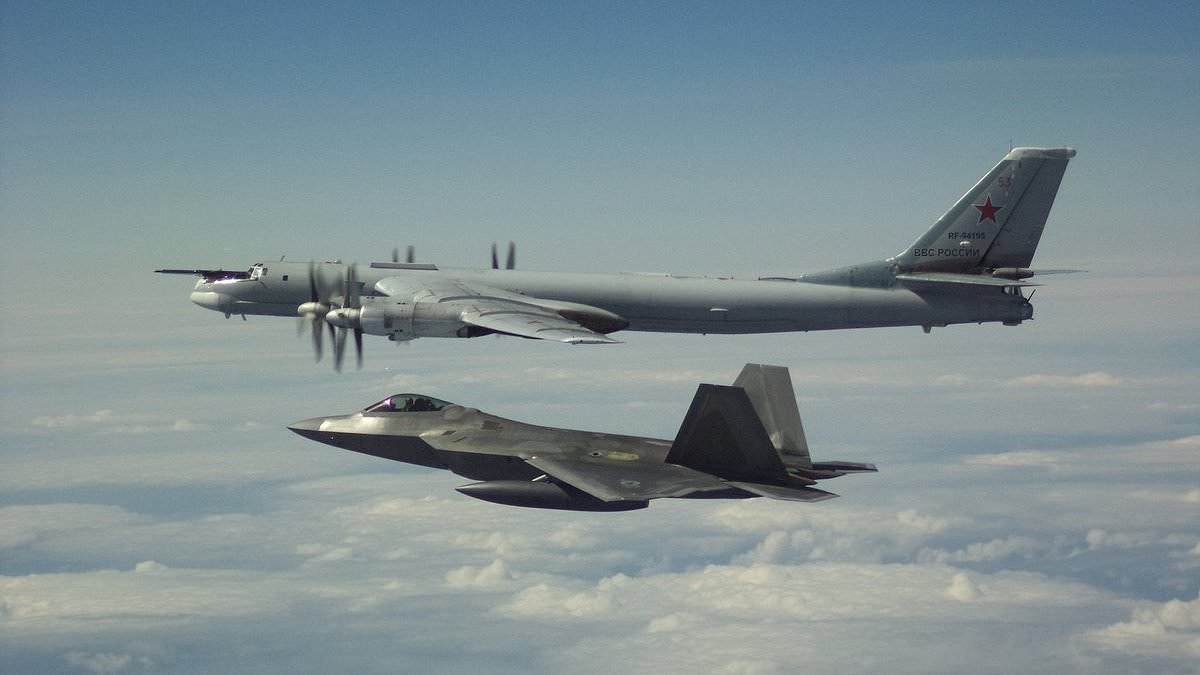
According to NORAD, the aircraft identified included two Russian Tu-95 bombers, two Su-35 fighter jets, and an A-50 airborne early warning and control aircraft. These aircraft were spotted maneuvering in the vicinity of Alaska, prompting a swift response from U.S. defense forces.
In response, NORAD scrambled a fleet comprising two F-16 fighters, two advanced F-35 stealth fighters, an E-3 Sentry AWACS, and four KC-135 Stratotanker aerial refueling planes. This formidable lineup was tasked with intercepting, identifying, and escorting the Russian planes as a precautionary measure.
Despite the proximity of the Russian aircraft, they remained in international airspace, carefully avoiding both U.S. and Canadian sovereign airspace, as stated by NORAD. The American jets closely monitored the Russian planes until they exited the Alaskan ADIZ.
NORAD pointed out that the presence of Russian aircraft in the ADIZ is a common occurrence and is not considered a direct threat. This routine activity underscores the ongoing vigilance required in monitoring airspace boundaries between nations.
NORAD said Russian aircrafts are regularly seen in the ADIZ, and the activity is ‘not seen as a threat’.
In September of last year, the US also scrambled fighter jets to intercept Russian Tu-95s and Su-35s spotted in the Alaskan ADIZ.
That came just weeks after a Russian IL-20 COOT aircraft was intercepted by NORAD four times in a week.

NORAD F-16 Fighting Falcon fighter aircraft positively identified and intercepted Russian Tu-95 and Su-35 military aircraft over the Bering Sea off Alaska’s western coast July 22, 2025

Two pairs of F-22 fighter jets, each with an E-3 intercepted Tu-95 bombers Su-35 fighter jets entering the Alaskan ADIZ in 2019
And in September 2024, NORAD shared a video showing a Russian fighter jet flying very close to a US aircraft in the ADIZ.
In July of that same year, Chinese bombers along with Russian planes were also intercepted, in the first joint entry into the ADIZ.
The Russian Tu-95MS ‘Bear’ turboprop and Chinese H-6 jet were intercepted close to Alaska.
The Alaskan ADIZ is an area of international airspace that begins where US and Canadian sovereign airspace ends.
NORAD says it is a ‘defined stretch of international airspace that requires the ready identification of all aircraft in the interest of national security.’
The five planes appearing in the ADIZ come as Russia was spotted carried out military drills with Iran on Thursday.

A Russian ship during the joint Navy exercise in the Gulf of Oman

Members of the Iranian Army attend the joint Navy exercise of Iran and Russia in southern Iran
The announcement of the joint naval exercises in the Gulf of Oman came as the USS Gerald R. Ford, the world’s largest aircraft carrier, arrived near the mouth of the Mediterranean Sea, joining other military assets the US has built up in the region.
The drills follow Tuesday’s Revolutionary Guards’ exercises in the Strait of Hormuz, the narrow opening of the Persian Gulf through which a fifth of the world’s traded oil passes.
Tehran temporarily shut down parts of the vital waterway and fired cruise missiles, in a stark warning of the potential fallout to the world economy if the US goes through with its threats to attack Iran.
The military exercises ran parallel to diplomatic talks in Geneva, where Abbas Araghchi, the Iranian foreign minister, held a second round of indirect nuclear talks with Jared Kushner and Steve Witkoff on Tuesday.
JD Vance, the US Vice-President, subsequently warned that the theocratic regime was failing to acknowledge Trump’s ‘red lines’, amid a heavy build up of American warplanes travelling to the Gulf.
The movements of additional American warships and airplanes don’t guarantee a US strike on Iran – but it does give President Trump the ability to carry out one should he choose to do so.