
Share this @internewscast.com
The University of Southern California (USC) has introduced a new policy at its campus gym, reserving a section of the facility exclusively for female and non-binary students. This decision follows complaints from these groups about feeling uncomfortable due to the presence of male peers.
According to a report by the Daily Trojan, USC’s student newspaper, this policy will be in effect from April 6 to May 15 as a trial period. During this time, men will be prohibited from entering the Robinson Room at the Lyon Center on Mondays and Wednesdays between 10 a.m. and 11 a.m.
This initiative was spearheaded by the Student Assembly for Gender Empowerment (SAGE) and subsequently approved by the Lyon Center. SAGE is described as an inclusive organization that supports queer and transgender individuals and organizes events to address gender-related issues affecting students, faculty, and staff.
The organization states on its website that its mission is to amplify all voices oppressed by patriarchal systems in dynamic and critical ways.
Jana Alnajjar, a sophomore and SAGE’s advocacy liaison, explained to the campus newspaper that the idea for a dedicated space arose after receiving numerous complaints from women and non-binary students. Alnajjar expressed a desire to create a trial space where these students could feel more comfortable and safe.
SAGE’s advocacy liaison, sophomore Jana Alnajjar, told the campus newspaper that she wanted to test out this space reserved for women and non-binary students after hearing similar grievances from many of them.
Multiple people told her they were getting approached regularly or being looked up and down.
‘Over time, that discomfort leads them to stop trying to go to the gym altogether,’ Alnajjar said.

The campus gym at the University of Southern California will ban men from a certain area of the gym two days a week, one hour per day. The space will be reserved for female and non-binary students (Pictured: Students walk the USC campus on March 9, 2020)
Mengze Wu, a senior studying neuroscience, told the newspaper that she often tries to work out near other women to feel more at ease.
‘My past experiences with being in enclosed spaces where it’s very men-dominated has never been super pleasant,’ she said.
Alnajjar said getting this restricted space going took months of planning and negotiations with the Lyon Center.
She mentioned that the federal restrictions on diversity, equity and inclusion (DEI) hampered the initial proposals and made her question whether it would be viable at all.
The university’s own policy also states that the usage of all its facilities, not just its gyms, is open to all students and faculty regardless of their race or gender.
Eventually, Alnajjar was able to work something out with university officials. The restricted space will not take up the entire gym floor in the Robinson Room.
She said she hopes 20 to 40 students use the space so her organization can lobby for more space and longer hours.
The Daily Mail approached the university’s administration for further comment.

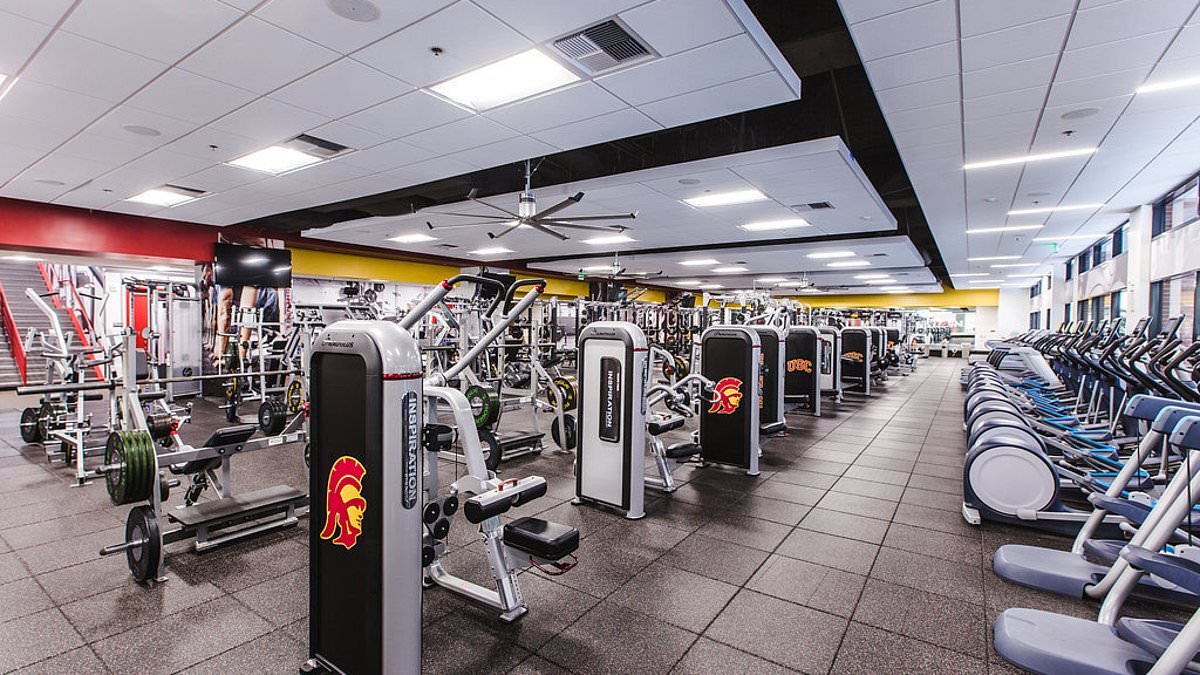
Pictured: The interior of the campus gym, the Lyon Center
In October 2025, USC became one of the nine colleges that received President Donald Trump’s ‘Compact for Academic Excellence’.
The proposal, while not an official executive order, aims to provide preferential funding opportunities to universities that comply with certain requests from the administration.
These include banning race or gender considerations in admissions, limiting international student enrollment and zero tolerance for viewpoint discrimination against conservatives.
The majority of the universities that were hit with the compact declined to adhere to it, including USC. None of the universities signed the agreement, though some showed openness to incorporating the administration’s ideas.
‘We are concerned that even though the Compact would be voluntary, tying research benefits to it would, over time, undermine the same values of free inquiry and academic excellence that the Compact seeks to promote,’ USC Interim President Beong-Soo Kim wrote to the administration on October 16.
None of the recipients of the compact have been directly punished by the administration for not signing onto it, though some of them did suffer federal funding freezes for other reasons.
This includes Brown University and the University of Pennsylvania. Brown restored the frozen $510 million in July 2025 after making a deal with the federal government, while UPenn got its $175 million in grants back after committing to restrict transgender females from women’s sports.