
Share this @internewscast.com
Queen Camilla has opened up for the first time about a harrowing incident from her teenage years, when she bravely defended herself against a sexual attacker on a train.
The revelation came during a conversation with BBC racing commentator John Hunt, whose family faced a tragic ordeal last year when his wife and two daughters were murdered. This discussion was part of a broader dialogue on Radio 4’s Today programme, focusing on issues of violence against women and misogyny.
Reflecting on the incident, Queen Camilla shared her feelings of intense anger and fury following the attack, which occurred while she was traveling to see her mother.
The Queen admitted that she had ‘sort of forgotten’ about the experience until she was inspired by the bravery of Mr. Hunt and his eldest daughter, Amy, prompting her to share her own story.
“I remember something that had been lurking in the back of my brain for a very long time,” she recalled. “That, when I was a teenager, I was attacked on a train… I remember at the time being so angry.”
During the panel, which was guest edited by former Prime Minister Baroness Teresa May, Camilla recounted how she courageously ‘fought back’ against her attacker, highlighting her resilience and strength in the face of danger.
She said: ‘Somebody I didn’t know. I was reading my book, and you know, this boy, man, attacked me, and I did fight back.

Queen Camilla has spoken for the first time about her ordeal as a young victim of indecent assault in a moving radio broadcast

The Queen previously recorded a radio broadcast with BBC racing commentator John Hunt and his daughter Amy, whose family were murdered at their home

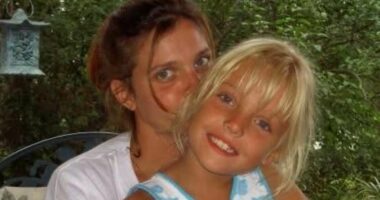
Pictured: Carol, John, Amy, Louise and Hannah Hunt
‘And I remember getting off the train and my mother looking at me and saying, “Why is your hair standing on end”, and “Why is the button missing from your coat”.
‘But I remember anger, and I was so furious about it, and it’s sort of lurked for many years.
‘And I think, you know, when all the subject about domestic abuse came up, and suddenly you hear a story like John and Amy’s, it’s something that I feel very strongly about.’
The Queen has campaigned for more than a decade on the issue of sexual violence against women and domestic abuse, making it a cornerstone of her public work.
This morning she praised the courage of the Hunt family, saying: ‘I’d just like to say, wherever your family is now, they’d be so proud of you both.
‘And they must be from above smiling down on you and thinking, my goodness me, what a wonderful, wonderful father, husband, sister.
‘They’d just be so proud of you both.’
And after hearing Camilla’s story, Amy Hunt told her: ‘Thank you for sharing that, Your Majesty. It takes a lot to share these things because every woman has a story.’
The Queen’s sex attack ordeal was first reported earlier this year in a book titled Power and the Palace by journalist Valentine Low.
It emerged that the royal had fought off a sex pest on a train as a teenager by hitting him in the groin with her shoe before reporting it to police. The man was arrested.
Low said Her Majesty had confided in former London Mayor Boris Johnson about the incident during a private meeting at Clarence House in 2008 to discuss her opening a new women’s refuge.

Britain’s King Charles III and Queen Camilla attend the ceremonial welcome at Windsor Castle on December 3

John Hunt (pictured with Carol) and his surviving daughter, Amy, were invited by the Queen to Clarence House in November to discuss issues around women and violence
He told his former communications director, Guto Harri, who many years later recalled it to Low.
While Camilla, 78, had never intended for the story ever to be made public – and indeed would have been guaranteed lifetime anonymity as a victim of a sex crime – a palace source responded saying her attitude was that: ‘If some good comes of this publication, which is that the wider issues are discussed, it de-stigmatises the whole topic and empowers girls today to take action and seek help, and to talk about it, then that’s a good outcome.’
Louise Hunt, 25, and her sister Hannah, 28, were murdered alongside their mother Carol, 61, by Louise’s ex-partner Kyle Clifford – who had armed himself with both a crossbow and a knife – at their home in Bushey, Hertfordshire, on July 9 last year.
Clifford, 27, was sentenced to a whole life order in March, after pleading guilty to the murders and receiving a further conviction for raping Louise, which he had denied and in doing so forced her family to sit through days of distressing evidence.
It was described as a brutal and cowardly attack motivated by ‘self pity’ by spineless and controlling man who couldn’t handle even Louise’s kind and gentle attempts to split up with him.
After his murderous attack Clifford went on the run and tried unsuccessfully to kill himself when the police caught up with him.
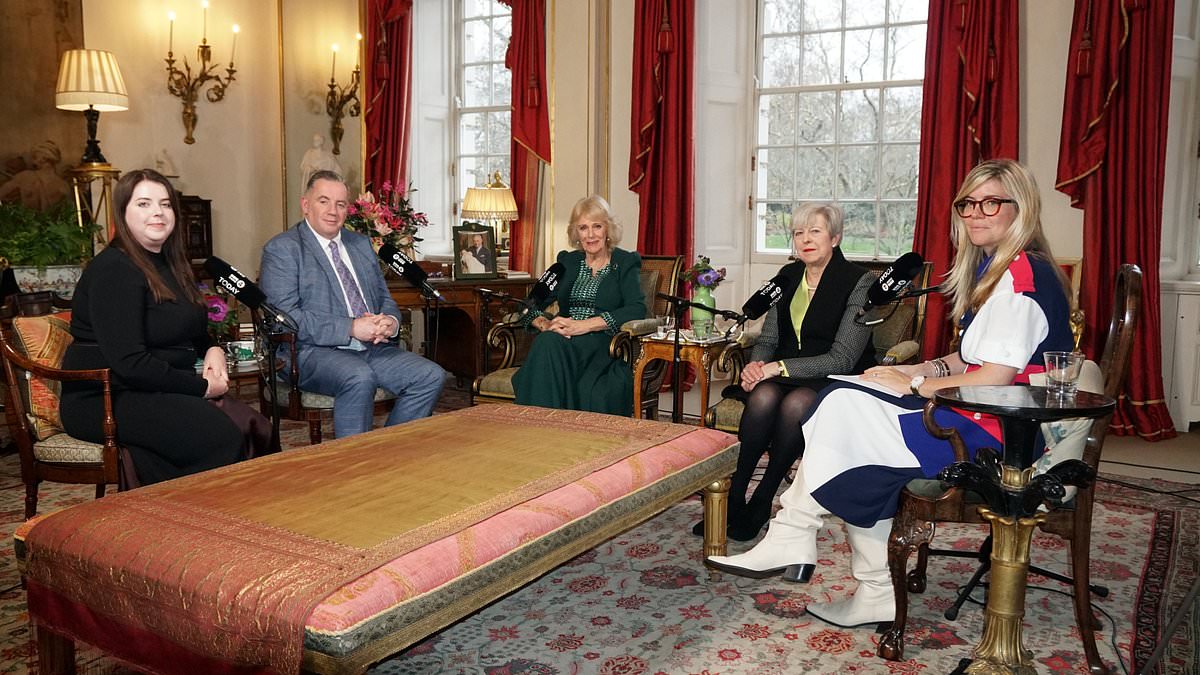
John Hunt and his surviving daughter, Amy, were invited by the Queen to Clarence House in November to discuss issues around women and violence with Today host Emma Barnett.
It is understood that Camilla is particularly keen to lend her support to calls for more education in schools to counter misogyny.
Today’s broadcast comes ahead of a fundraising gala for a new Hunt Family Fund, set up in memory of Carol, Louise and Hannah, which will take place on Thursday evening to support causes that that help and inspire young women.
Speaking of the Queen’s decision to take part in the broadcast, a senior royal aide stressed that she had previously chosen not to talk about her experience as she has always wanted the focus of her work championing the victims and survivors of domestic and sexual violence to be on the stories of other women.
‘While it is not a situation of her choosing, now that it has been put in the public domain she decided to talk about it with John and Amy in the particular context of misogyny and the patterns of behaviour that lead to it,’ they said.
‘Her Majesty is keen not for the specifics of her case to be trawled over and it is important to stress that it is not what has inspired her work in this field. Nor has not been a lifelong stigma or shame that she has carried with her.
‘However it has given her perspective and some understanding of the issues involved around violence against women and formed a [natural] part of their conversation focusing on calling out patterns of behaviour during an incredibly emotive meeting.’