
Share this @internewscast.com
Residents in certain areas may face a significant 75% hike in council tax as Labour highlights its strategy to redistribute funds from wealthier regions to support struggling municipalities.
Under a new funding approach in England, central government funds will be redirected to the most “deprived” regions, putting pressure on other areas to either cut services or generate additional local revenue.
Six London boroughs, known for their historically low council tax rates, will see the 5% cap on increases lifted for the next two years. Government officials are encouraging these areas to raise their rates, with the Institute for Fiscal Studies (IFS) indicating potential 75% increases in Wandsworth and Westminster.
Other councils with below-average tax rates are being advised to seek “exceptional” permission to exceed the traditional cap. They are also being encouraged to explore options like increasing taxes on second homes.
The IFS has cautioned that it will be challenging for ministers to maintain the stance that most councils should cap tax hikes at 5% annually until 2029, a rate already surpassing inflation.
Conversely, some areas stand to gain significantly, such as Birmingham, which has been facing financial difficulties. The Labour-run city is expected to see a 45% increase in its “core spending power” by the fiscal year 2028-29.
A Labour source said: ‘The days of Rishi Sunak shovelling money to Tunbridge Wells then bragging about it at garden parties are over.
‘Deprivation is now back at the heart of council funding. The places that were devastated by Tory austerity will get the support they need to get back on their feet.
‘This is the difference a Labour Government makes.’

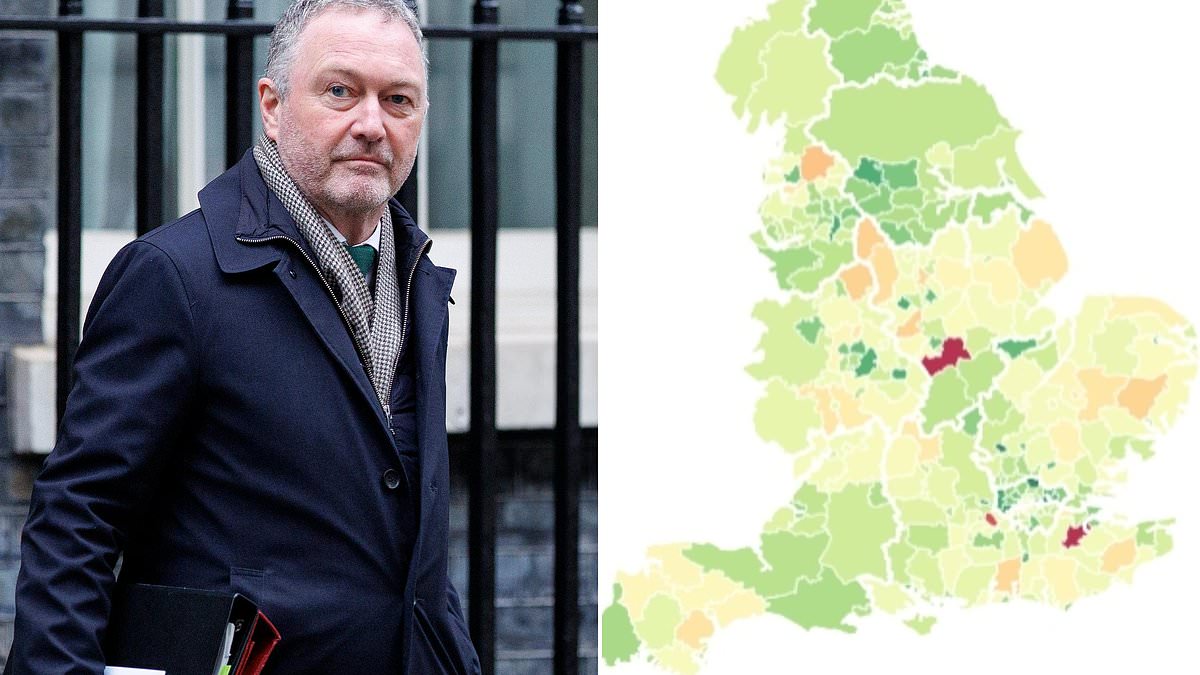
This chart from the IFS shows how shire district councils dominant the losers from the government’s reforms
Overall, English councils will receive £78billion for essential services next year as part of a new multi-year funding settlement, which sets out local government finances for the three years up to 2029.
According to the Ministry of Housing, Communities and Local Government (MHCLG), councils will see an increase of 23 per cent in their core spending power compared to 2024-25 by the end of the multi-year settlement.
This can be used to pay for services like bin collections, housing and children’s services.
The Tories condemned Labour’s plan as ‘fiddling’ the figures, accusing the Government of a ‘nakedly political power grab’.
But local government secretary Steve Reed said: ‘This is a chance to turn the page on a decade of cuts, and for local leaders to invest in getting back what has been lost – to bring back libraries, youth services, clean streets, and community hubs.
‘Today we’re making sure every community has the funding they need to succeed.’
An updated funding system aims to make more money available for areas with the greatest need, with the most deprived 10 per cent of councils seeing a 24 per cent per head boost.
Details of the settlements for specific councils revealed the percentage change in core spending power from 2024/25 to 2028/29, assuming local authorities increase council tax in line with the maximum of 5 per cent.
Birmingham (45.3 per cent), Bradford (46.9 per cent), Barking and Dagenham (47.9 per cent), Coventry (46.5 per cent), Derby (46.8 per cent), Enfield (58.2 per cent), Hillingdon (47.1 per cent), Hounslow (52.1 per cent), Luton (63.4 per cent), Manchester (46.8 per cent), Newham (52.8 per cent) and Slough (47 per cent) were among the biggest winners.
Ashfield (-3.8 per cent), Ashford (-3 per cent), Derbyshire Dales (- 3.4 per cent), Harborough (-15.8 per cent), High Peak (-4.5 per cent), Horsham (-3.9 per cent), Mid Suffolk (-4.3 per cent), North West Leicestershire (-4.3 per cent), Ribble Valley (-5.5 per cent), Runnymede (-12.5 per cent), and Tonbridge and Malling (-15 per cent) were among the biggest losers.
County and district councils – many of which are already teetering on the brink of bankruptcy – have already warned they will face huge pressure to hike levies in order to make ends meet.
The Government argues that some councils benefit disproportionately from the existing system, enabling them to build up financial reserves while others ‘struggle to cope’.
Unveiling the new system last month the Ministry for Housing, Communities and Local Government (MHCLG) said ‘taking account of the differing ability to raise funds’ would mean ‘all local authorities will be able to provide the same level of service to residents’.
The five London authorities having the 5 per cent cap on increases waived are Wandsworth, Westminster, Hammersmith and Fulham, City of London, Kensington and Chelsea, and Windsor and Maidenhead.
MHCLG said 500,000 households in these areas already have ‘very low bills’, with a typical Band D paying between £450 and £1,280 a year less than the average for England.
The funding reforms are part of a wider effort to ‘fix the foundations of local government’ under the Government’s plan for change.
This includes consolidating grants, reducing bureaucracy and enabling councils to invest in prevention to tackle the root causes of rising costs through reforming children’s social care and a new homelessness and domestic abuse grant, the department said.
Tendring, Blackpool, Rotherham and Hastings are among the areas highest on the deprivation rankings that will help dictate funding.
Join the debate
Is it fair for wealthier areas to face higher council tax to fund services in more deprived regions?

The Government is facing a bitter backlash after unveiling a ‘fairer’ funding system targeting central resources on areas classified as suffering ‘deprivation’

Local Government Secretary Steve Reed said: ‘This is a chance to turn the page on a decade of cuts, and for local leaders to invest in getting back what has been lost – to bring back libraries, youth services, clean streets, and community hubs.’
Senior Tory MP Sir James Cleverly, the shadow local government secretary, said: ‘Labour say they want to make local government funding ‘fair’, but are instead launching a nakedly political power grab.
‘The Government is fiddling the funding model to punish councils that keep council tax low and moving funding to badly-run Labour councils that spend irresponsibly.
‘Inevitably, councils that lose out will be forced to cut services or raise tax – and with referendum principles scrapped, those hikes will be big.
‘This is part of Labour’s mission to hike council tax across the board. Hidden behind their rhetoric about supporting local government is a council tax bombshell, with the average family in a Band D home facing a cumulative £1,143 council tax increase across this Parliament.
‘Under Labour, ordinary people are paying more for less. Only the Conservatives will keep tax on the family home down and ensure residents get a fair deal across the country.’
Cllr Jeremy Newmark, finance spokesperson for the District Councils’ Network (DCN), said: ‘As with any local government settlement there are winners and losers.
‘While some councils are getting a reprieve from the prolonged period of spending restraint, other councils may have little option but to scale back services over the next few years.’
Cllr Steven Broadbent, Finance Spokesperson for the County Councils Network, said: ‘Overall, the three-year settlement outlined today will be extremely challenging and will leave many of member councils facing a substantial funding shortfall over the course of this parliament.
‘It is simply unrealistic to expect them to provide vital care services while receiving deep reductions in government grant and more councils may now have to apply for exceptional financial support.
‘The CCN will analyse this settlement in full and set out its consultation response but it is vital that the government makes more money available to mitigate the impact of the most recent – and unfair – changes to their proposals and ensure all councils have the resources they need to prevent severe cuts to services.’
Kate Ogden, a senior research economist at the IFS, said: ‘With councils’ finances still under pressure from rising demands and costs, the Government may find it hard to hold the line that limit-busting council tax increases will only take place in ‘exceptional cases’ and where bills are currently below average.’
She added: ‘Overall, it is welcome that the Government has finally grasped the funding reform nettle.
‘For arguably two decades, England has lacked a proper system for allocating funding between councils.
‘The new system involves subjective decisions that not everyone will agree with though, including the big redistribution of funding from more affluent to more deprived parts of England.’
The settlement announced on Wednesday also includes other changes, including letting councils keep all additional council tax from new homes to encourage local growth and home ownership.
The £600million Recovery Grant introduced last year will continue throughout the three-year settlement, which aims to help areas hit hardest by underfunding.
A new Recovery Grant Guarantee will also protect upper-tier councils receiving this money, giving them above-inflation increases while they adapt to the new funding system.