Share this @internewscast.com
In a turn of events that has captured public attention, Prince Harry and Meghan Markle faced what seemed to be a diplomatic snub from Jordan’s royal family during their visit to the Middle East. Notably absent from their itinerary was any meeting with King Abdullah II, Queen Rania, or Crown Prince Hussein, signaling a distance in relations.
The British Government has also taken a step back from the couple’s trip, as revealed by the Daily Mail. This distancing comes in light of criticism surrounding the Sussexes’ recent engagement with Phillip Hall, the British Ambassador in Amman.
Former Conservative minister Tim Loughton expressed disapproval over the couple’s presence at an event hosted by Mr. Hall. He argued it was “entirely inappropriate” for them to be treated with such diplomatic courtesies given their status as private citizens.
While the Foreign Office has refrained from commenting on the two-day visit, sources close to the situation clarified that the British Ambassador had not directly extended an invitation to Prince Harry and Meghan for the Iftar reception. Instead, the invitation was originally made to Dr. Tedros Adhanom Ghebreyesus, the Director-General of the World Health Organization. It was Dr. Tedros who then invited the Duke and Duchess to accompany him as his guests.
But a source with knowledge of the trip has said the British Ambassador had not invited Harry and Meghan to his reception marking Iftar – the meal eaten by Muslims at sunset to break their fast during Ramadan.
The invitation had been to Dr Tedros Adhanom Ghebreyesus, Director-General of the World Health Organization (WHO). He had then asked the Duke and Duchess along as his guests, it is understood.
The source insisted that the British Government had not been involved in arranging or facilitating their trip because they are ‘private citizens’.
The couple have said they were in Jordan at the invitation of the WHO and its boss Dr Tedros.

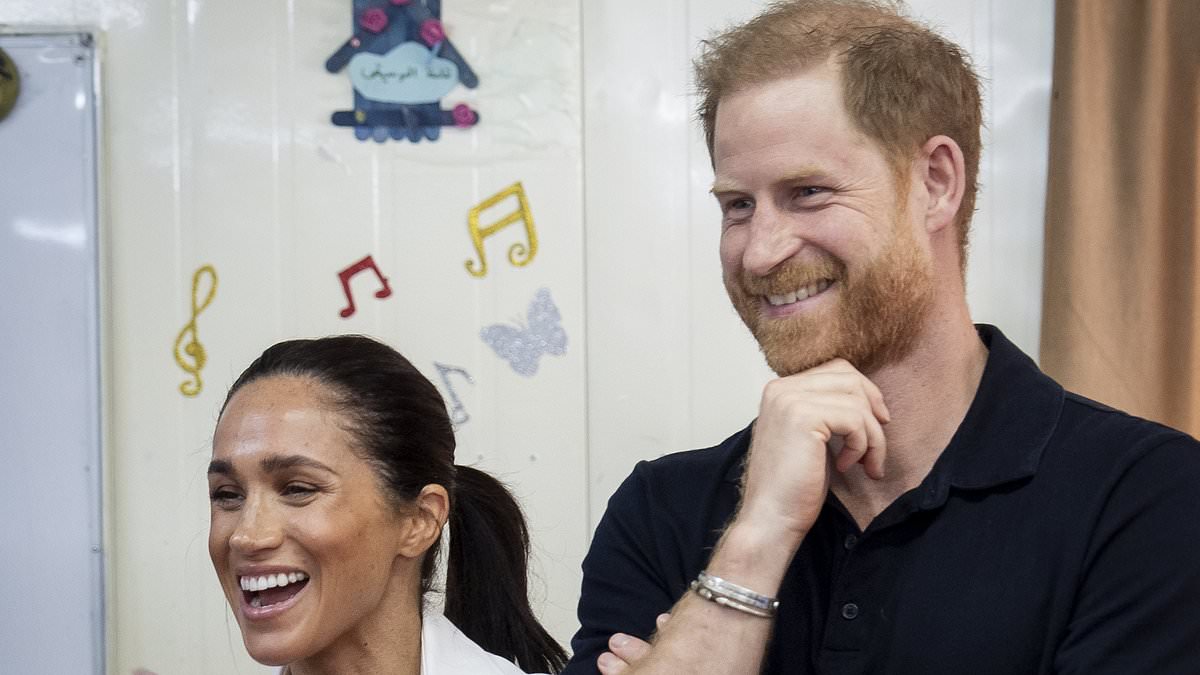
Meghan and Harry spent two days in Jordan but have insisted they were there as private citizens

Meghan and Dr Tedros Adhanom Ghebreyesus in Jordan. A source has said that the WHO chief had invited Meghan and Harry to the British Ambassador’s residence in Amman, not the Ambassador himself or the British Government
The couple had said in their own press release this week: ‘At sunset, the Duke and Duchess joined World Health Organisation officials and Embassy staff at the British Ambassador’s residence for Iftar as day one closed with a renewed sense of urgency and resolve.’
One royal insider also said that their appearance at the British Ambassador’s reception was an ‘intriguing’ part of the trip.
The source added: ‘Once again, British diplomats are involved’.
While Mr Loughton told the Daily Mail: ‘They are not working royals and do not represent the British Government or UK PLC. Given their capacity to say unhelpful things which border on political, giving them an official platform could be construed as them saying something that represents official UK policy.
‘It would be legitimate for the embassy to assist on security issues and neutral briefing but not anything that platforms them on what should clearly be seen as a private visit by private individuals’.
Yesterday it emerged that the Duke and Duchess of Sussex have been seemingly snubbed by the King and Crown Prince of Jordan during their whistle-stop pseudo-royal tour of the Middle East.

Philip Hall, British Ambassador to Jordan, did not directly invite the Sussexes, a source with knowledge of the trip has said
Harry and Meghan landed in the capital, Amman, late on Tuesday night for a royal-style tour and within hours began a series of humanitarian visits to various charity organisations – providing countless photo opportunities.
The current king of Jordan, Abdullah II, has strong ties to the British Royal Family and is close to King Charles – having met him on an official visit to London last year where they were pictured warmly greeting each other.
Their relationship is so close that King Abdullah and his wife Queen Rania were special VVIP guests at the coronation. Queen Rania also had several meetings with Queen Camilla to discuss women’s issues.
Their son Crown Prince Hussein is also friends with Prince William, spending time together in recent years in Britain and Jordan, from watching football together to a joint visit to a RAF base. The Prince and Princess of Wales, who were at a community event in Llanidloes, Wales, together this afternoon, also attended Hussein’s wedding in 2023.
But despite Harry and Meghan being in Amman, a source in Jordan told the Daily Mail: ‘There is no meeting scheduled between the Duke and Duchess [of Sussex] and the Jordanian Royal Family.’
The only member of the Jordanian Royal Family whom Harry and Meghan met briefly was Princess Basma Bint Talal, an aunt of the current King, during a visit to a venture run by the Jordanian Hashemite Fund for Human Development.

Harry and Meghan used the trip to meet refugees from Syria and Gaza as part of their partnership with the WHO

The Duchess of Sussex visits the National Centre for Rehabilitation of Addicts in Amman on Thursday
Indeed, King Abdullah appears to have deliberately swerved any public meeting with the California-based couple – instead choosing to meet Indonesian President Prabowo Subianto.
While in another seemingly apparent rebuff, King Abdullah met the head of the World Health Organisation, Tedros Adhanom Ghebreyesus, who is leading the Duke and Duchess’s trip to Jordan.
Official photographs showed King Abdullah at talks with the WHO chief as well as a sizeable party of delegates but Meghan and Harry were nowhere to be seen.
This is despite the Sussexes’ own charity, Archewell Philanthropies, partnering with the WHO.
The King and Crown Prince also met with Indonesian President Prabowo Subianto in Amman.
The current Jordanian monarch’s late father, King Hussein, who died in 1999, was also on excellent terms with Queen Elizabeth II and King Charles, as highlighted during a previous visit to Amman in 2021.
The British monarch said: ‘I feel this friendship in the most personal of ways, as Jordan has always been part of my life.
‘His Majesty King Hussein came to the throne in 1952, the same year as my dear mother, the Queen.
‘They would be of great mutual support to each other through the decades ahead.’
King Abdullah was educated in Britain and served with the Army after graduating from Sandhurst.
Another source in Jordan told the Daily Mail: ‘The fact the Duke and Duchess of Sussex haven’t met King Abdullah and been given the traditional royal welcome is glaringly obvious.
‘There has been no red carpet treatment, even though King Abdullah has met officials from the World Health Origination have been behind this visit by the Duke and Duchess
‘It’s well known that King Abdullah and King Charles have a very warm relationship and that was passed down through the friendship between the late Queen Elizabeth and King Abdullah’s father.’
A third royal insider said Harry and Meghan may be disappointed not to have been able to meet the King or Crown Prince of Jordan.
‘It’s a pseudo royal visit, mimicking many of the things they or William and Kate would have done when they were part of the Firm but it seems to be lacking in the ceremonial side of things’, the source said.
It came as Harry and Meghan were accused of using ‘sick children as props’ on their two-day trip to Jordan.
Palestinian diplomat Abdal Karim Ewaida also branded the Sussexes’ ‘publicity seeking celebrities’.
Meghan and Harry were both visibly moved when they went to a Jordanian hospital met young Palestinian refugees who had been injured in Gaza.
They spoke with a number of children on the visit organised by the World Health Organisation. Harry also made a plea for food and medical aid corridors to be opened to help people in Gaza, calling the situation a ‘humanitarian catastrophe’.
But Mr Ewaida, a Palestinian ambassador to Congo and Ivory Coast, revealed he had been upset by the Sussexes’ behaviour in Jordan – especially their photo opportunity with children injured in Gaza.
He tweeted a picture of Harry and Meghan meeting a young medical evacuee in Amman and said: ‘I am sad to see that our sick children are being used as props for celebrities in the middle of a full-blown public relations operation, when those same people completely ignored our suffering during the worst moments of the genocidal war in Gaza.
‘Let us remember that Prince Harry has always refused to hear the calls to boycott the Israeli team at his famous ‘Invictus Games’ dedicated to wounded veterans’.

The Duke of Sussex and Meghan, Duchess of Sussex, meet a young medical evacuee during a visit to the Specialty Hospital on February 26, 2026 in Amman, Jordan

Palestinian diplomat Abdal Karim Ewaida shared the picture above in a tweet that was highly critical of Meghan and Harry’s trip to Jordan, accusing them of using ‘sick people as props’
The Duke and Duchess of Sussex have been asked to comment.
Palestine has ambassadors in around 150 countries around the world that recognise it has a sovereign state, including the UK, which opened in January.
Food and medical aid corridors need to be opened to help people in Gaza, the Duke of Sussex said as he left Jordan last night.
The duke told Channel 4 News ‘the aid corridors need to be opened and they are currently not’.
Harry was speaking after hearing an update on the situation from World Central Kitchen, which provides fresh meals in response to crises.
Echoing the thoughts of WHO director-general Dr Tedros, the duke said there is a need for ‘full access for humanitarian organisations to be able to deliver that aid to the people that need it the most’.
Harry and Meghan also met children at a refugee camp at the invitation of Dr Tedros, according to the programme.
The duke said ‘it was a really important time for us to collaborate and come here and shine a light and focus on the very real humanitarian catastrophe that has happened and continues’.
On Wednesday Harry visited a hospital providing care for children who have been recently injured in Gaza.
The WHO has said the hospital helps to show the importance of the medical evacuation corridor through Jordan and the need for sustained international support to ensure children and others in need can access essential care.
The duke praised Jordan’s ‘moral leadership’, telling the programme the country is doing ‘incredible work’ for the region and is acting as ‘a humanitarian hub for the Middle East’.
On Thursday Harry urged a group of recovered addicts to go back to their communities and help others, telling them: ‘There’s no shame in having an addiction.’
He and Meghan listened intently as a group of men described the emotional toll of substance abuse and the support they have received from Jordan’s National Centre for Rehabilitation of Addicts.
During their second day in Jordan, the couple visited the centre in the capital Amman and described it as ‘incredible’ after hearing about its holistic approach to dealing with patients, providing facilities and activities such as a gym and yoga classes.
After chatting to one man who was addicted to drugs but is now a mentor at the centre, the duke said: ‘I want you guys to know there’s no shame in having an addiction, it stems from something else which is an emotional pain – you’re very, very brave to come here into hospital.
‘Now what you need to do is use this experience and go back into your communities and help other people who are in a similar situation.’
The couple visited the centre’s gym and chatted to recovering addicts using rowing machines, and Harry asked one man: ‘When you leave, will you continue exercising?’
When he replied ‘Yes’, the duke told him: ‘New habits, good habits rather than bad habits – we all have bad habits.’
Meghan stood in the doorway of a yoga class and watched the men holding poses on the floor and introduced herself.
The centre, operating under the Ministry of Health’s National Centre for Mental Health, has a 40-bed capacity, and since its inauguration in 2001 has served as a short-term residential and outpatient treatment centre offering medical withdrawal services, psychological support and social counselling.
During the visit the couple were invited to write messages of support along with a WHO delegation.
Harry’s message on a sticky note, left on a wall with others, read: ‘It’s ok to not be ok. Trust each other.
‘Congratulations on your recovery. Now share your courage and experience.’
His wife wrote in italic script: ‘Congratulations on your dedication to your care. Wishing you continued healing and happiness.’