
Share this @internewscast.com
Esteemed artist David Hockney has voiced strong opposition to the proposed relocation of the Bayeux Tapestry to Britain, labeling the endeavor as “madness” and cautioning that such a move could irreparably damage the delicate, centuries-old artifact.
Hockney has criticized the initiative as a “vanity” project orchestrated by the British Museum. This follows the UK government’s decision to provide insurance for the tapestry, valuing it at up to £800 million.
The intricate logistics are being arranged to transport the 70-meter-long embroidery from its home in Bayeux, northern France, to London. This historical piece, which vividly illustrates the Norman Conquest of 1066, is set to be exhibited at the British Museum in September, marking its first journey across the English Channel in nearly a millennium.
Living in Normandy at the age of 88, Hockney has launched a fervent last-minute campaign to prevent this relocation. In a passionate piece for the Independent, he emphasized the tapestry’s immense cultural value, stating it is “too precious to take a risk with.” Hockney’s plea underscores the potential dangers associated with moving such an ancient and fragile work of art.
Mr Hockney, 88, who now lives in Normandy, has launched a last-minute bid to halt the plans.
Writing in the Independent, he said the tapestry is ‘too precious to take a risk with’.
He said: ‘While moving the Bayeux Tapestry to the UK might have vanity and symbolic educational value, the physical and environmental risks are substantial.
‘Any damage would be irreversible, and even successful transport could shorten the tapestry’s lifespan.’

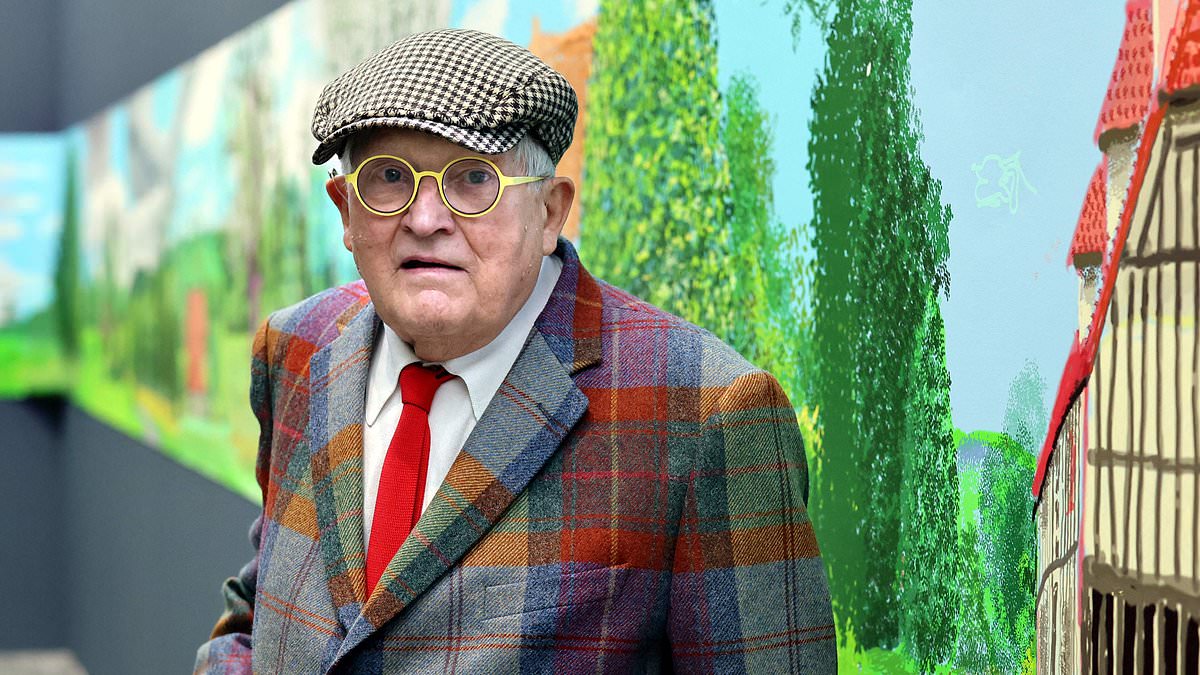
Artist David Hockney, 88, has launched a last-minute bid to stop the move of the Bayeux Tapestry to London

The Bayeux tapestry is over 900 years old and 70 metres long, and depicts the Norman conquest over Britain

The Battle of Hastings, seen here, is a key event depicted in the tapestry’s 58 scenes
Stitched onto the cloth is the story of William the Conqueror’s journey to becoming the first Norman king of England.
Among the 58 scenes is the famous moment Harold Godwinson, the Anglo-Saxon king, was shot in the eye with an arrow during the Battle of Hastings.
The British Museum responded with a reassurance that the tapestry was in safe hands.
Director Nicholas Cullinan said: ‘While we understand these concerns, the museum has a world-leading conservation and collections team who are experts at handling and caring for this type of material.’
The French and British governments have agreed the tapestry will be loaned to the British Museum July 2027 while the Bayeux Museum – its usual home – is renovated.
Some French art experts have also flagged concerns about the plan, suggesting the tapestry is too delicate to be transported, but French officials insist it can be done.
Mr Hockney recalled visiting the tapestry for the first time in 1967, and said he has viewed it more than 20 times in the last three years alone.
The legendary artist described the work as ‘something that has defined my life for more than eight decades’.

Hockney claimed the British Museum wants the tapestry in order to boast about the number of visitors it attracts

Both the British Museum and French officials have insisted the tapestry is in safe hands
He wrote: ‘It is nearly a thousand years old, the most complete narrative work of art in Europe and remember it is very long, more than 70 metres in length.
‘It is fragile, which makes it madness to think of moving it. It is too big a risk.’
Mr Hockney also dismissed the £800million – the figure the Treasury is reportedly insuring the tapestry for – as ‘meaningless’, because the artwork is ‘priceless’.
He continued: ‘The linen backing is weakened by age, and the wool embroidery threads are vulnerable to stress,” he said, adding that he had researched the process.
‘Rolling, unrolling or handling it in a new way can cause damage.’
The tapestry has already been taken off display in France and moved into storage, in preparation for its journey.
Mr Hockney claimed the move was being carried out for ‘the vanity of a museum which wants to boast of the number of visitors’.
The British Museum said it had consulted and was working closely with specialists in France to ensure no damage is done.
Cullinan said they ‘send and receive thousands of loans each year – including ancient frescoes and textiles which are older than the Bayeux tapestry’.
He added that their condition and safety was ‘always of paramount importance’.
The eyewatering insurance pledge comes through the Government Indemnity Scheme.
This is an alternative to commercial insurance that allows art and cultural objects to be shown in the UK.
An HM Treasury spokesperson said last month: ‘The Government Indemnity Scheme is a long-standing scheme that allows museums and galleries to borrow high-value works for major exhibitions, increasing visitor numbers and providing public benefits.
‘Without this cover, public museums and galleries would face a substantial commercial insurance premium, which would be significantly less cost-effective.’
The scheme is estimated to have saved UK museums and galleries £81 million compared to commercial insurance.