
Share this @internewscast.com
A former air traffic controller from the Washington, D.C. area has come forward, highlighting long-standing issues within the aviation system that existed well before a tragic collision involving an American Airlines plane and a Blackhawk helicopter last year.
This incident occurred on January 29, 2025, when the American Airlines flight was navigating the skies above Ronald Reagan Washington National Airport. It tragically collided with a U.S. Army Blackhawk helicopter, resulting in the deaths of all 67 passengers aboard the plane.
Emily Hanoka, who worked as an air traffic controller at the busy airport, revealed that she had been aware of significant problems long before her shift ended just hours before the devastating crash.
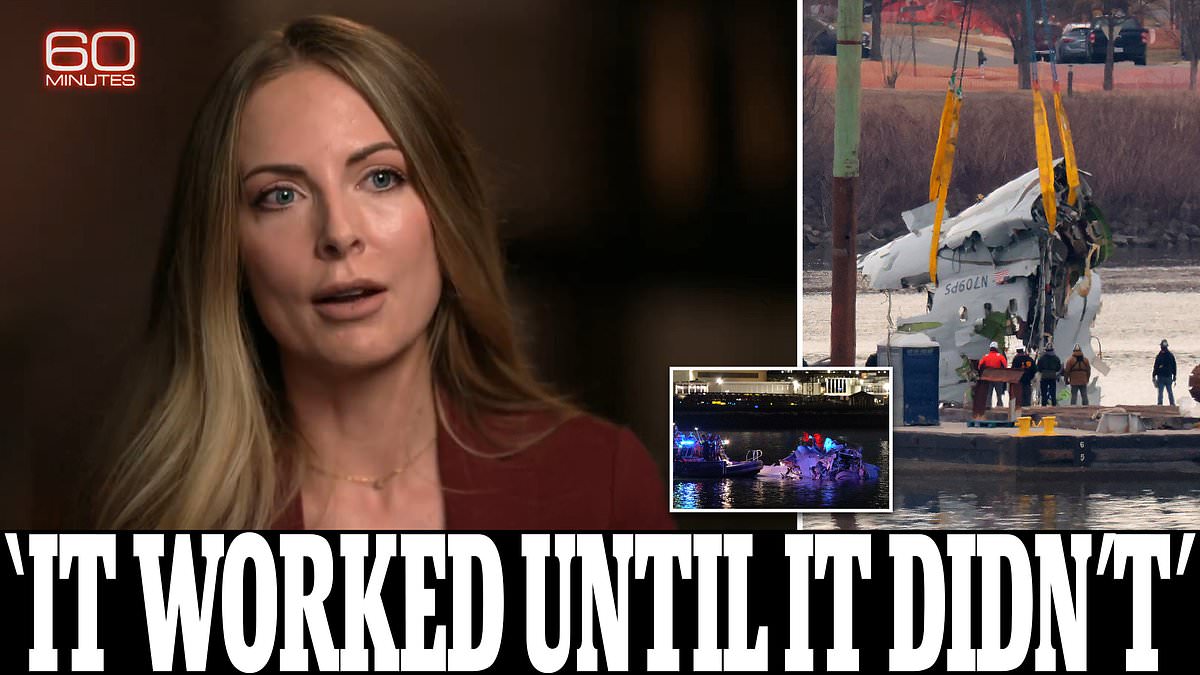
In an interview with Sharyn Alfonsi on “60 Minutes,” Hanoka stated, “There were obvious cracks in the system, obvious holes. Frontline controllers had been sounding the alarm for years, insisting, ‘This is not safe. This cannot continue. Please change this.’ Yet, nothing changed.”
Earlier this year, the National Transportation Safety Board released a report confirming that between 2021 and 2024, there were 85 reported near mid-air collisions between helicopters and commercial aircraft at the airport, as documented by the FAA.
In a report released earlier this year, the National Transportation Safety Board confirmed that between 2021 to 2024, 85 near mid-air collisions between helicopters and commercial planes at the airport were reported to the FAA.
60 Minutes also obtained records that show that just one day before the fatal collision, two separate passenger jets had to take sudden action to avoid colliding with Army helicopters.
‘The warning signs were all there,’ Hanoka said. ‘Controllers formed local safety councils and every time that a controller made these safety reports, another controller was compiling data to back up the recommendation. And many recommendations were made and they never went too far.’

Emily Hanoka, a former air traffic controller at Ronald Reagan Washington National Airport, spoke out about the ‘cracks in the system’ that existed before a fatal crash last year

An American Airlines flight collided with a Black Hawk helicopter mid-air over Reagan National Airport last year
Part of the problem, Hanoka said, is that Reagan National Airport is owned by the federal government – and Congress decides how many flights can take off from the airport each day.
Since 2000, lawmakers added at least 50 flights a day to the airport’s roster and approved another 10 in 2024.
Reagan National Airport now transports 25 million passengers each year, 10 million more than its intended capacity.
‘Some hours are overloaded, to the point where it’s over the capacity that the airport can handle,’ Hanoka said, adding that there was ‘definitely pressure to get planes out.
‘I you do not move planes, you will get gridlock at the airport,’ she explained.
Making matters even more complicated, airspace is restricted over the White House, the US Capitol and other government buildings, funneling planes and helicopters into the same narrow corridor over the Potomac River.
There are also only three short runways at Reagan that all interconnect, with the airport’s Runway 1 ranking as the busiest in the country, with more than 800 flights a day, or roughly one every minute.
To meet the demand, Hanoka said air traffic controllers relied on what they called ‘squeeze play,’ which she said is ‘dependent on an aircraft rolling, an aircraft slowing and you know it’s gonna be a very close operation.’

Hanoka revealed how there are only three short runways at the airport, which all interconnect

Airspace is restricted over the White House, the US Capitol and other government buildings, funneling planes and helicopters into the same narrow corridor over the Potomac River
That is not a common practice at other airports, she noted.
‘So you’ll get new controllers come in, so they’ve transferred from other facilities and they’ll look at the operation and say, “Absolutely not,”‘ Hanoka said.
‘And they’ll withdraw from training. And that, when I was there was about 50 percent… About half of the people that walked in the building to train would say “Absolutely not.”‘
More than one year after the fatal collision, nearly one-third of controller positions at the airport remain unfilled.
‘It was surprising, walking into that work environment, how close aircraft were,’ she said. ‘This is what has to happen, in order to make this airspace work.
‘And it did work,’ she noted. ‘It worked until it didn’t.’
In January, the NTSB determined that the mid-air crash was preventable as it cited ‘systemic failures,’ including ignored warning signs about the risks and a ‘helicopter route’ that was designed so poorly that in some parts of the sky, it allowed for just ’75 feet of vertical separation’ between helicopters and passenger jets.

The crash marked the deadliest commercial aviation accident in the US in almost 25 years

All 67 passengers onboard the American Airlines flight were killed
The night of the crash, which became the deadliest commercial aviation accident in the US in almost 25 years, investigators said the Black Hawk crew was relying solely on ‘visual separation’ – looking out the window to avoid nearby passenger jets.
The Black Hawk was then flying 78 feet higher than it should have been as the Army pilots turned off a system that would have broadcast the helicopter’s location more clearly.
An animation showing the view from inside the jet’s cockpit, meanwhile, showed pilots were dealing with dark skies and landing with the help of night-vision, while air traffic controllers failed to warn them they were on course to hit the helicopter.
The chopper then appeared suddenly to the left of the plane’s windshield, hitting the jet in a flash and without offering any time for the pilots to swerve out of the way.
This is a breaking news story and will be updated.