
Share this @internewscast.com
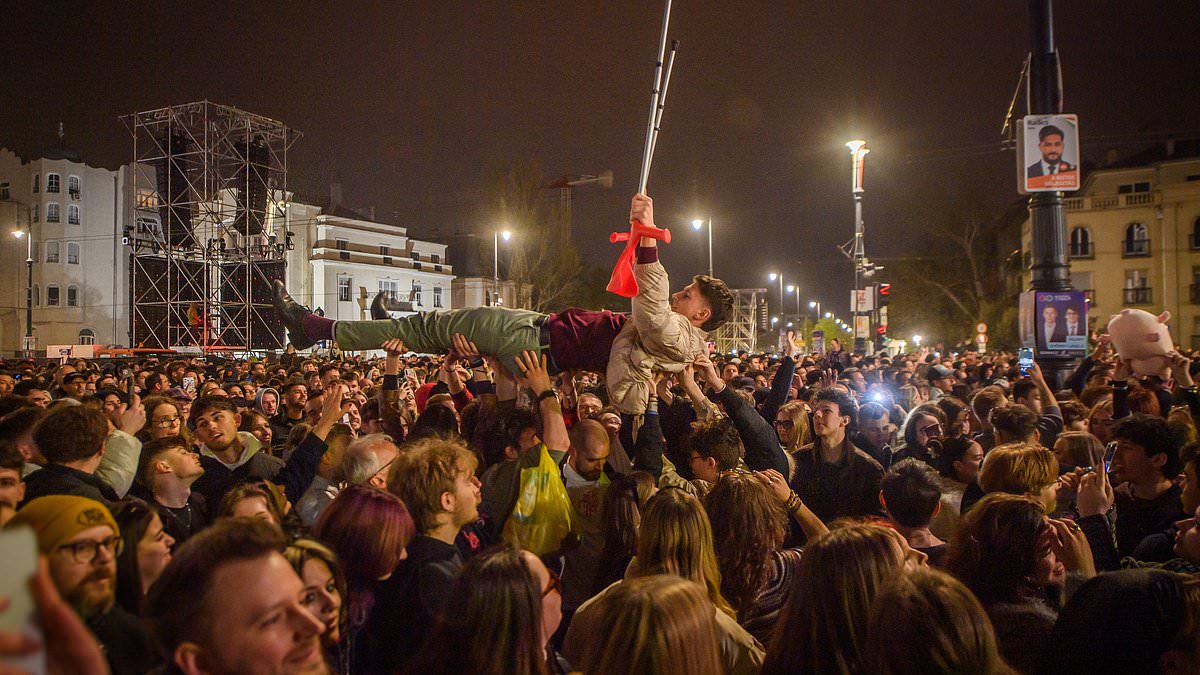
In Budapest, a crowd exceeding 100,000 gathered for a musical protest on Friday, advocating for the election of a new leader to replace Prime Minister Viktor Orban.
Featuring over 50 bands, the event was a marathon of music with each group performing a single song. Known for their outspoken criticism of Orban’s nationalist-populist administration, these artists aimed to make their voices heard through a seven-hour “system-breaking” concert.
Young attendees dominated the scene, frequently erupting into anti-government chants such as “Ruszkik haza!” or “Russians go home!”
This slogan, originating from Hungary’s 1956 revolution against Soviet influence, has gained new relevance due to Orban’s increasingly tight ties with Russia.
Organized merely two days ahead of Hungary’s elections, the concert occurred at a time when Orban appeared to be losing ground in the polls, despite receiving favorable remarks from U.S. Vice President JD Vance.
After 16 years in power, Orban, a proponent of right-wing nationalism, finds himself with the support of only 30 percent of voters. In contrast, his opponent Peter Magyar enjoys 39 percent backing, according to a poll published on Thursday.
His falling popularity has prompted a major intervention from Vance, who travelled to Budapest on Tuesday in a last-ditch attempt to boost his support.

People attend the so-called concert ‘Rendszerbonto’ (“Demolition of the System”), which features more than 40 artists and is organized by the citizen resistance movement on Heroes’ Square in Budapest on April 10, 2026, two days before general elections

More than 100,000 attended the event. Pictured: Band called Elefant perform at Heroes’ Square

People wear hats showing opposition leader Peter Magyar, during the concert on Friday
Standing alongside Orban, the US Vice President said he was in the Hungarian capital ‘to help him in this campaign cycle’.
Vance and his wife were welcomed to Budapest by Foreign Minister Péter Szijjártó, who said Orban’s warm friendship with Donald Trump had created a ‘new golden age’ in relations.
The vice president launched a scathing attack on the EU and Ukraine, accusing the EU of attempting to rig the election against Orban.
He said the EU had presided over ‘one of the worst examples of foreign election interference that I have ever seen or ever even read about… because they hate this guy’.
He also said ‘part of the reason’ for his visit was because ‘interference that’s come from the bureaucracy in Brussels has been truly disgraceful’.
One attendee at Friday’s concert, Helena Sugar, 19, said she was drawn to the event by some of her favourite artists, but that the desire for change was the concert’s most crucial aim.
‘I listen to these performers every day. But now the most important thing here is the political goal,’ she said.
‘I think it is important to show how many of us think this way, how many of us think that the time for this system is over, and it is time for us to change.’

A young man holds a picture of Viktor Orban at Heroes’ Square during the anti-government concert in Budapest, Hungary
The group organising the event, the Civic Resistance Movement, wrote that each song to be performed was ‘critical of the corrupt regime’, and meant to ‘demonstrate to the masses of voters and make them realise that the era of impunity is over’.
The big turnout in Budapest’s Heroes’ Square and the concert’s anti-government atmosphere reflected the broad level of dissatisfaction with Mr Orban’s government, especially among Hungary’s youth.
In addition to the throngs of people in the streets, more than 100,000 were following a livestream online.
A generational gap has been widening in Hungary, with its young people pushing overwhelmingly for an end to Mr Orban’s autocratic rule, while the oldest citizens remain loyal to the prime minister.
Mr Orban and his Fidesz party’s declining popularity comes amid economic stagnation, political and corruption scandals and the rise of a new opposition challenger that is posing the biggest threat to the prime minister’s power in nearly two decades.
That challenger, the centre-right Tisza party and its leader Peter Magyar, have galvanised large numbers of voters across Hungary who see him as the most credible challenger yet to Mr Orban’s 16-year grip on power.
A recent survey by pollster 21 Research Centre found that 65 per cent of voters under 30 support Tisza, while only 14 per cent back Mr Orban.
One concertgoer, 22-year-old Noel Ivan, said he had immigrated from Hungary to Austria seeking a better life, but that he ‘would like to move back and plan the future at home, which is currently hopeless and deeply sad’.

Led screen shows Viktor Orban’s face at Heroes’ Square

A person holds a placard depicting Hungarian Prime Minister Viktor Orban and Russia’s President Vladimir Putin as a Matryoshka doll during the free concert
He added that although he does not consider himself conservative, he wants to ‘contribute to regime change by voting for the Tisza party’.
Friday’s performers included some of Hungary’s most popular acts: singer Azahriah, rappers Beton.Hofi and Krubi, and alternative rock bands Quimby and Ivan and the Parasol.
Another performer, Benedek Szabo, the frontman and lead songwriter for the popular band Galaxisok, told The Associated Press that for him, Hungary’s increasingly close connections with Moscow were tantamount to ‘selling out the EU allies to Russia’.
‘Everyone’s fed up, and everyone’s ready to finally change this system, to finally send a message,’ he said.
‘Not only today, but the day after tomorrow, that we’ve had enough, and we want to belong to Europe.’
Galaxisok performed a song that laments what the band sees as missed opportunities and wasted years under Mr Orban’s rule.