
Share this @internewscast.com
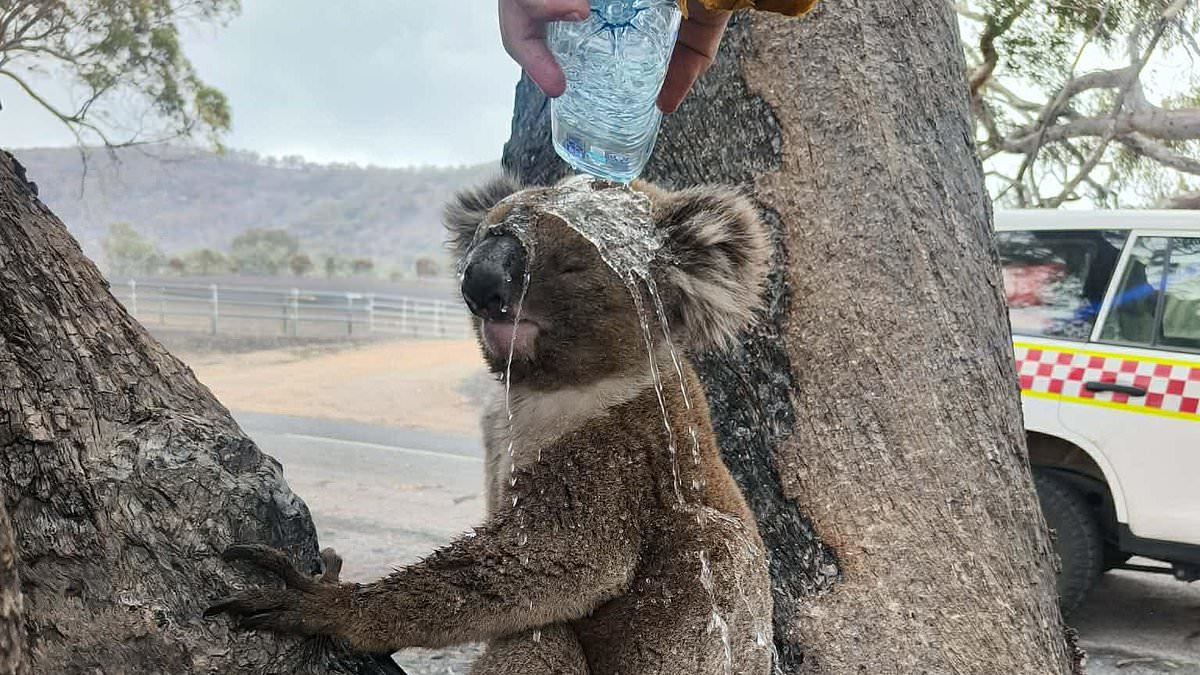
An emotional photograph has surfaced depicting a firefighter gently spraying water on a koala amid the devastating bushfires sweeping through Victoria.
Captured by a member of the Benalla Fire Brigade, the image shows the koala taking refuge on a tree as dense smoke billows dramatically in the background.
This powerful photo encapsulates the severity of the current bushfire season, which experts are calling the most destructive since the catastrophic Black Summer fires of 2019.
The raging fires have claimed one life, scorched over 350,000 hectares, and obliterated more than 300 buildings.
Although some fires have been downgraded to a Watch and Act status, authorities are still battling to contain several active blazes.
Even with these downgrades, residents have been cautioned that the cooler weather sweeping across the eastern states on Sunday may not offer reprieve, as unpredictable winds are complicating efforts to control the fires.
There are still 15 emergency warnings related to three fires in different parts of Victoria.
‘Strong south-westerly winds may cause the situation to change at any time,’ a Vic Emergency warning said.

A firefighter pours cool water over the head of a distressed koala in Victoria on Sunday
Other states are providing crucial help in the battle to contain the blazes with a contingent of 20 Western Australian firefighters now in Victoria after flying out of Perth on Sunday morning for a seven-day mission to help Victorian colleagues.
Emergency Services Minister Paul Papalia said WA’s help was much appreciated.
‘Victorians are in peril, and Western Australians are stepping forward to help. It’s really heartening,’ he said.
‘These people are the best of Western Australians, stepping forward with no notice to go the other side of the country to help their fellow countrymen and women in their time of need.’
There are two major fires with emergency warnings – the Walwa blaze in the state’s north-east and a fire in the Otways region.
The massive Longwood fire has been downgraded to a Watch and Act.
On Sunday afternoon, Victoria Police confirmed that human remains were found about 100m from a car at the Longwood bushfire area, near the Victorian town of Seymour.
Meanwhile, Victorian Premier Jacinta Allan slammed ‘fire tourists’ for travelling to bushfire-ravaged towns to gawk at the devastation.

A burnt-out property that was destroyed in the Longwood fire

The bushfires have destroyed about 350,000 hectares of land in Victoria
Allan condemned sightseers entering fire-flattened towns and delivered a sharp message: ‘Stay away.’
‘It is wrong to go into these fire grounds where it’s unsafe and you don’t belong there, and you’ll be dealt with by Victoria Police,’ she said.
Emergency management commissioner Tim Wiebusch echoed her frustration, revealing that authorities had already intercepted unwanted visitors in restricted areas.
‘Disappointingly, in the last 24 hours we’ve started to see some tourists or spectators heading into some of our fire‑impacted zones,’ he said.
‘I can’t emphasise enough, the state of disaster is now in place for 18 local government areas. Where those fire‑impacted zones appear on the Vic Emergency website, those are the areas we do not expect to see visitors.
‘Our clear message is that in the fire‑impacted zones, these are not places for visitors, spectators or tourists; they are places for our emergency services and, when safe, local residents.’
Prime Minister Anthony Albanese and Allan on Sunday announced a $19.5million relief package for communities devastated by Victoria’s bushfires.
The biggest share, $10million, will go to farmers struggling to feed livestock after huge tracts of pasture were lost.

The Longwood bushfire has now been downdgraded but two more are still of concern

Prime Minister Anthony Albanese toured the fire-damaged town of Harcourt
Another $5million will fund case support workers through the Recovery Support Program, assisting fire-affected residents with everything from lost documents to emergency help.
A further $1.5million is earmarked for temporary accommodation for families who’ve lost their homes, while $1million will go towards mental health support as communities grapple with the emotional toll of the disaster.