
Share this @internewscast.com
Supermarkets have come under fire for allegedly misleading consumers by selling European turkeys as if they were British, a practice that has raised eyebrows this holiday season. With a bird flu outbreak affecting supply, major retailers such as Asda, Morrisons, Lidl, and Aldi have been importing these birds to satisfy customer demand, according to concerned campaigners.
For families eager to enjoy a truly local turkey on Christmas Day, the key to identifying the bird’s origin lies in the fine print. Often, this crucial information is tucked away on the packaging’s underside or buried in the small print on retailers’ websites.
Labels prominently displayed on supermarket shelves can sometimes be deceptive. Take, for instance, a ‘Bootiful’ turkey crown by Bernard Matthews found in a Morrisons store in London. It sits alongside poultry branded as ‘British whole chicken’, even though the meat originates from various sources.
Close inspection of the festive product’s packaging reveals a telling detail: it is “produced in the UK using turkey from the EU and UK.” A similar situation is noted with a Cherrywood-produced turkey crown sold at Asda, which carries the same description. Asda maintains that all its own-label turkeys are sourced from farms in Britain and Ireland.
The underside of the festive product’s wrapping reveals it is ‘produced in the UK using turkey from the EU and UK’.
A Cherrywood-produced turkey crown sold in Asda came with the same description. Asda said all of its own-label turkeys are sourced from British and Irish farms.
Some birds are being sourced from as far away as Poland, with Morrisons’s ‘Bootiful’ turkey shipped from the eastern European country, according to the supermarket giant’s website.
The retailer confirmed it offered both British turkeys and additional birds from the EU.

Supermarkets have been accused of secretly selling European turkeys to shoppers this Christmas – while claiming they are from Britain

Some birds are being sourced from as far away as Poland, with Morrisons’s ‘Bootiful’ turkey shipped from the eastern European country
Lidl’s ‘Braemoor’ brand of Christmas meat is named after a town in Scotland but its three-bird roast offering is actually ‘produced in the UK using EU and non-EU chicken, turkey, duck and pork’.
Some of the supermarket’s turkeys have been shipped in from Europe, it confirmed, although it said its fresh turkeys and own-branded frozen whole turkeys are from Britain.
Meanwhile, at Aldi, the ‘Ash Valley’ turkey breast joint is advertised by a sign reading: ‘Proudly supporting British farmers’.
But, on closer inspection, the packaging admits the festive feast was produced ‘using EU and UK turkey’.
The product, which shares its name with a Hertfordshire golf club, is the only one to include non-UK turkey meat, Aldi claimed.
Marks and Spencer and Waitrose both said all of their turkeys were sourced from the UK and Ireland.
Sainsbury’s own-brand turkeys are all ‘sourced from the UK’, the chain confirmed.
Co-op’s commercial director Thomas Bradley said: ‘Turkey is still number one for Christmas dinner and there’s nothing better than a British turkey, which is the only kind we will be selling at Co-op this year.’

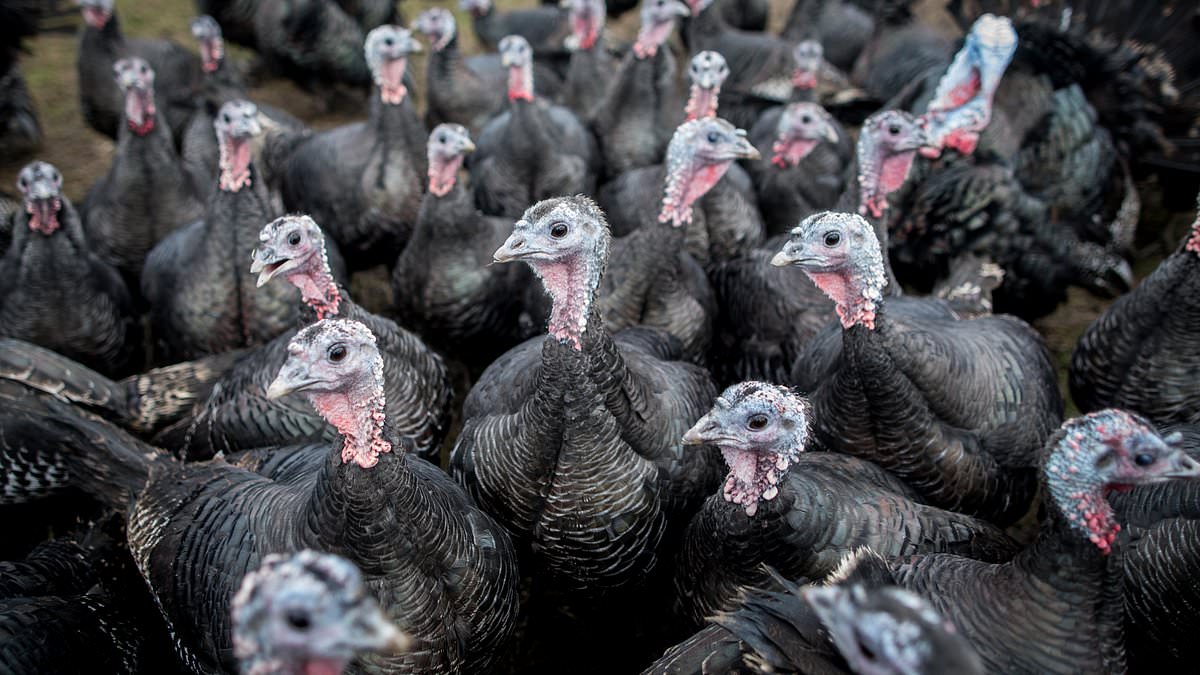
Families looking to serve a homegrown turkey can tell the difference by checking the bottom of the packaging or visiting the retailer’s website (Stock photo of turkeys in a supermarket)

Demand for turkey surges steeply over the Christmas period with around 10 million consumed each year (Stock photo)
Tesco, M&S and Aldi were contacted for comment.
Demand for turkey surges steeply over the Christmas period with around 10 million consumed each year.
But in the last three months alone there have been 70 confirmed cases of bird flu, a sharp surge from the 81 recorded in the 12 months between October 2024 and September 2025.
As a result, English birdkeepers were told to house flocks containing more than 50 birds indoors starting from November 6.
The increase in supermarkets’ meat imports comes amid Labour’s animal welfare crackdown.
The new strategy, which also aims to end trail hunting and the practice of boiling live lobsters, has promised to ban caging hens in the UK.
Answering concerns that this could lead to a surge in cheaper foreign imports, the Prime Minister’s spokesman said: ‘We’ll always consider whether overseas products have an unfair advantage and are prepared to use the full range of powers at our disposal to ensure produce made here in the UK by our farmers is always the most viable option.’
The advertising tactic is similar to the ‘fake farm’ branding used by many supermarkets to distract from the origins of certain food by evoking the British countryside.
Chains such as Morrisons, Sainsbury’s and Asda were accused by the National Farmers’ Union this summer of importing meat from countries with lower animal welfare standards.
Sirloin steak from Australia, raw chicken from Poland, sirloin and ribeye steaks from Uruguay and wagyu beef from New Zealand have all been spotted on UK shelves.
The UK has an animal welfare standards ranking far above all the other countries – listed as B, according to the World Animal Protection’s Animal Protection Index. This is compared to C for Poland and New Zealand and D for Uruguay and Australia.
Morrisons, which sponsors TV show Clarkson’s Farm, was selling raw chicken and Australian beef – the latter of which was made possible by Liz Truss’s much-criticised post-Brexit trade deal with Australia in 2021, according to NFU sources.
Meanwhile Asda was selling sirloin and ribeye steaks from Uruguay, priced much lower than the UK equivalents, under the Grass and Grill brand owned by Hilton Foods.
Elsewhere, Sainsbury’s was stocking wagyu beef from New Zealand – instead of Japan, where it normally comes from.