
Share this @internewscast.com
On a typical Thursday morning, I find myself lounging on the bed in my beloved London hotel. Downstairs, the breakfast buffet beckons with an array of freshly baked muffins, fluffy pastries, and other tempting treats that usually prove irresistible.
However, before I indulge in the morning feast, I engage in a peculiar ritual aimed at quieting the clamor of food temptation that is soon to follow.
This ritual doesn’t involve any injections of Mounjaro or Ozempic. Instead, it consists of a ten-minute tapping session on different points of my face, collarbone, and underarm, all while I repeat affirmations like, “Though many resort to weight-loss injections, I achieve similar results through the power of my mind,” “My appetite is changing; I am eating less,” and “The weight is shedding effortlessly.”
Admittedly, this might sound like a dose of new-age mumbo-jumbo, but hear me out. That morning, following my tapping meditation, I approached the sumptuous breakfast spread and found myself content with just a few spoonfuls of the hotel’s specialty porridge oats. The usually irresistible muffins, croissants, and even a slice of sourdough toast held no appeal.
I was enveloped by an unusual sensation, a blend of nausea and an odd sense of satisfaction. It wasn’t the onset of a bad day, nor did I wake up without my usual appetite. Typically, I’m greeted by a grumbling stomach each morning.
But this time, it was thanks to my “thought injections,” the tapping technique I’ve adopted, that my appetite seemed to vanish.
I’ve been trying, and failing, to lose half a stone for over a year. I’ll admit, the quick fix of weight-loss jabs like Ozempic has crossed my mind. But at 5ft 5in and weighing 10st 7lbs, with a healthy BMI, I’m not large enough nor suffering from the health conditions which would warrant me getting them for free.
Plus, I don’t fancy the reported side-effects from the jabs, that include hair loss, impaired vision and gripping bouts of diarrhoea.

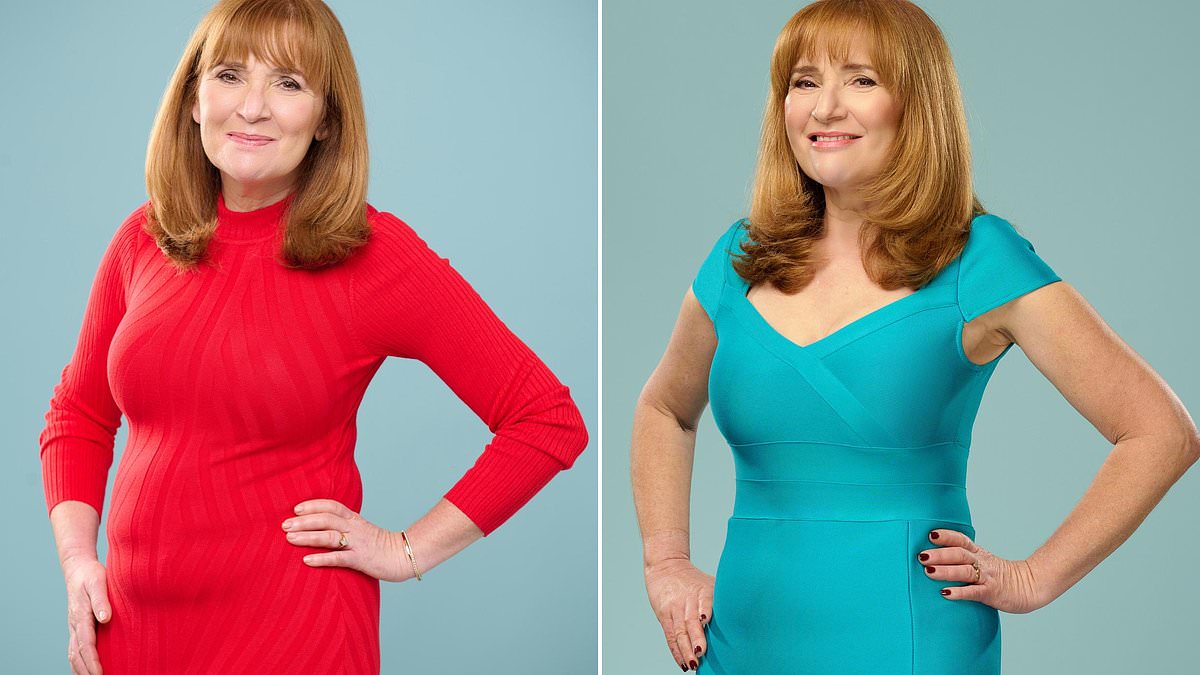
Weighing 10st 7lbs at 5ft 5in, Angela had a healthy BMI and didn’t qualify for free weight-loss jabs, so she turned to ‘tapping’ in an effort to lose weight

After six weeks of tapping, also called Emotional Freedom Technique, Angela lost 6lbs
Yet, at 58, I am in a constant battle with mid-life spread like thousands of women my age; that tendency to accumulate a stubborn layer of fat around the hips and middle – an unwanted load I never had to carry in my 30s and 40s.
It’s all the more infuriating as I live an objectively healthy lifestyle. I don’t drink much – a couple of glasses of wine at the weekend – and I exercise almost daily, whether that’s cycling, swimming or a brisk 45‑minute walk straight after work.
I cook unapologetically wholesome meals for myself and my husband, Martin: fresh salads, vegetable risottos and homemade stews with lean cuts of meat. My only real vice is chocolate – and, even then, I certainly wouldn’t polish off a packet of buttons or a whole Dairy Milk in one sitting.
I’ve tried every fad under the sun to shift those extra pounds – fasting, cutting carbs, sporadic ‘grazing meals’ rather than three large ones. But nothing proved effective.
So when I heard about a trial using a self-help therapy colloquially known as ‘tapping’ to mimic the effects of weight‑loss injections, I thought: why not? It’s non‑invasive, free, and – despite journalistic scepticism – I had nothing other than half a stone to lose.
Tapping, or EFT (Emotional Freedom Technique) is a method that evolved from Traditional Chinese Medicine (TCM), and involves using the two fingertips to tap in a set sequence on certain parts of the body and face.
The points you tap – including above the eyebrows, under the arm, on the collarbone, below the nose – correspond to so‑called meridians, the energy pathways described in TCM.
There is some scientific backing. A 2022 review of more than 50 studies found EFT to be moderately to highly effective in managing anxiety, depression, PTSD, pain and insomnia. Prince Harry uses tapping therapy to treat unresolved anxiety. It hasn’t been tested for weight loss, until now.

A 2022 review of more than 50 studies found EFT to be moderately to highly effective in managing anxiety, depression, PTSD, pain and insomnia
Pearl Lopian, 66, is an EFT practitioner and expert tapping trainer, who is the mastermind behind this unique experiment.
Born in London, she has been practising EFT for 15 years and her work now takes her – via Zoom – around the world. It was growing chatter about weight-loss injections among friends that led her to wonder if tapping could play a role in managing weight.
She tells me: ‘I kept hearing that the jabs suppressed appetite and silenced ‘food noise’ – I wanted that too. But I had absolutely no intention of injecting myself because of the side-effects. So I made a decision I could achieve the same outcomes through ‘thought injections’ – harnessing the power of the mind to ‘inject’ the willpower that the jabs give.
‘Saying affirmations alone often doesn’t work, because our bodies resist statements that feel untrue. For example, if you say, ‘I am calm’ but you’re not calm, your mind immediately thinks, ‘But I’m not.’ That resistance in our minds blocks any change we are looking to make. Tapping releases those negative reactions so your body stops resisting.’
Pearl trialled it on herself, with astounding results: she shed eight pounds in just three months and now weighs a trim 8st 5lb.
Following her success, she decided to offer online classes for a group of women who all, like me, had a small but stubborn amount of weight to lose. At our first Zoom meeting, Pearl explained how each week, we would be given a list of phrases to say aloud, while simultaneously tapping specific parts of the body.
We would have the sheets in front of us and repeat the line and the action after her. Some muted their microphones if feeling self-conscious.
The list of phrases included ‘My body knows when it’s had enough,’ ‘I feel satisfied earlier,’ and ‘I enjoy food without needing more’. As we tapped, Pearl encouraged us to picture someone losing weight with injections, and imagine ourselves achieving the same effect through ‘thought injections’.
I did feel faintly ridiculous, chanting scripted affirmations while tapping my face. Yet there was something oddly calming about it.
We were told to practise these at home, at least once a day for ten minutes. And so I began six weeks of daily tapping.
I mostly tapped in the mornings, partly to just get it done, but also because doing it in public felt absurd. On one memorable commute, having forgotten my morning session, I caught my reflection in the train window – tapping my face like a mad, muttering extra in a dystopian horror film.
The real test came at the weekends. Being Jewish, Friday night dinners are an essential part of the calendar and involve mountains of food. Usually when I host, I struggle to ignore leftover roast potatoes or mouthfuls of dessert when the guests have left. But I simply wasn’t interested and ate a smaller portion at supper too.
After two weeks, I had lost 2lb. I found myself genuinely less hungry. From then, I got into a routine. Once I’d tapped I couldn’t face breakfast – I actually felt quite sick. Lunch was light – say a tuna sandwich – and then nothing until the evening.
By the end of six weeks, I’d lost 6lb and was thrilled. Trousers that were always tight zipped up with ease. At a party someone complimented my slender arms (a first!)
So I intend to carry on tapping indefinitely. Would I recommend it? Yes, but with conditions: it requires focus, consistency and a willingness to believe that thoughts can influence behaviour.
And, unlike with Mounjaro, I’ve lost the pounds without it costing me a single pound. That’s a phrase worth repeating over and over again.