Share this @internewscast.com
Twenty soldiers from Scotland have been expelled from the Army after being found guilty of drug use, while an additional ten are currently under investigation.
This year, a total of 30 soldiers from the Royal Regiment of Scotland have tested positive for drugs, including both cannabis and the Class-A drug, cocaine.
Out of these, twenty have been discharged, and ten are undergoing disciplinary action.
The soldiers involved hold various ranks, including private, lance corporal, corporal, sergeant, and warrant officer class 2.
Drug use within the armed forces has become a significant concern, with hundreds of soldiers across the UK being dismissed annually for substance abuse violations.
According to recent Ministry of Defence data, cocaine is the most frequently abused drug among British troops, followed by cannabis and ecstasy.
Scottish Conservative MSP Murdo Fraser said: ‘It is incredibly alarming to see positive drug tests in those serving in our armed forces.

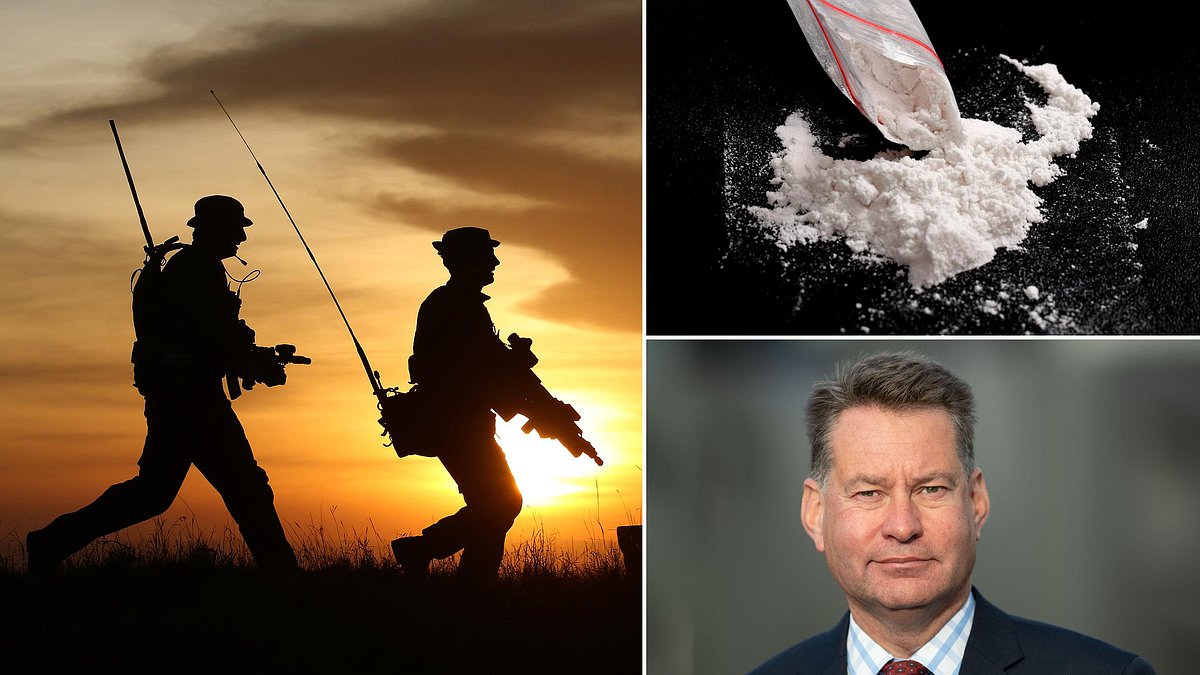
The Royal Regiment of Scotland is the senior and only Scottish line infantry regiment of the British Army and boasts around 2,300 serving soldiers

Scottish Conservative MSP Murdo Fraser said drug use in the armed forces was ‘alarming’
‘While this points to stress levels increasing among our troops, it is unacceptable for them to be taking dangerous and illegal substances at any time.
‘This could ultimately have had consequences for other soldiers and the wider public.
‘The Ministry of Defence must work closely with the Royal Regiment to ensure that this level of drug misuse is stamped out, while offering support to soldiers who are turning to these substances.’
The 30 soldiers in Scotland who failed drug tests this year is three times the 10 service personnel who tested positive in 2024 – all of whom were discharged.
The latest cases bring the total number of squaddies in Scotland caught out after taking drugs in the last five years to 130, with the vast majority – 110 – discharged as a result.
Army top brass regularly carry out spot checks on military personnel, both when they are serving in war zones and when they are stationed at home.
The failed drugs test remains on their Army records for life, making it difficult for them to find civilian jobs.
Experts have warned of an increasing level of combat stress among troops, with many turning to alcohol and drugs to deal with traumatic illness.
It has also been claimed that some soldiers deliberately fail tests to avoid going to conflict zones.
Formed in 2006, The Royal Regiment of Scotland is the senior and only Scottish line infantry regiment of the British Army.
It was founded on the fighting heritage of six historic Scottish infantry regiments representing more than 390 years’ continuous service to the Crown.
Today, it consists of three regular battalions, two reserve battalions, and an incremental company dedicated to ceremonial duties.
With 2,300 serving soldiers and more than 9,000 veterans and families, the regiment has been one of the most deployed in the past two decades, acting in almost every theatre of operations the British Army has been involved in.
Its soldier have served in conflicts in Afghanistan, Iraq, Bosnia and Northern Ireland, as well as supporting peace operations in Cyprus, West and North Africa.
Failing a drug test is not the only grounds for dismissal related to illegal substances.
Those found to have committed a criminal offence in relation to the possession or supply of illegal substances can also expect to be discharged and punished.

The regiment has been one of the most deployed in the past two decades, acting in almost every theatre of operations the British Army has been involved in

Cocaine is one of the narcotics most frequently used by drug-taking soldiers
In 2019, a soldier was kicked out of the Royal Regiment of Scotland for dealing cocaine to fellow service personnel.
He was dishonourably discharged after almost 22g of the drug, worth about £2,000, was found in his car.
The squaddie had admitted being concerned in the supply of drugs at Fort George and was ordered to carry out 120 hours of unpaid community work.
His lawyer told a court that the soldier deeply regretted what he called a ‘serious error of judgment’.
The problem of drug use is not solely contained to service military personnel, with some veterans also known to have substance issues.
A report into by the Scottish Government in 2018 stated there was ‘a growing sense that self-medication using both prescription and non-prescription drugs amongst UK veterans’ was ‘on the rise’, in line with ‘trends in the wider community’.
The Army said exceptions are occasionally made under specific circumstances, so that in rare cases individuals may be retained rather than being discharged from the service.
A Ministry of Defence spokesperson said: ‘Substance abuse is unacceptable in the Armed Forces. We robustly enforce a zero-tolerance policy to drug use by all those who serve and provide an education programme to inform all personnel of the dangers and consequences of substance misuse.
‘We maintain a comprehensive programme of compulsory random drug testing to ensure maximum deterrence.
‘Anyone found to have misused drugs faces severe consequences, including discharge from service.’